Exploring the Meaning of Purinos in Greek
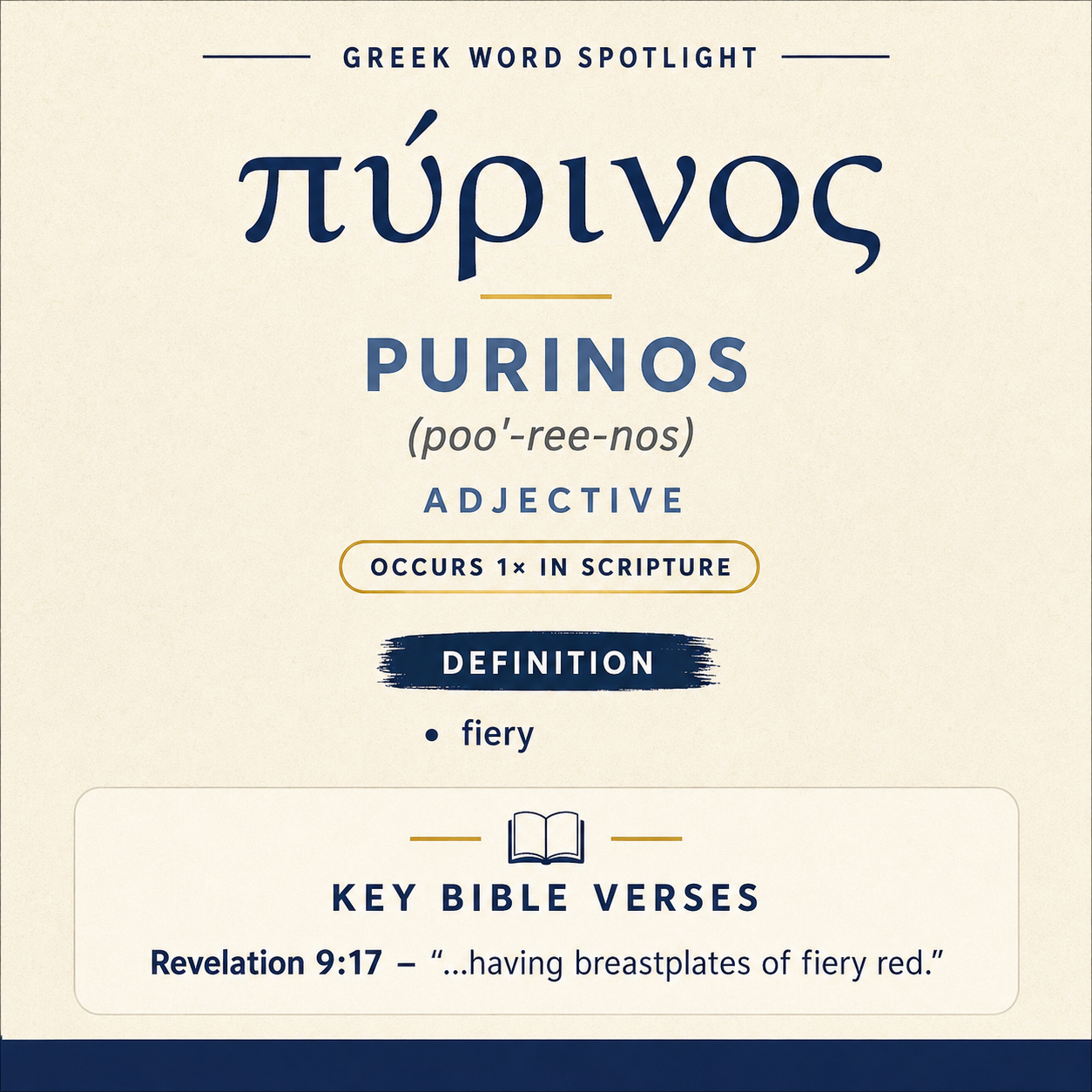
πύρινος means “fiery” and appears once in Scripture, in Revelation 9:17 describing fiery red breastplates in a vision.
Context in Verse
In Revelation 9:17 it describes “breastplates of fiery red” seen in a vision of horses and riders.
Learn More →πύρινος means “fiery” and appears once in the Greek New Testament, in the description of the riders’ breastplates within a visionary scene of warfare imagery. In that single context, the word functions as a vivid color-and-fire adjective that intensifies the threatening atmosphere of the vision.
Root and Related Words
πύρινος derives from pyra (πυρά), “fire” (Strong’s G4443). The relationship is visible in the shared πυρ- sound, linking the adjective closely to the basic idea of fire as a concrete phenomenon.

Occurrences
“Thus I saw the horses in the vision, and those who sat on them, having breastplates of fiery red, hyacinth blue, and sulfur yellow; and the horses’ heads resembled lions’ heads. Out of their mouths proceed fire, smoke, and sulfur.” (Revelation 9:17)
In Revelation 9:17, πύρινος appears inside a tightly packed sequence of visual descriptors: “breastplates of fiery red, hyacinth blue, and sulfur yellow.” The adjective does two things at once in this line. First, it helps specify what is seen—these are not merely red breastplates, but breastplates characterized as “fiery red,” a description that pushes beyond neutral color into a more intense, flame-associated hue. Second, it binds the armor’s appearance to the larger fire-laden imagery that immediately follows: “Out of their mouths proceed fire, smoke, and sulfur.” Within the single sentence, the vision repeatedly returns to combustion and burning (fire; smoke; sulfur), and πύρινος anticipates that cascade by coloring the riders’ protection with the same fiery register.
The word is attached to “breastplates,” the protective gear worn by “those who sat” on the horses. In this scene, the riders are presented as an organized force: horses, riders, armor, and coordinated coloration (“fiery red, hyacinth blue, and sulfur yellow”). πύρινος therefore contributes not only heat imagery but also a sense of deliberate, almost militarily arranged appearance. The breastplates form the first focus of the description before attention shifts upward to “the horses’ heads” and then forward to the terrifying emission “out of their mouths.” The placement of πύρινος at the opening of the color triad sets the tone for the rest of the portrayal, since the narrative soon makes literal fire erupt within the same breath.
Because the context explicitly mentions “fire, smoke, and sulfur,” the adjective’s “fiery” quality resonates as more than decorative. It visually harmonizes armor, color, and the destructive output described at the end of the verse. The riders are not merely surrounded by the idea of fire; their equipment visually bears it, and the horses themselves become sources from which fire proceeds. In that way, πύρινος helps fuse sight (“I saw”) with menace: what looks fiery aligns with what acts through fire.
Sense and Usage
The definition “fiery” is realized in Revelation 9:17 primarily as a descriptor of appearance, tied to color (“fiery red”) and set alongside two other intense, saturated descriptors (“hyacinth blue, and sulfur yellow”). In a visionary report, such adjectives do not operate as casual embellishment; they are part of how the vision is structured for the reader—by layering specific sensory impressions. πύρινος, by invoking fire-language in a color phrase, sharpens the image of the riders’ breastplates so that the reader does not picture ordinary red but a red that suggests flame.
The immediate co-text also anchors “fiery” to the broader phenomenon of burning and its byproducts. The verse ends with a threefold procession from the horses’ mouths: “fire, smoke, and sulfur.” In ordinary description, color terms can remain purely visual; here, the narrative itself brings fire into literal action. πύρινος thus sits on the boundary between visual resemblance (a breastplate that looks fiery) and the later description of actual fiery output (fire that proceeds). The adjective works as a bridge: it prepares the imagination for the explicit mention of fire by first threading fire into the palette of the riders’ armor.
Even within the single occurrence, the word’s effect is shaped by the grammar of coordination. “Fiery red” is not isolated; it is one element in a triad, each color term contributing to a composite spectacle. The sequence also pairs the riders’ armor with the animals’ anatomy (“the horses’ heads resembled lions’ heads”) and with the eruption from their mouths. The result is an integrated portrayal in which fieriness is part of a larger network of violent, elemental imagery. πύρινος serves that network by giving the protective equipment a flame-associated character, making the riders appear suited to—or aligned with—the fire that soon dominates the verse’s closing line.
Because the word modifies armor rather than the fire itself, it also functions by contrast: the vision does not begin by stating “fire” outright, but by describing a “fiery” aspect of what is seen. Only after the armor and heads are described does the text move to the active emission of “fire, smoke, and sulfur.” The adjective’s placement therefore helps pace the reader’s experience of the scene, moving from striking color to frightening action. In this usage, “fiery” is not an abstract quality; it is a concrete, pictorial feature that belongs to what the seer reports seeing in the vision.
Imagery
In Revelation 9:17 the word participates in a concentrated cluster of burning imagery. “Fiery red” on the breastplates visually foreshadows the closing depiction: “Out of their mouths proceed fire, smoke, and sulfur.” The adjective helps the scene feel internally consistent: what appears fiery at the level of color corresponds to what is later expressed as fire in motion. Within this single verse, πύρινος adds a flame-tinted intensity to the vision’s first details and helps carry the reader toward the final, overt eruption of fire.
Sources: Lexical data from Strong’s Exhaustive Concordance and the Translators Brief Lexicon of Extended Strongs for Greek (STEPBible, CC BY). Occurrence data from the Translators Amalgamated Greek New Testament (STEPBible, CC BY). Scripture quotations from the World English Bible (public domain).