Understanding the Meaning of Aparabatos in Greek
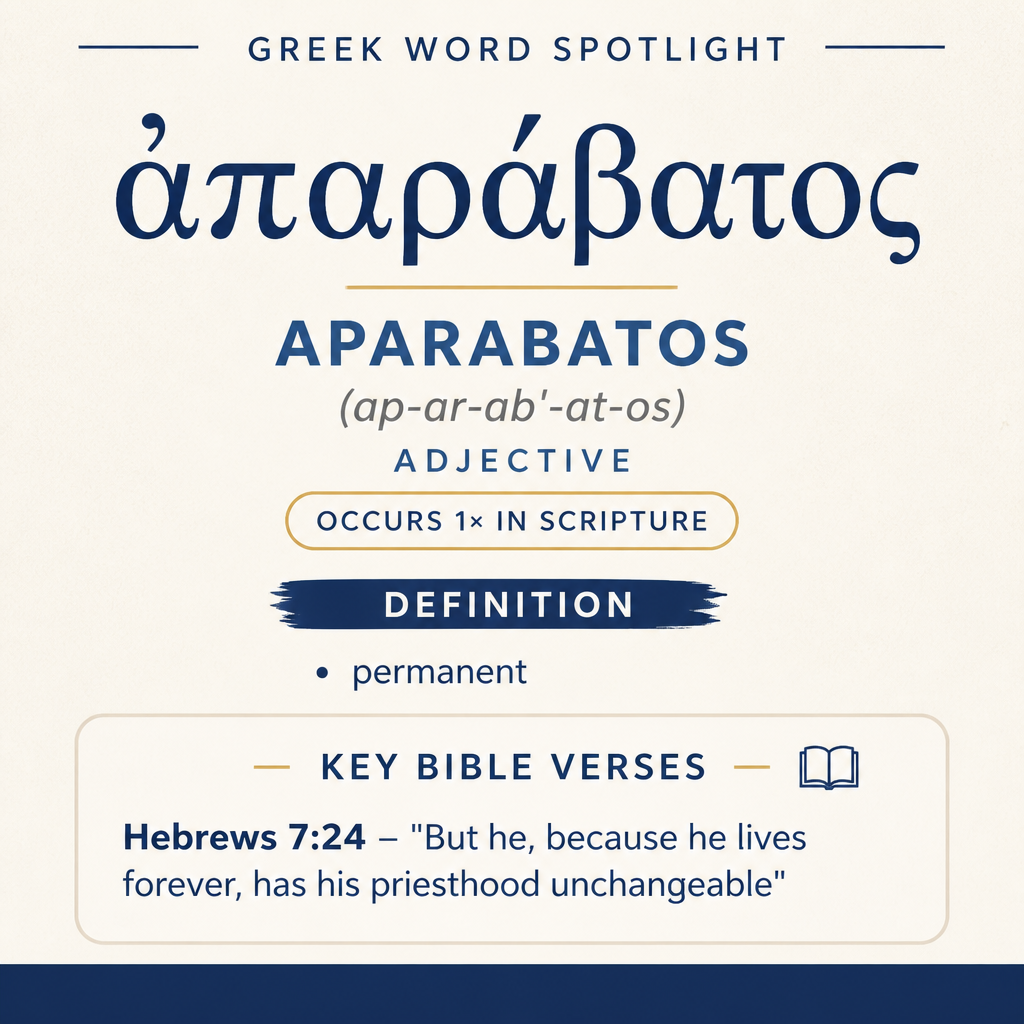
ἀπαράβατος means “permanent” and appears once in Scripture, in Hebrews 7:24.
Hebrews Context
In Hebrews 7:24 it describes a priesthood that is “unchangeable” because he lives forever.
Learn More →ἀπαράβατος means “permanent” and appears in Hebrews 7:24. In that verse it characterizes the kind of priesthood held by the one who “lives forever.”
Root and Related Words
ἀπαράβατος is connected with παραβαίνω (parabainō), “to transgress” (Strong’s G3845). It is also linked, in Strong’s derivation, with α (Alpha), “Alpha” (Strong’s G1).

Occurrences
“But he, because he lives forever, has his priesthood unchangeable.” (Hebrews 7:24)
Here ἀπαράβατος qualifies “his priesthood.” The sentence gives the reason for that description: “because he lives forever.” The word’s force in context is to mark this priesthood as one that does not shift into another form or pass to another holder; its stability is tied directly to the ongoing life of the priest in view. Within the verse’s logic, the permanence of the priesthood is not presented as an abstract quality floating free of history, but as the practical consequence of a priest who continues without end: as long as he “lives forever,” the priesthood remains what it is, consistently and without alteration.
The immediate rhetorical effect is to place “his priesthood” in a distinct category. The verse contrasts a situation where a priestly office might otherwise be interrupted or replaced with a situation where the office remains fixed. ἀπαράβατος therefore functions as a key descriptor supporting the author’s larger claim in this single line: continuity of life grounds continuity of priesthood.
Sense and Usage
The single New Testament use of ἀπαράβατος in Hebrews 7:24 anchors “permanent” in a concrete institutional setting: priesthood. In this verse, permanence is not treated as mere duration for its own sake, but as durability of an appointed role. The word is attached to something that can be “had” (“has his priesthood”), so the permanence described is the enduring character of an office possessed and exercised by a living subject. That framing keeps the term close to lived reality: the priesthood is permanent because the priest “lives forever,” and the verse links the two so tightly that the permanence reads as the steady, uninterrupted continuance of priestly identity and function.
The verse also shows how “permanent” works as a stabilizing concept in argument. A permanent priesthood provides a fixed point: what is true of this priestly office today remains true, because its bearer continues. The word therefore bears argumentative weight: it is the predicate that converts “he lives forever” into a conclusion about the status of “his priesthood.” In the flow of the sentence, ἀπαράβατος is the term that seals the inference.
Because the verse chooses to state permanence specifically of “his priesthood” rather than merely of his life, the focus falls on what his ongoing life implies for his role toward others. The text does not elaborate further within the quoted line, but the phrasing itself is directional: an enduring life yields an enduring priesthood. In that way, ἀπαράβατος conveys permanence as an attribute that secures continuity where change might otherwise be expected—continuity in the priestly office itself.
Imagery
Hebrews 7:24 ties ἀπαράβατος to the picture of an enduring priestly office that remains steady because its holder “lives forever.” The imagery is not visualized through objects in the verse, but it is conceptually concrete: a priesthood that stands firm in time, remaining in place without being altered by succession or interruption, precisely because the priest’s life does not come to an end.
Sources: Lexical data from Strong’s Exhaustive Concordance and the Translators Brief Lexicon of Extended Strongs for Greek (STEPBible, CC BY). Occurrence data from the Translators Amalgamated Greek New Testament (STEPBible, CC BY). Scripture quotations from the World English Bible (public domain).