
Exploring the Meaning of Anthistemi in Greek
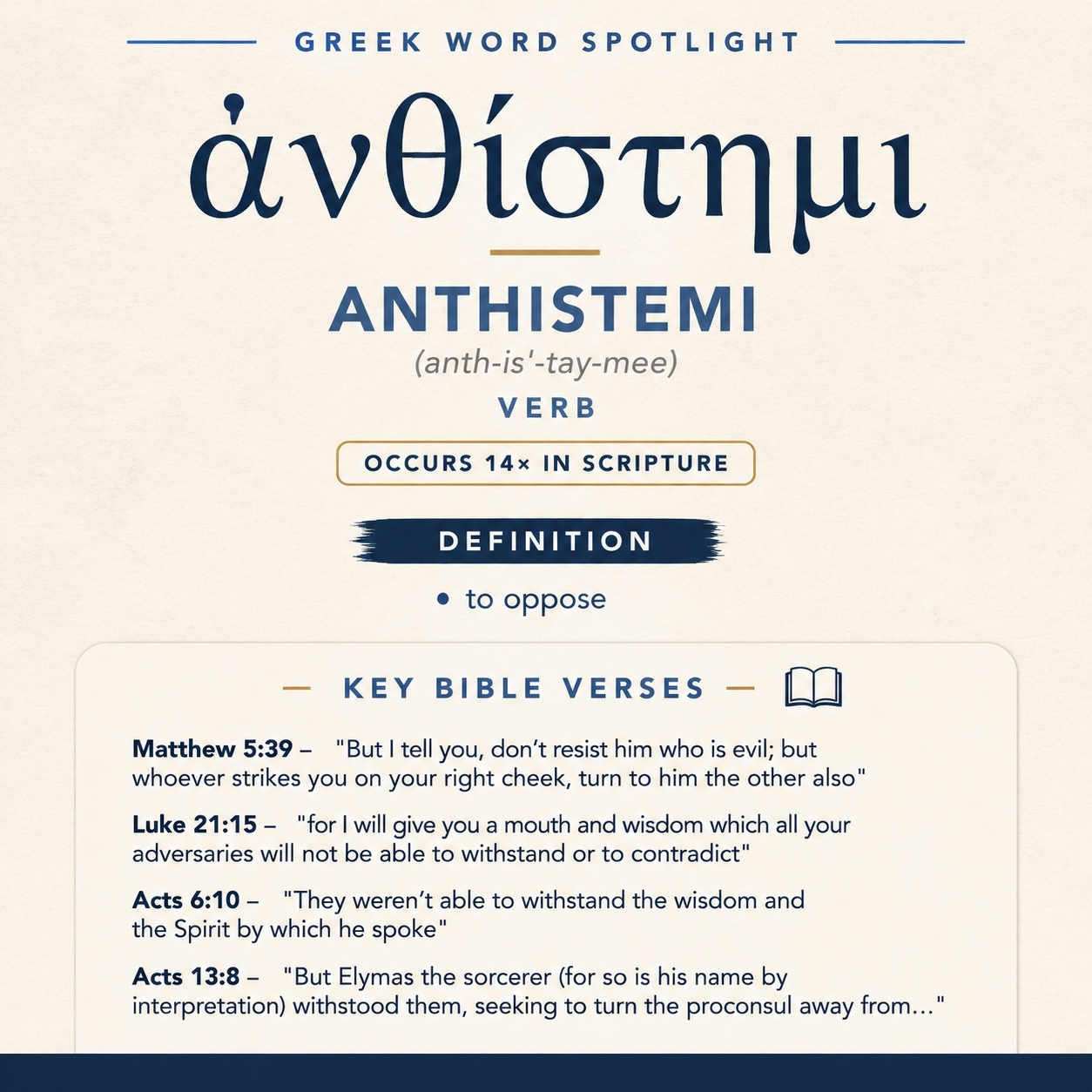
ἀνθίστημι means “to oppose” and occurs 14 times in Scripture, including Matthew 5:39, Luke 21:15, Acts 6:10, Romans 13:2, and Ephesians 6:13.
Core Meaning
ἀνθίστημι is defined as “to oppose.” In several verses it is translated “resist” or “withstand.”
Learn More →Gospel & Acts Use
In Matthew 5:39, Jesus teaches, “don’t resist him who is evil.” In Acts 6:10 and Luke 21:15, opponents are not able to “withstand” wisdom.
Learn More →Epistles Emphasis
Romans 13:2 warns that resisting authority is withstanding God’s ordinance. Ephesians 6:13 calls believers to be able to withstand in the evil day.
Learn More →ἀνθίστημι means “to oppose.” In the New Testament it appears in scenes ranging from interpersonal conflict and public testimony to spiritual struggle, describing actions that stand over against a person, message, will, or authority.
Occurrences
“But I tell you, don’t resist him who is evil; but whoever strikes you on your right cheek, turn to him the other also.” (Matthew 5:39)
Here the word is framed by a direct prohibition: “don’t resist him who is evil.” The context is a concrete insult or assault (“strikes you on your right cheek”), and the instruction contrasts opposition with a startling alternative response (“turn to him the other also”). The force of ἀνθίστημι in this setting is practical and relational: it names the instinct to push back against wrongdoing, an instinct Jesus forbids in this illustration.

“for I will give you a mouth and wisdom which all your adversaries will not be able to withstand or to contradict.” (Luke 21:15)
In this promise about hostile hearings, opposition is attributed to “adversaries,” yet they are said to be unable “to withstand or to contradict” what Jesus provides (“a mouth and wisdom”). ἀνθίστημι contributes the image of an attempted counter-stance—an effort to meet testimony with resistance—that fails because the speaker’s wisdom cannot be held back or successfully set against.
“They weren’t able to withstand the wisdom and the Spirit by which he spoke.” (Acts 6:10)
The same idea is illustrated in narrative form. A group confronts Stephen, but their inability “to withstand” is specifically directed toward “the wisdom and the Spirit by which he spoke.” ἀνθίστημι marks the collision between Stephen’s Spirit-empowered speech and the opposing effort to answer it down; the verse highlights the futility of that opposition.
“But Elymas the sorcerer (for so is his name by interpretation) withstood them, seeking to turn the proconsul away from the faith.” (Acts 13:8)
Here ἀνθίστημι is purposeful and strategic. Elymas “withstood them” in order to influence a third party (“the proconsul”), and his aim is stated: “seeking to turn the proconsul away from the faith.” The verb depicts direct interference—standing in the way of the message and its reception.
“You will say then to me, “Why does he still find fault? For who withstands his will?”” (Romans 9:19)
In this rhetorical question, ἀνθίστημι is set against “his will.” The imagined objector treats opposition to divine will as the relevant issue: if God’s will stands, what creature can successfully set itself against it? The verb thus functions as the language of contest, raising the notion of resistance in the face of sovereign purpose.
“Therefore he who resists the authority withstands the ordinance of God; and those who withstand will receive to themselves judgment.” (Romans 13:2)
Opposition is now directed toward “the authority,” and Paul equates that resistance with standing against “the ordinance of God.” The second clause (“those who withstand will receive to themselves judgment”) treats opposition as a culpable act with consequences. ἀνθίστημι gives the action its moral contour: a stance taken not merely against human structures but against what God has ordered, leading to judgment.
“But when Peter came to Antioch, I resisted him to his face, because he stood condemned.” (Galatians 2:11)
This occurrence is personal and face-to-face. Paul’s opposition is explicit (“to his face”) and is justified by an evaluation of Peter’s standing (“because he stood condemned”). ἀνθίστημι here is not hidden or indirect; it is open contradiction in a community setting, presented as a necessary confrontation with a fellow leader.
“Therefore put on the whole armor of God, that you may be able to withstand in the evil day, and having done all, to stand.” (Ephesians 6:13)
In the context of armor and the “evil day,” ἀνθίστημι carries the sense of holding one’s ground under pressure. The goal is capability: being equipped “that you may be able to withstand,” and then, after exhausting the required action (“having done all”), still “to stand.” Opposition here is less about attacking and more about remaining unyielding when faced with hostile forces.
“Even as Jannes and Jambres opposed Moses, so these also oppose the truth, men corrupted in mind, who concerning the faith are rejected.” (2 Timothy 3:8)
The verb appears twice, first in a comparison (“opposed Moses”) and then applied to contemporary opponents (“these also oppose the truth”). ἀνθίστημι thus bridges past and present, describing a recognizable pattern of resistance. What is opposed shifts from a person (Moses) to a content-reality (“the truth”), and the opponents are characterized as “corrupted in mind” and “concerning the faith… rejected,” tying their opposition to their inward and communal condition.
“of whom you also must beware; for he greatly opposed our words.” (2 Timothy 4:15)
Opposition becomes a pastoral warning. The person in view “greatly opposed our words,” making his resistance not incidental but intense. ἀνθίστημι identifies the target as “our words”—the apostolic message as spoken—and the exhortation “must beware” shows that such opposition has practical effects on ministry and relationships.
“Be subject therefore to God. Resist the devil, and he will flee from you.” (James 4:7)
This command places opposition within a larger posture: first “Be subject therefore to God,” then “Resist the devil.” ἀνθίστημι expresses an active stance against an evil personal adversary, and the result is stated as a promised retreat (“he will flee from you”). The word thus serves a directive function: opposition is not merely described but commanded as part of submission to God.
“Withstand him steadfast in your faith, knowing that your brothers who are in the world are undergoing the same sufferings.” (1 Peter 5:9)
Here the imperative is strengthened by the manner of opposition: “steadfast in your faith.” The verse places resisting “him” alongside communal solidarity in suffering (“your brothers… are undergoing the same sufferings”). ἀνθίστημι describes not a momentary refusal but a sustained stance, one that is supported by faith and by awareness that this pressure is shared across the wider community.

Sense and Usage
Across these passages, ἀνθίστημι consistently marks an opposing stance taken toward a person, a message, a will, or a power. The objects of opposition vary: an “evil” person in a concrete provocation (Matthew 5:39), “adversaries” trying to meet testimony with contradiction (Luke 21:15; Acts 6:10), a missionary team whose message is being obstructed (Acts 13:8), “his will” invoked in a theological challenge (Romans 9:19), and “the authority” understood as bound up with God’s ordinance (Romans 13:2). In Galatians 2:11 the verb becomes a vehicle for direct interpersonal confrontation, where opposition is enacted “to his face,” not as a private sentiment but as public correction.
Several texts attach ἀνθίστημι to speech. Luke 21:15 and Acts 6:10 focus on the inability of opponents to withstand wise, Spirit-empowered words; 2 Timothy 4:15 warns of one who “greatly opposed our words.” In these settings, opposition is not mainly physical but discursive and strategic: it tries to counter, silence, or redirect what is being said, whether by contradiction or by turning a hearer “away from the faith” (Acts 13:8). The verb thus highlights the social dynamics of contested proclamation.
Other uses emphasize endurance under pressure rather than verbal contest. Ephesians 6:13 pairs “withstand” with “stand,” embedding the verb within the imagery of being outfitted for conflict. The focus is readiness to remain firm “in the evil day,” suggesting a posture that does not collapse when tested. James 4:7 and 1 Peter 5:9 present opposition as a commanded response to a personal spiritual adversary (“the devil”; “him”), and both supply a framework for that resistance: submission to God (James) and steadfast faith amid shared sufferings (Peter). In these imperatives, ἀνθίστημι is not reactive stubbornness; it is a deliberate stance shaped by allegiance and trust.
Finally, the verb can be framed as futile or perilous depending on what is opposed. Romans 9:19 treats opposition to divine will as the sharp edge of an objection—who could do it?—whereas Romans 13:2 assigns judgment to those who take that oppositional stance toward authority as God’s ordinance. These uses give ἀνθίστημι a moral and theological weight: opposition is not a neutral posture, and its meaning in a given scene depends greatly on who or what stands on the other side.
Imagery
The passages collect several vivid pictures around opposition: a struck cheek met without resistance (Matthew 5:39), adversaries unable to mount an effective counter (Luke 21:15; Acts 6:10), an opponent actively blocking a hearer’s path toward faith (Acts 13:8), and a soldier-like readiness to remain standing through an “evil day” (Ephesians 6:13). Alongside these, the commands to resist the devil (James 4:7) and to withstand “steadfast in your faith” in the midst of widespread suffering (1 Peter 5:9) cast ἀνθίστημι as the language of steadfast refusal—opposition that holds its ground.
Sources: Lexical data from Strong’s Exhaustive Concordance and the Translators Brief Lexicon of Extended Strongs for Greek (STEPBible, CC BY). Occurrence data from the Translators Amalgamated Greek New Testament (STEPBible, CC BY). Scripture quotations from the World English Bible (public domain).




