
Exploring the Meaning of Anthrakia in Greek
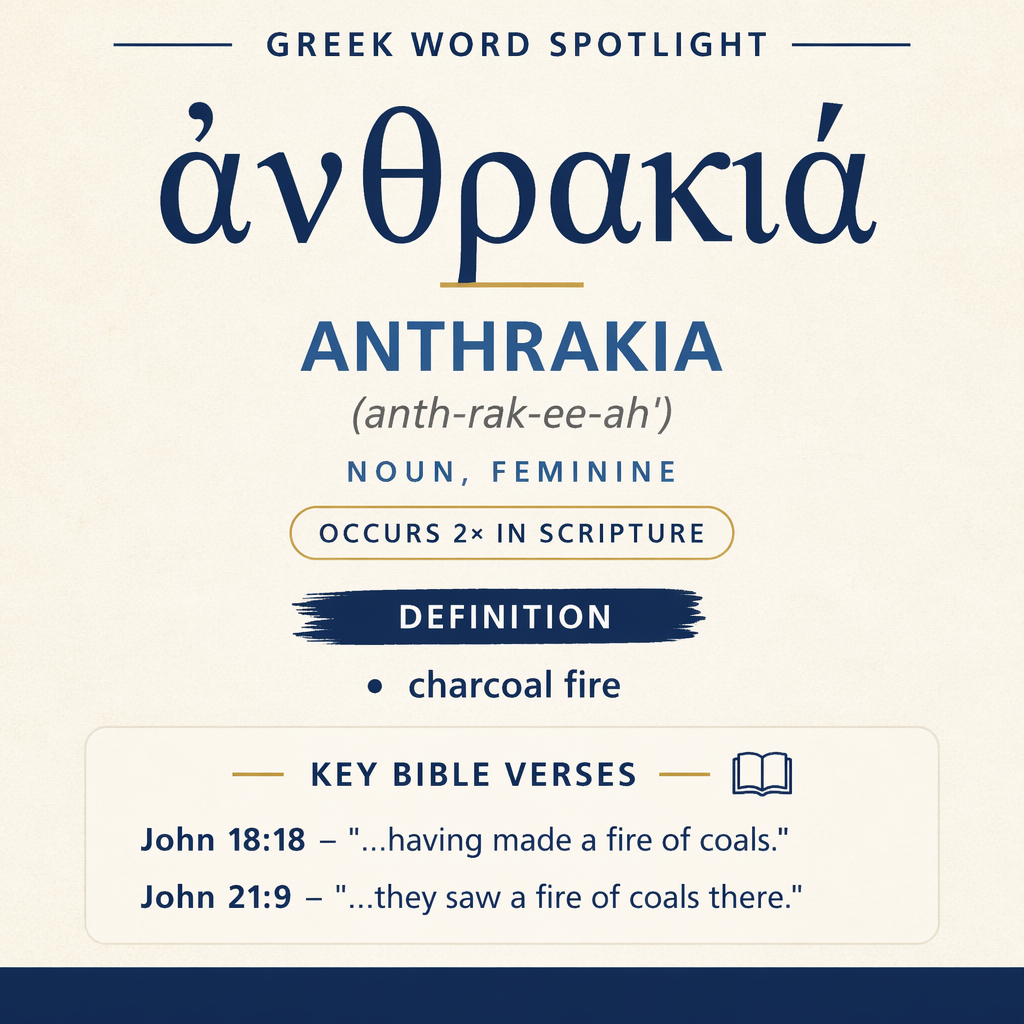
ἀνθρακιά means “charcoal fire” and appears in John 18:18 and John 21:9.
Gospel Occurrences
It occurs two times in Scripture, both in the Gospel of John: 18:18 and 21:9.
Learn More →Scene Details
In John 18:18, servants and officers stand by a charcoal fire for warmth. In John 21:9, a charcoal fire is seen with fish and bread laid on it.
Learn More →ἀνθρακιά refers to a “charcoal fire,” a specific kind of fire made from coals. In the New Testament it appears in two scenes in John’s Gospel, each framed by people gathered around such a fire.
Root and Related Words
ἀνθρακιά (Anthrakia) is related to ἄνθραξ (anthrax), “charcoal” (Strong’s G440).

Occurrences
John 18:18: “Now the servants and the officers were standing there, having made a fire of coals, for it was cold. They were warming themselves. Peter was with them, standing and warming himself.”
Here ἀνθρακιά names the physical center of a nighttime gathering: “a fire of coals” made because “it was cold.” The word anchors the verse in ordinary bodily need—warmth—and explains why the group remains in place: the servants and officers are “standing there” by the heat source they have prepared. The charcoal fire creates a small pocket of comfort in the cold and becomes the shared space where different people stand together, doing the same action: “warming” themselves.
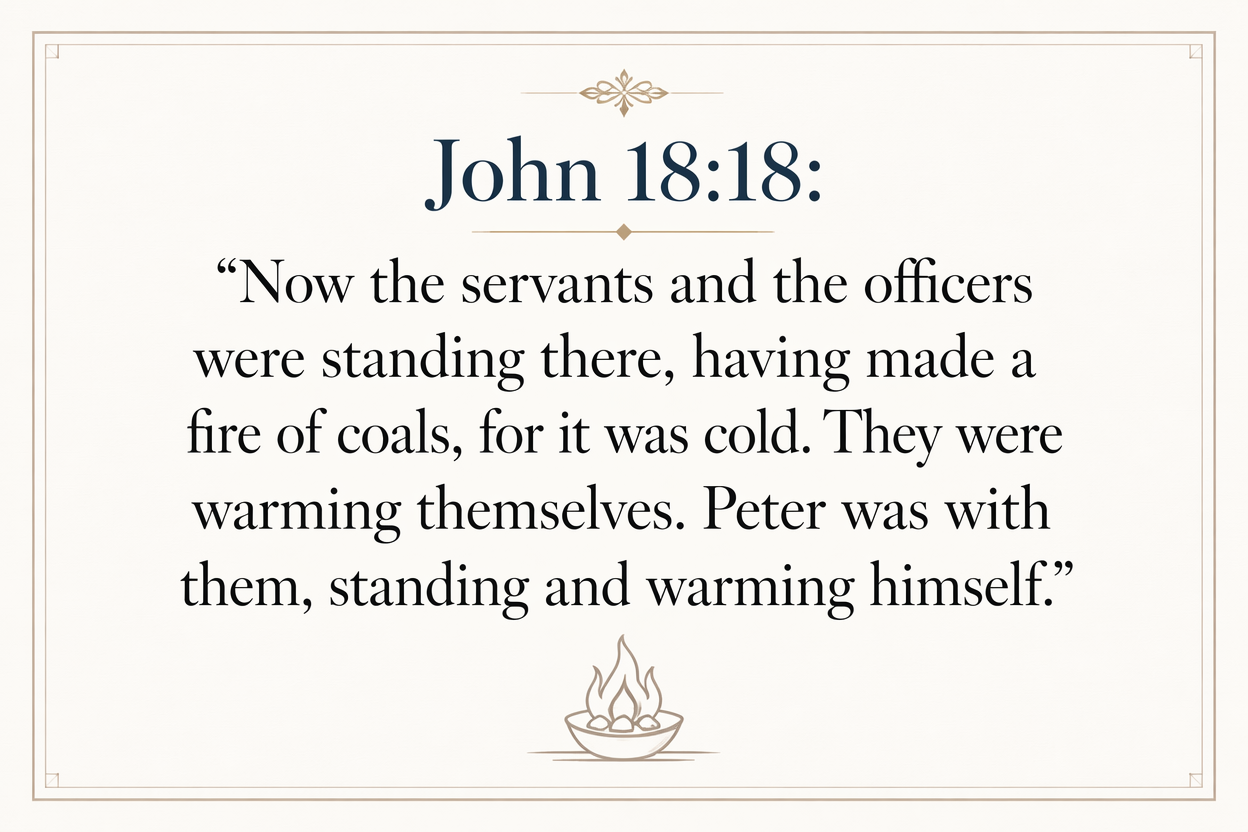
Within the scene, the charcoal fire is not simply background detail. It provides the setting that holds the figures in proximity: the servants and officers on one side and Peter among them, “standing and warming himself.” The repeated description of warming underscores the fire’s practical function and keeps the reader’s attention on the close, lingering moment around the coals. ἀνθρακιά thus contributes a concrete, sensory element—heat in the cold—that organizes where the action takes place and how the people relate spatially (standing together around the same fire).
John 21:9: “So when they got out on the land, they saw a fire of coals there, with fish and bread laid on it.”
In this second occurrence, ἀνθρακιά again points to a “fire of coals,” but the scene differs in tone and purpose. The fire is already present when “they got out on the land,” and the first thing observed is the prepared charcoal fire “there,” outfitted for a meal: “with fish and bread laid on it.” The word draws attention to a ready-made, deliberate arrangement. Unlike John 18:18, where the fire is made “for it was cold” and people cluster around it to warm themselves, here the charcoal fire functions as a cooking place and a serving surface.
The phrase “they saw a fire of coals there” places the charcoal fire as an immediate visual focus on landfall, marking a transition from whatever preceded to a scene of provision and shared food. The detail that fish and bread are already “laid on it” gives the fire a purposeful stillness: it is not merely for heat but part of a prepared setting for eating. ἀνθρακιά, in this context, contributes the texture of domestic, practical hospitality—an open fire used to warm and hold food—without describing any elaborate structure, only coals and what rests upon them.
Sense and Usage
Across both passages, ἀνθρακιά consistently denotes a charcoal fire—coals arranged and burning in a way suitable for close presence. The scenes show that this kind of fire can serve more than one immediate purpose within everyday life: in one setting, it is made because of cold weather and becomes the place where people stand to regain warmth; in the other, it is positioned on the shoreline with food laid upon it, ready for a simple meal.
Because the word specifies “charcoal” rather than describing a generalized blaze, it naturally evokes a controlled fire that can be approached and used at close range. In John 18:18 the fire’s role is personal and bodily—people are “warming themselves”—and the repeated warming language matches the expectation that charcoal coals give sustained heat suitable for standing nearby. In John 21:9 the fire’s role is culinary and communal: it is part of an arrangement where food is already in place. In both cases, ἀνθρακιά points to an ordinary but intentional human action: coals are gathered and made into a usable fire, either by the servants and officers (“having made a fire of coals”) or already prepared at the shore (“they saw a fire of coals there”).
The two occurrences also show how a charcoal fire can define a scene’s physical boundaries. People “were standing there” in John 18:18, a location implied by the fire they had made; likewise, “there” in John 21:9 situates the group’s landing spot by what they immediately see. The word therefore functions as a setting-marker as well as an object: it establishes where attention gathers and what sort of activity is natural in that spot—warming in cold air, or eating where fish and bread are laid over coals.
In narrative terms, ἀνθρακιά introduces a concrete sensory detail that can be seen (“they saw”), felt (“it was cold… warming themselves”), and used (food “laid on it”). The word’s contribution is not abstract; it supplies a material environment in which other actions occur. By naming the fire as a charcoal fire, the text conveys a scene that is close, grounded, and domestic: a place where people stand shoulder-to-shoulder for warmth, or a place where simple food rests on heat.
Imagery
In John 18:18, the charcoal fire is the small, bright point in a cold setting, drawing “the servants and the officers” into one tight circle and including Peter among them as all “warming” takes place. In John 21:9, the charcoal fire becomes a quiet sign of prepared food—“fish and bread laid on it”—so that the first sight on land is not emptiness but a ready hearth. In both scenes, ἀνθρακιά carries the imagery of shared proximity: coals gathered in one place, giving heat that brings people near and holds their attention.
Sources: Lexical data from Strong’s Exhaustive Concordance and the Translators Brief Lexicon of Extended Strongs for Greek (STEPBible, CC BY). Occurrence data from the Translators Amalgamated Greek New Testament (STEPBible, CC BY). Scripture quotations from the World English Bible (public domain).




