
Exploring the Meaning of Antapodoma in Greek
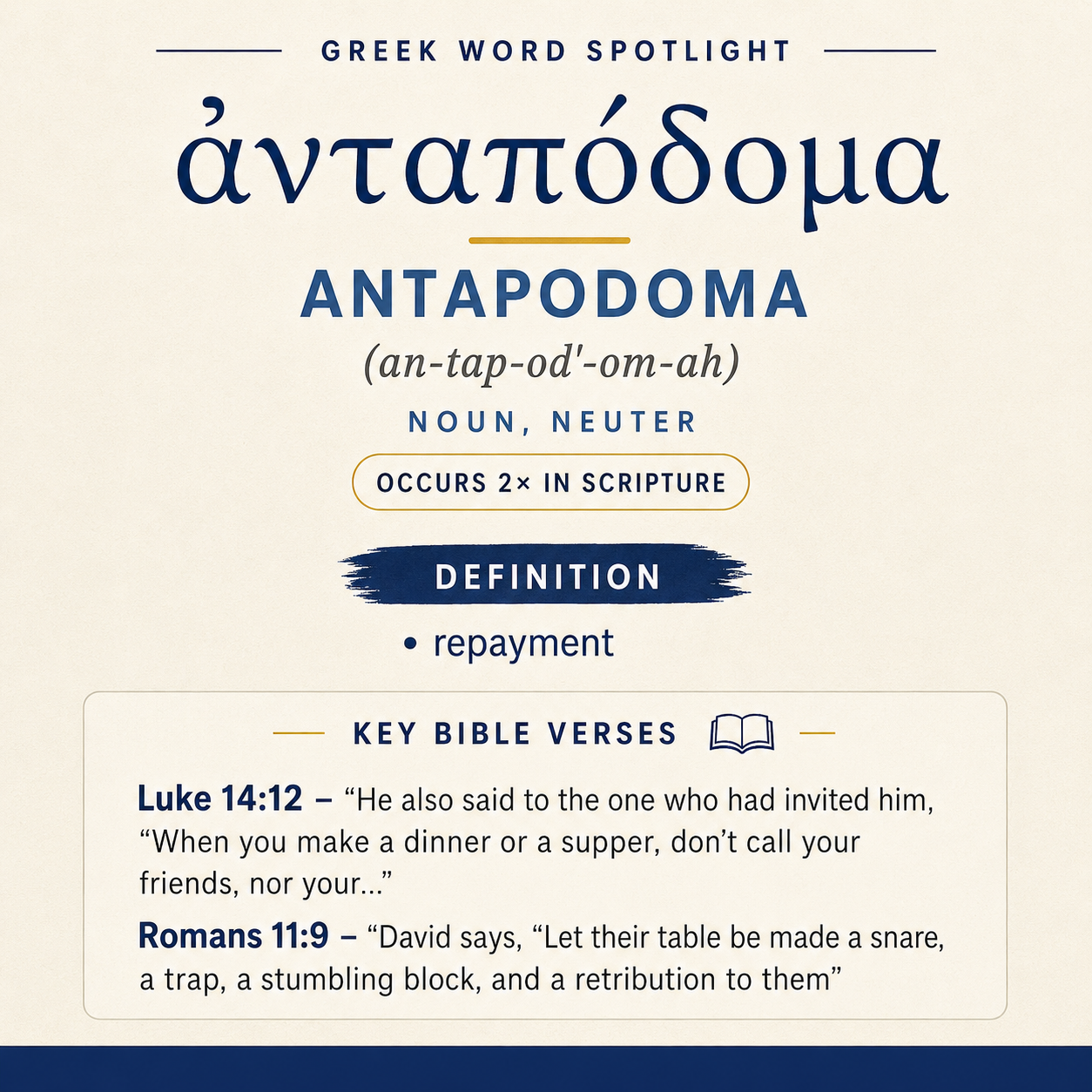
ἀνταπόδομα means “repayment” and appears twice in Scripture, in Luke 14:12 and Romans 11:9.
Scripture Occurrences
This word occurs 2 times in Scripture: Luke 14:12 and Romans 11:9.
Learn More →Context Snapshots
In Luke 14:12 it appears within Jesus’ instruction about whom to invite to a meal. In Romans 11:9 it is used in a statement about “retribution” at their table.
Learn More →ἀνταπόδομα means “repayment.” It appears in a teaching scene about social invitations and in a quotation that speaks of “retribution” at a table.
Root and Related Words
ἀνταπόδομα corresponds to the verb antapodidōmi (ἀνταποδίδωμι), “to repay” (Strong’s G467). The noun expresses the result or due outcome implied by that verbal idea: something rendered back in response to an action.

Occurrences
“He also said to the one who had invited him, “When you make a dinner or a supper, don’t call your friends, nor your brothers, nor your kinsmen, nor rich neighbors, or perhaps they might also return the favor, and pay you back.” (Luke 14:12)
Here ἀνταπόδομα belongs to the everyday economy of hospitality. The setting is a “dinner or a supper,” and the warning concerns a predictable cycle of mutual benefit among social equals: invite those who are able to “return the favor,” and the host receives an answering benefit described as being “pay[ed] … back.” In this scene, repayment is not cast as an abstract principle but as a concrete social possibility embedded in relationships (“friends,” “brothers,” “kinsmen,” “rich neighbors”). The force of the word lies in its straightforward reciprocity: the host’s act can generate an answering act, so that the meal becomes a kind of exchange where the original generosity is met with a return.
The verse frames that return as a motive to be resisted (“don’t call… or perhaps…”). ἀνταπόδομα therefore carries the sense of an expected counter-gift that can subtly redefine the intention of giving. The meal is not merely food shared; it is an action that may be calculated in anticipation of a future balancing gesture. The noun helps the saying pinpoint the social dynamic: an invitation can be offered in a way that is already oriented toward what comes back.
“David says, “Let their table be made a snare, a trap, a stumbling block, and a retribution to them.” (Romans 11:9)
In this line, ἀνταπόδομα is rendered “retribution,” and it sits alongside a cluster of vivid, overlapping images: “snare,” “trap,” and “stumbling block.” The focal object is “their table,” normally associated with provision and security, but here imagined as the very site where harm is encountered. The word places the emphasis on what comes back upon the persons in view: the table “be made” into something that functions as a repayment toward them.
Because the verse piles up terms of danger and downfall, ἀνταπόδομα contributes the idea of a return that is not beneficial but judicial in effect within the imagery of the quotation. The “table” is not merely a location; it becomes an instrument by which an answering outcome meets them. The noun’s presence gives this outcome the shape of an exchange: something is rendered back, and what returns is experienced as “retribution.” It thus belongs to the logic of consequence within the quotation’s picture—what is “made” at the table becomes what is handed back to them.
Sense and Usage
Across these two passages, ἀνταπόδομα keeps a consistent core: a return rendered in response to an act. Luke 14:12 sets the term in a familiar social pattern where gifts and invitations can generate counter-invitations—repayment as social reciprocity. Romans 11:9 uses the same kind of return-language in a more ominous register, where what comes back is experienced as punitive rather than friendly. In both places, the noun points to the “back-and-forth” structure of actions and outcomes: an initial situation is met by an answering return, and that return is described as something due or fitting within the scene’s own logic.
The two contexts also show how repayment can be morally or emotionally charged without changing the basic notion of return. In Luke, repayment is linked to advantage and social calculation: the host may choose guests in order to receive something back. In Romans, repayment is linked to reversal and danger: the table itself becomes the arena where the return is felt. The word therefore functions well in both interpersonal and communal imagery, because it names not the initial act but what answers it—what comes back to the actor or to the group as a result of the situation described.
Another feature common to both uses is their orientation toward future outcome. In Luke 14:12, repayment is prospective (“perhaps they might also return the favor”), a possibility that can shape choices in the present. In Romans 11:9, repayment is expressed as a desired outcome (“Let their table be made… and a retribution”), a result envisioned as taking form. ἀνταπόδομα thus naturally fits statements that warn about what an action may generate, or that speak about what a condition may become: it names the answering return that completes the sequence.
Imagery
Both occurrences place ἀνταπόδομα near a table. In Luke 14:12, the table is a setting for invitation, relationship, and the temptation of social payback. In Romans 11:9, the table is transformed into a place of peril—“a snare, a trap, a stumbling block”—so that the “retribution” is pictured not as an abstract verdict but as something encountered where one would normally expect nourishment and ease. The word’s imagery, as used in these passages, is the experience of a return that meets a person in the ordinary spaces of life.
Sources: Lexical data from Strong’s Exhaustive Concordance and the Translators Brief Lexicon of Extended Strongs for Greek (STEPBible, CC BY). Occurrence data from the Translators Amalgamated Greek New Testament (STEPBible, CC BY). Scripture quotations from the World English Bible (public domain).




