
Understanding the Meaning of ‘Adad in Hebrew
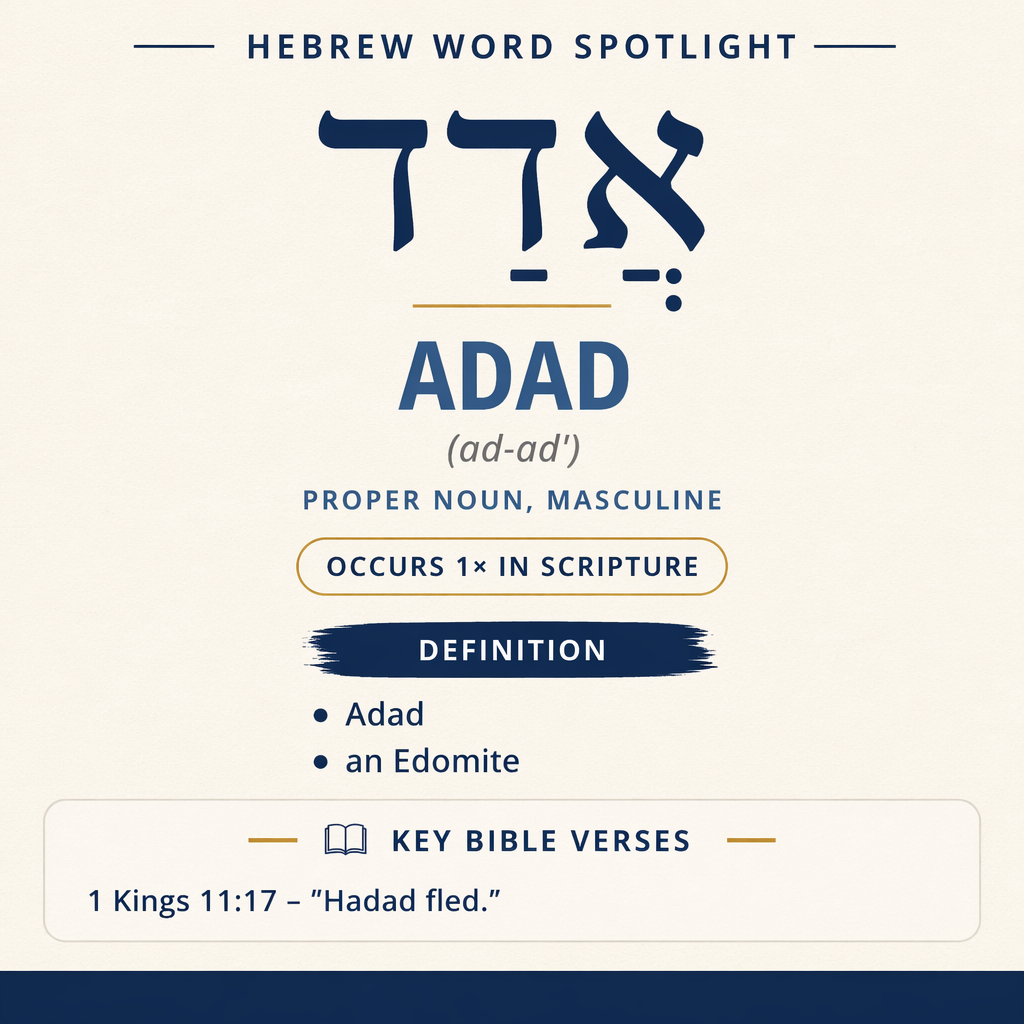
אֲדַד (Adad) is the name of an Edomite and appears in 1 Kings 11:17.
Biblical Context
In 1 Kings 11:17, Hadad fled with certain Edomites of his father’s servants to go into Egypt.
Learn More →Adad is a personal name borne by an Edomite in the narrative of royal conflict and flight in 1 Kings 11:17. In the verse where it appears, the name anchors a brief but vivid notice about escape, companionship, and childhood vulnerability during a journey to Egypt.
Occurrences
Hadad fled, he and certain Edomites of his father’s servants with him, to go into Egypt, when Hadad was still a little child. (1 Kings 11:17)
In this single attestation, Adad functions as the identifying name for the one who “fled” and for whom the whole movement of the sentence is organized. The verse frames him as the central figure in an urgent departure: the verb “fled” sets a tone of danger or pressure, and the destination “to go into Egypt” marks the flight as a cross-border refuge rather than a short local retreat. The second mention of the name (“when Hadad was still a little child”) gives the notice a biographical contour: the same named person is both the agent of flight and, at the time of flight, a child. The repetition of the name in one verse ties these points together—identity, movement, and age—so that the reader receives the flight not as an anonymous migration but as the formative early experience of a specific Edomite individual.
The companions named with Adad sharpen his social setting. He flees “with” others described as “certain Edomites of his father’s servants.” This phrase locates Adad within a household network large enough to have “servants,” and it suggests that the party traveling with him is not random but connected to his father’s service. Adad, then, is not introduced merely as a solitary fugitive: his name gathers around itself a small group defined by both ethnicity (“Edomites”) and domestic loyalty (“of his father’s servants”). Within the compact wording, Adad’s flight becomes an event in which household allegiance and ethnic identity travel alongside him into Egypt. The name, as a proper noun, is what allows the verse to compress all of this into a single snapshot without further description: it is Adad’s story being opened by a single sentence.
The verse also uses the name to highlight fragility. By saying “when Hadad was still a little child,” the text asks the reader to picture the journey and the fleeing through the lens of childhood. That does not change the outward action—he “fled” and went “into Egypt”—but it colors the scene with dependence and exposure. The proper name Adad is therefore not simply a label; it is the hook on which the narrative hangs an early-life circumstance that is likely to matter for how he is understood later. Even without additional details in this verse, the name marks the beginning of a personal trajectory: a named Edomite, carried out of danger in childhood, moving toward Egypt with retainers tied to his father.

Sense and Usage
The definition “Adad; an Edomite” matches the way the verse embeds the named individual within an explicitly Edomite circle: he flees “with…Edomites.” In usage here, “Edomite” is not presented as a mere background label; it is part of the description of the party and thus helps situate Adad’s identity as belonging to a people-group distinct enough to be named. Because the verse specifies “certain Edomites,” the text does not portray the companions simply as generic servants but as servants whose ethnicity is relevant to the narrative moment. The name Adad, in this setting, becomes the focal point of an Edomite remnant moving together—one named child and a handful of connected followers.
As a proper noun, Adad does not describe a trait or action in itself; it identifies the person around whom the action occurs. Yet even within that narrow function, the verse shows how a personal name can carry narrative weight. The author chooses to repeat the name rather than replace it with a pronoun in the final clause (“when Hadad was still a little child”). That stylistic choice keeps the identity foregrounded: the child in view is not merely “he,” but Adad, the same named fugitive mentioned at the outset. The verse thus treats the name as an anchor for coherence, linking the flight, the accompanying group, the destination, and the age into one compact unit.
The brief notice also shows how the designation “an Edomite” fits with movement into Egypt. The journey “to go into Egypt” indicates leaving one’s homeland region and seeking safety elsewhere. In that light, “an Edomite” is not an abstract label but a marker of origin set against a foreign destination. The name Adad stands at the intersection of those two places: he is identified as Edomite while the sentence places him on the road to Egypt. The verse therefore uses his identity to heighten the sense of displacement—an Edomite child being carried into another land—without needing to spell out political circumstances or motivations in this line.
Finally, the mention of “his father’s servants” adds a subtle social dimension to the definition. Adad is not simply an isolated Edomite; he is one whose family is implied to have servants and whose father’s household retains enough cohesion that some servants can be described as belonging to it even in flight. The name gathers up those associations, so that “Adad” in this verse refers to a person with a lineage (“his father”), a household structure (“servants”), an ethnic identity (“Edomites”), and a formative experience (“still a little child”)—all expressed in a single sentence.
Imagery
The imagery attached to Adad in 1 Kings 11:17 is the image of hurried travel under threat: fleeing with a small band, heading toward Egypt, and doing so while still a child. The verse invites a concrete mental picture of a young named Edomite being taken along by adult attendants connected to his father’s service, moving away from danger into a place of refuge. In that picture, the name Adad is the point of focus that keeps the scene personal rather than anonymous: the flight is remembered as the flight of Adad.
Sources: Lexical data from Strong’s Exhaustive Concordance and the Open Scriptures Hebrew Lexicon. Occurrence data from the Westminster Leningrad Codex with STEPBible reference data (CC BY). Scripture quotations from the World English Bible (public domain).





