Discovering the Meaning of ‘Abiyam in Hebrew
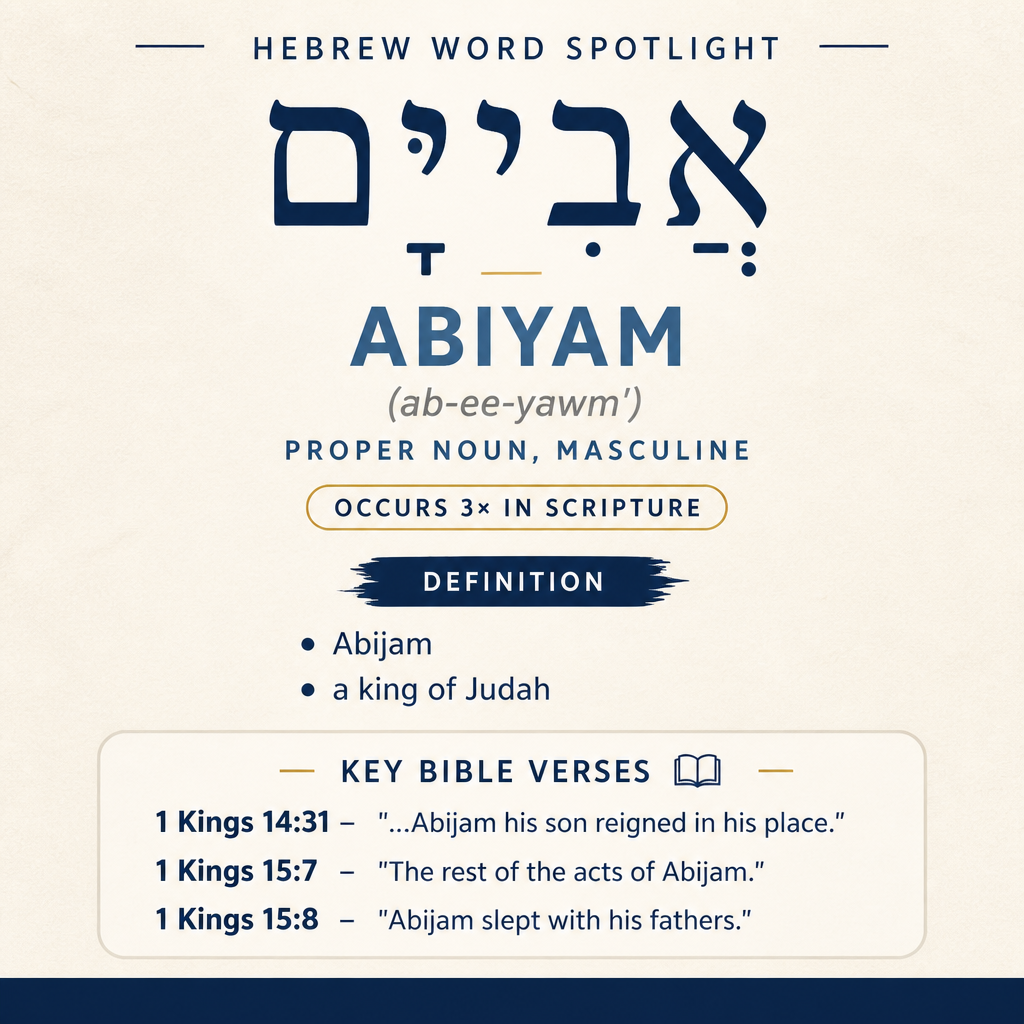
אֲבִיָּם (Abiyam) means “Abijam,” a king of Judah, and appears in 1 Kings 14:31; 15:7; and 15:8.
Scripture Locations
This name occurs three times, all in 1 Kings. The references are 1 Kings 14:31; 15:7; and 15:8.
Learn More →Narrative Notes
In 1 Kings 15:7, Abijam’s acts are mentioned as recorded in the chronicles of Judah’s kings. In 1 Kings 15:8, Abijam dies and Asa his son reigns.
Learn More →אֲבִיָּם (Abiyam) names “Abijam; a king of Judah” in a small cluster of narrative notices in 1 Kings. In these verses the name functions as the identifying label for a royal figure whose reign is framed by succession, burial, and conflict.
Occurrences
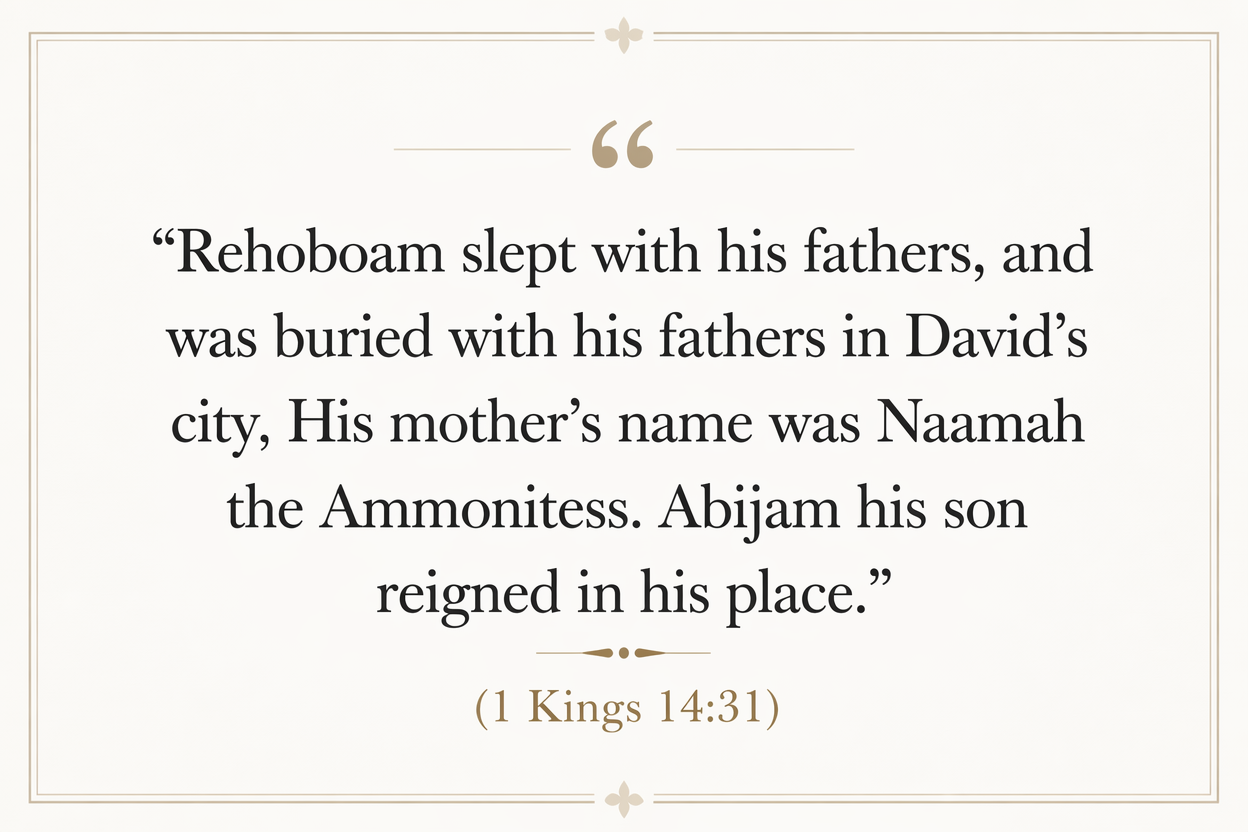
“Rehoboam slept with his fathers, and was buried with his fathers in David’s city. His mother’s name was Naamah the Ammonitess. Abijam his son reigned in his place.” (1 Kings 14:31)
Here Abiyam appears at the hinge of a dynastic transition. The verse presents the close of Rehoboam’s life in the conventional royal formula (“slept with his fathers… buried… in David’s city”), adds a maternal identification (“Naamah the Ammonitess”), and then introduces Abiyam as the next ruler: “Abijam his son reigned in his place.” In this scene the name is not a descriptive title but the decisive marker of continuity: the succession is established by naming the heir and explicitly stating that he “reigned” where his father had reigned. The placement of Abiyam after the mother’s name sets him within a family line and within a specific political location (“David’s city”), anchoring his kingship in an inherited royal setting.
“The rest of the acts of Abijam, and all that he did, aren’t they written in the book of the chronicles of the kings of Judah? There was war between Abijam and Jeroboam.” (1 Kings 15:7)
In this notice Abiyam is the subject of a summary that gestures beyond the immediate narrative: “The rest of the acts of Abijam, and all that he did…” The name functions as the header for a remembered reign whose details are not unfolded here but are treated as a set of “acts” and “all that he did.” The rhetorical question (“aren’t they written…?”) signals that Abiyam’s rule is regarded as having a recordable scope, even if the present account compresses it. The verse then gives one concrete characterization within its own bounds: “There was war between Abijam and Jeroboam.” By naming both parties, the text sets Abiyam in an adversarial royal relationship, casting his reign as one marked—at least in part—by military or political conflict. Abiyam’s identity is therefore presented not only as a successor in Judah but also as a king engaged in contested relations with another named ruler.
“Abijam slept with his fathers, and they buried him in David’s city; and Asa his son reigned in his place.” (1 Kings 15:8)
This verse mirrors the earlier succession formula, now applied to Abiyam himself. The name stands at the center of a second transition: “Abijam slept with his fathers,” followed by burial “in David’s city,” and then the installation of a new king: “Asa his son reigned in his place.” Abiyam is thus portrayed as occupying the middle position between Rehoboam and Asa, a link in a continuing line of rulers. The repetition of “David’s city” ties Abiyam’s end to the same royal locus that marked his father’s burial and his own accession, reinforcing the stability of place and dynasty in the narrative’s way of tracking Judah’s kings. The verse’s movement—from death, to burial, to succession—uses the name Abiyam to make the transition precise: this king’s reign has a clear endpoint and a named heir who takes his place.

Sense and Usage
Across these verses, Abiyam functions strictly as the personal name of “a king of Judah,” and its usage is shaped by the conventions of royal reporting. The name appears at two edges of his reign: first when he begins to rule (“Abijam his son reigned in his place”) and then when he dies and is replaced (“Asa his son reigned in his place”). These two formulas frame Abiyam’s kingship as a defined span within a larger dynastic sequence; the text’s interest is not in elaborating his character in these lines, but in securing the continuity of Judah’s monarchy by naming who followed whom.
Between those bookends, Abiyam’s name also anchors a brief evaluative summary of historical remembrance: “The rest of the acts of Abijam, and all that he did…” Even without recounting those acts, the wording treats Abiyam as a ruler whose reign generated actions and consequences significant enough to be remembered as a body of deeds. The mention of “war between Abijam and Jeroboam” then supplies a specific relational and political setting: Abiyam’s reign is not portrayed as isolated internal administration but as a period involving open hostility with another king. Within the confines of these quotations, Abiyam’s semantic contribution is therefore twofold: (1) he is the named royal successor in Judah, and (2) he is the named participant in a conflict that situates Judah in opposition to another ruler.
The narrative handling of Abiyam also shows how a proper name can carry institutional weight. Because he is identified by his kinship ties (“his son”) and by his place in the line of rule (“reigned in his place”), the name becomes a shorthand for legitimacy and succession. The associated details—maternal identification in one verse, burial location in two—do not redefine the name’s meaning, but they thicken the portrait of the king in a typically annalistic way: reigns are connected to family, to place, and to public events such as war. Abiyam, as used here, is the fixed point by which those connections are traced.
Royal Frame
The passages that name Abiyam are marked by recurring imagery of royal continuity: sleeping with one’s fathers, burial in “David’s city,” and a son reigning “in his place.” Abiyam is set within that cycle twice—once as the one who receives the throne, and once as the one who hands it on through death and succession—so the name carries the feel of a brief but formally recorded reign within Judah’s dynastic story.
Sources: Lexical data from Strong’s Exhaustive Concordance and the Open Scriptures Hebrew Lexicon. Occurrence data from the Westminster Leningrad Codex with STEPBible reference data (CC BY). Scripture quotations from the World English Bible (public domain).