
Exploring What ‘Abel Mitsrayim Mean in Hebrew
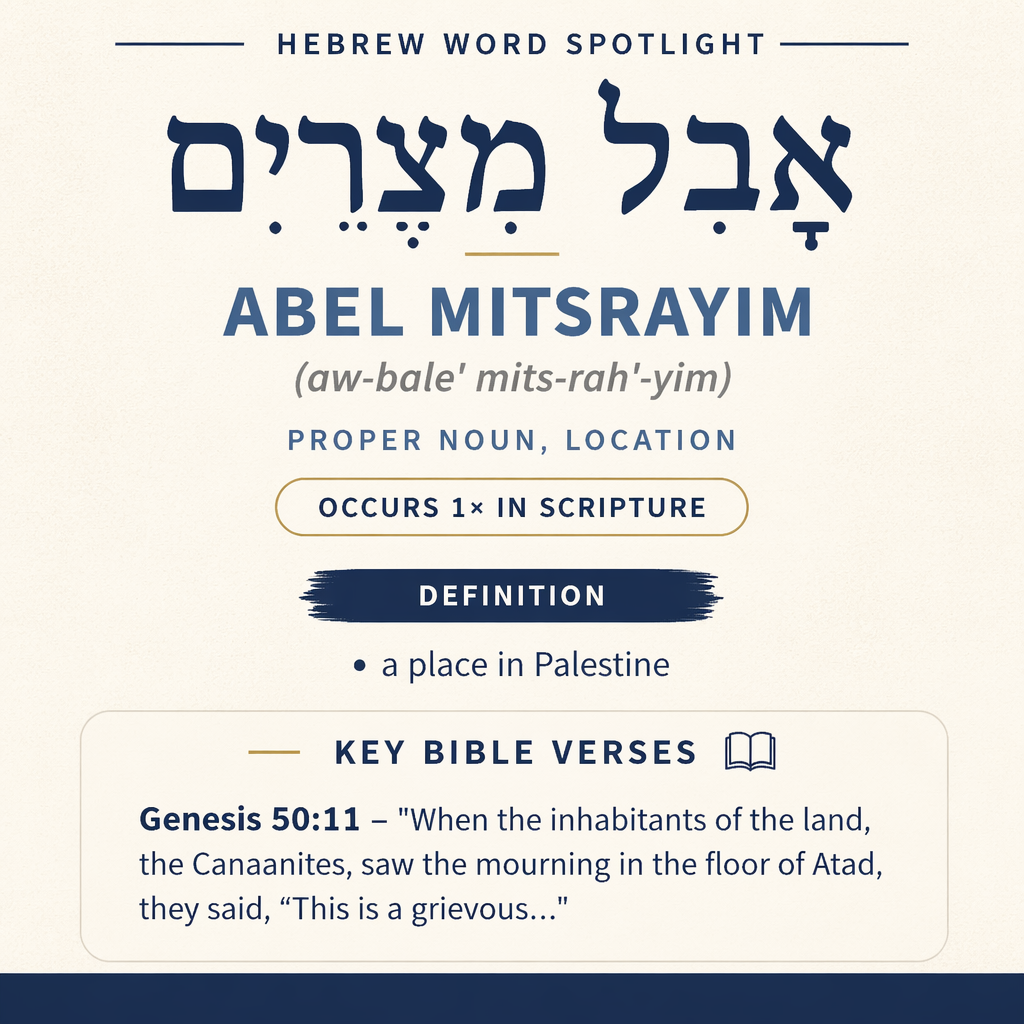
אָבֵל מִצְרַיִם (Abel Mitsrayim) means “a place in Palestine” and appears once in Scripture in Genesis 50:11.
Context Snapshot
In Genesis 50:11, Canaanites observe mourning at the floor of Atad and call it “a grievous” mourning.
Learn More →אָבֵל מִצְרַיִם (Abel Mitsrayim) names a place in Palestine. Scripture uses this place-name in a single narrative moment that explains how it received its name.
Occurrences
“When the inhabitants of the land, the Canaanites, saw the mourning in the floor of Atad, they said, “This is a grievous mourning by the Egyptians.” Therefore its name was called Abel Mizraim, which is beyond the Jordan.” (Genesis 50:11)
In Genesis 50:11, אָבֵל מִצְרַיִם functions as an explanatory place-name: the scene describes local observers (“the inhabitants of the land, the Canaanites”) seeing a public act of mourning at a specific site (“the floor of Atad”). Their spoken reaction—“This is a grievous mourning by the Egyptians.”—supplies the immediate reason for naming. The verse then moves from observation to toponymy: “Therefore its name was called Abel Mizraim,” presenting the name as a consequence of what was witnessed and said.
The phrasing ties the name to the social perception of the event. The Canaanites identify the mourners not merely as a group present, but as “the Egyptians,” and their assessment is emphatic (“grievous mourning”). By placing the naming formula after that assessment, the text presents Abel Mitsrayim as a label that crystallizes what made that moment noteworthy to the local population: the intensity of mourning, and the association of that mourning with Egypt. In the narrative logic of the verse, the name preserves the memory of an event at a particular locality rather than merely marking a point on a map.
The final clause locates the named place geographically in relation to a well-known boundary: “which is beyond the Jordan.” This locational tag does not create a second site; it anchors the named place within the reader’s mental geography. In this verse, then, Abel Mitsrayim is both (1) the name bestowed on a place because of an observed communal action and (2) a geographical reference point, set “beyond the Jordan,” that helps identify which place is meant.

Sense and Usage
As a proper name for “a place in Palestine,” אָבֵל מִצְרַיִם is used in a way characteristic of place-names that arise from remembered happenings: it is introduced alongside a cause (“Therefore”) and is linked to what people saw and said at that location. The verse depicts naming as an interpretive act by onlookers: the inhabitants’ description of the mourning provides the rationale for the designation that follows. The name thus operates as a narrative hinge, turning a passing report of mourning into a lasting geographical identifier.

The verse also shows how a place-name can bear a relational quality: it is not presented as an isolated label but as one that is understood in relation to groups and regions. The immediate context includes at least three such relations. First, there is relation to the local population (“the Canaanites”), who act as witnesses and namers. Second, there is relation to the identity assigned to the mourners (“the Egyptians”), which becomes part of the significance that drives the naming. Third, there is relation to wider geography (“beyond the Jordan”), which clarifies where this named place sits in the landscape known to the audience.
Within the verse, Abel Mitsrayim is not merely a coordinate; it is a named place defined by a remembered public scene at “the floor of Atad.” The text does not treat “the floor of Atad” and Abel Mitsrayim as competing names in parallel; rather, it presents “the floor of Atad” as the place where the mourning is seen, and then states that “its name was called Abel Mizraim.” In other words, the narrative reports a renaming or naming-after-the-fact that fixes the event to the location through a new designation.
Because the verse explicitly grounds the name in a visible communal act (“saw the mourning”) and a spoken evaluation (“This is a grievous mourning”), the usage suggests that the place-name functions as a reminder of that experience. The definition “a place in Palestine” is therefore expressed here in a concrete and story-bound manner: the place is recognizable not only by its position “beyond the Jordan,” but also by the episode that gave rise to its name. The act of naming becomes part of the way the place is known.
Imagery
The single scene attached to אָבֵל מִצְרַיִם is visually and emotionally charged: mourning observed in a specific open area (“the floor of Atad”) and recognized as unusually intense (“a grievous mourning”). The name, introduced as the outcome of that recognition, carries the weight of public lament into the landscape, so that the place itself is remembered through the imagery of gathered grief and the testimony of those who saw it.
Sources: Lexical data from Strong’s Exhaustive Concordance and the Open Scriptures Hebrew Lexicon. Occurrence data from the Westminster Leningrad Codex with STEPBible reference data (CC BY). Scripture quotations from the World English Bible (public domain).





