
Discovering the Meaning of ‘Abeh in Hebrew
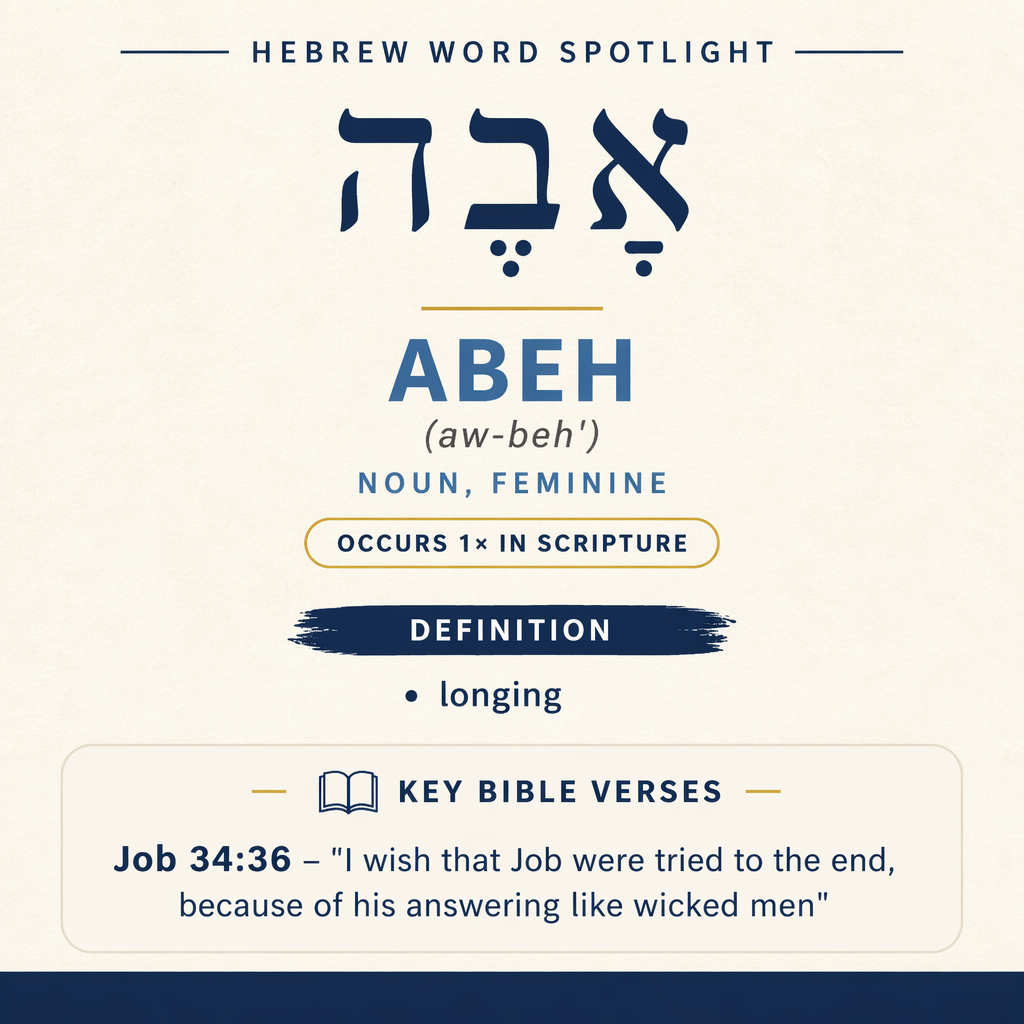
אָבֶה means “longing” and appears once in Scripture, in Job 34:36.
Biblical Occurrence
This word occurs 1 time in Scripture. Its sole reference is Job 34:36.
Learn More →Verse Context
In Job 34:36, it appears in a statement expressing a wish that Job were tried to the end.
Learn More →אָבֶה (abeh) denotes “longing” and is attested in Job 34:36. In that setting it colors a speaker’s expressed wish concerning Job’s testing and the moral assessment of Job’s replies.
Occurrences
“I wish that Job were tried to the end, because of his answering like wicked men.” (Job 34:36)
In Job 34:36 the word is embedded in a sentence of desire: “I wish that Job were tried to the end.” The statement is not neutral observation but a voiced yearning for an outcome—an internal pull toward a particular course of events. The longing is directed toward an extended, thorough trial (“to the end”), which makes the desire more than a momentary preference; it is a settled wish aimed at a process carried through fully.
The reason attached to the wish (“because of his answering like wicked men”) places the longing within a moral argument. The speaker’s desire for Job’s testing is framed as a response to Job’s manner of answering, which the speaker compares to the answers of “wicked men.” Within this line, longing functions as the emotional-volitional force behind a proposal for further examination. It signals an appetite for vindication of the speaker’s evaluation, an insistence that the matter be pressed forward until it reaches a decisive endpoint.

Sense and Usage
The sense of “longing” here is expressed as a wish that something be done: Job “were tried.” Longing, in this usage, is not portrayed as vague yearning but as a directed desire that seeks realization in a specific action and duration. The clause “to the end” shapes the longing toward completeness; the desire aims at a full measure of testing rather than a partial or abbreviated inquiry. The word therefore lends weight and intensity to the speaker’s stance, conveying that the matter is, in the speaker’s mind, unresolved and requires continuation until a final limit is reached.
Because the longing is tied to speech—“because of his answering like wicked men”—it also illuminates the social and rhetorical setting of the verse. The desire is not merely for Job’s inner state to be evaluated; it is provoked by Job’s outward responses. In that way, longing operates as a reaction to contested words, suggesting the speaker’s internal drive to see those contested words met with a corresponding external process of trial. The verse’s structure links desire (wish), proposed outcome (trial to completion), and justification (answers resembling those of the wicked), so that longing is presented as an impulse that seeks moral resolution through an intensified testing.
This usage also shows longing as something that can be framed in rational terms. The wish is supported with “because,” giving it an argumentative posture rather than treating it as sheer emotion. The longing is thus pictured as desire with reasons attached, and its object is not a personal benefit explicitly named in the line but a demanded procedure—Job’s continued trial—intended to address the perceived character of Job’s answering. Even within a single attestation, the word’s placement suggests that longing can be voiced publicly and used to press a case: it is desire brought into speech to propel a judgment about what should happen next.
Imagery
The imagery that rises from Job 34:36 is that of a disputed case being driven onward to completion. The longing expressed in “I wish” is like a hand pushing the matter forward, insisting that the trial not stop short but run “to the end.” Within the verse’s own terms, the word evokes the tension of contested answers and the desire to see the controversy carried through until it yields a decisive finish.
Sources: Lexical data from Strong’s Exhaustive Concordance and the Open Scriptures Hebrew Lexicon. Occurrence data from the Westminster Leningrad Codex with STEPBible reference data (CC BY). Scripture quotations from the World English Bible (public domain).




