Exploring the Meaning of ‘Abanah in Hebrew
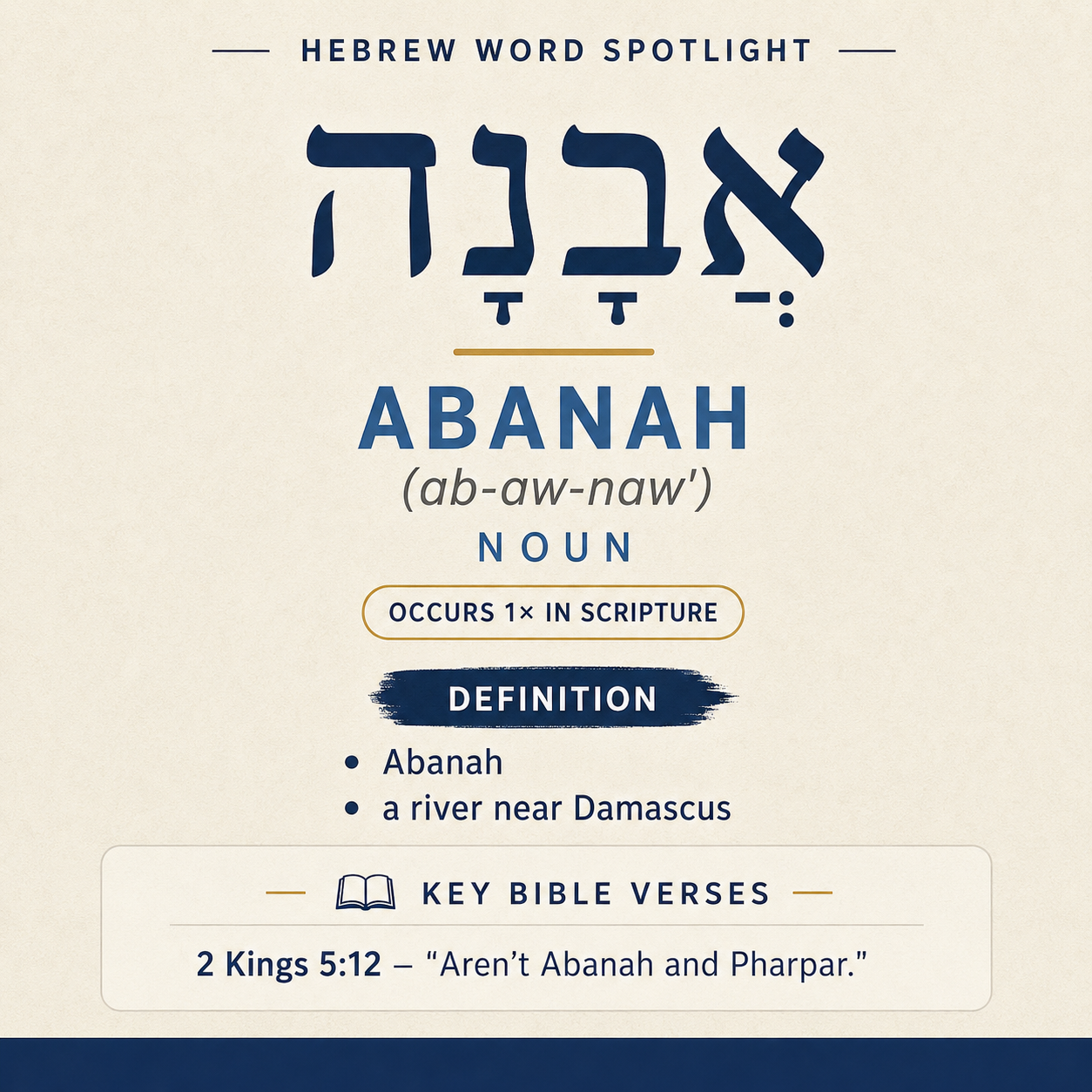
אֲבָנָה (Abanah) is a river near Damascus, appearing in 2 Kings 5:12.
Verse Context
In 2 Kings 5:12, Abanah is mentioned with Pharpar as “the rivers of Damascus.”
Learn More →אֲבָנָה (Abanah) denotes “Abanah; a river near Damascus.” It appears in a single narrative line where it is named alongside another river as part of a complaint about where cleansing should take place.
Occurrences
“Aren’t Abanah and Pharpar, the rivers of Damascus, better than all the waters of Israel? Couldn’t I wash in them, and be clean?” So he turned and went away in a rage.” (2 Kings 5:12)
In this verse Abanah functions as a concrete place-name, one of “the rivers of Damascus,” and is brought forward as evidence in a comparison. The speaker sets Abanah and Pharpar over against “all the waters of Israel,” not merely naming geography but invoking the perceived quality and sufficiency of Damascus’s rivers. The rhetorical question assumes that a river’s identity and reputation—signaled by its proper name—carry persuasive weight: if Abanah is “better,” then washing there should logically achieve the same goal, namely to “be clean.”

Abanah is therefore embedded in the language of evaluation (“better than”), choice (“Couldn’t I wash in them”), and outcome (“and be clean”). The name anchors the argument in a real, local alternative, making the objection practical rather than theoretical: the speaker can point to specific rivers he regards as superior and readily accessible. The closing narrative note, “So he turned and went away in a rage,” shows that naming Abanah is not incidental; it is tied to a refusal that escalates into anger, because the mention of Abanah supports a confident expectation that cleansing should be achievable on the speaker’s own terms and in his own setting.

Sense and Usage
The sense “a river near Damascus” is expressed in 2 Kings 5:12 through coordination with another named river and through an explanatory apposition: “Abanah and Pharpar, the rivers of Damascus.” This framing treats Abanah as one item within a known set of local waters identified with Damascus. The verse does not present Abanah as an abstract symbol; it is invoked as a tangible body of water associated with washing, and its “river” character is essential to the argument because washing requires water that is plentiful and accessible.
The verse also shows how a named river can carry evaluative force in speech. Abanah is introduced not neutrally but as part of a superiority claim. The question “Aren’t Abanah and Pharpar … better than all the waters of Israel?” makes the river’s name function as shorthand for the speaker’s assessment of its worth. Abanah, in this usage, stands for a whole complex of assumptions: that Damascus’s rivers are fit for cleansing, that they may be cleaner or more desirable than Israel’s waters, and that local resources ought to suffice. The name does not need further description beyond its association with Damascus; the speaker expects the audience to accept that these rivers have a recognized standing.
At the same time, the logic of the verse ties Abanah specifically to the goal of cleansing: “Couldn’t I wash in them, and be clean?” The river is envisioned as a plausible means to an end—washing that results in cleanliness. The wording places emphasis on location and selection: “in them” refers back to the named rivers, so Abanah becomes part of a proposed alternative site for washing. The sense is thus practical and situational: Abanah is a place where one can wash, and the speaker believes washing there should count.
Because Abanah is used in a comparative rhetorical question, it is not merely a geographical label but a term that participates in a dispute about what kind of water, and whose water, is acceptable for cleansing. The mention of “all the waters of Israel” broadens the comparison beyond a single stream. In contrast, Abanah remains particular and sharply defined: it is one named river near Damascus, singled out as exemplary. That specificity heightens the contrast—one familiar river near Damascus is held up against the entire range of Israel’s waters, and the speaker’s confidence in Abanah’s superiority fuels his indignation when his preferred option is not affirmed.
Finally, the narrative consequence (“he turned and went away in a rage”) shows that Abanah is invoked with emotional investment. The name is part of a protest that reveals pride and resistance: the speaker does not merely suggest Abanah; he insists on its adequacy and reacts strongly when that adequacy is implicitly denied. Abanah, as “a river near Damascus,” becomes a touchpoint in the clash between familiar local resources and the demand to seek cleansing elsewhere.
Imagery
Within 2 Kings 5:12, Abanah carries the imagery of running water offered as a place to wash. The verse pictures a person weighing two settings—“the rivers of Damascus” and “all the waters of Israel”—and choosing, in anger, to turn away rather than submit to cleansing on unfamiliar terms. Abanah’s imagery is therefore bound to the ordinary act of washing in a river and to the intensity of a comparison that treats one river near Damascus as the obvious, preferred source of cleansing.
Sources: Lexical data from Strong’s Exhaustive Concordance and the Open Scriptures Hebrew Lexicon. Occurrence data from the Westminster Leningrad Codex with STEPBible reference data (CC BY). Scripture quotations from the World English Bible (public domain).