Exploring the Meaning of Cheirographon in Greek
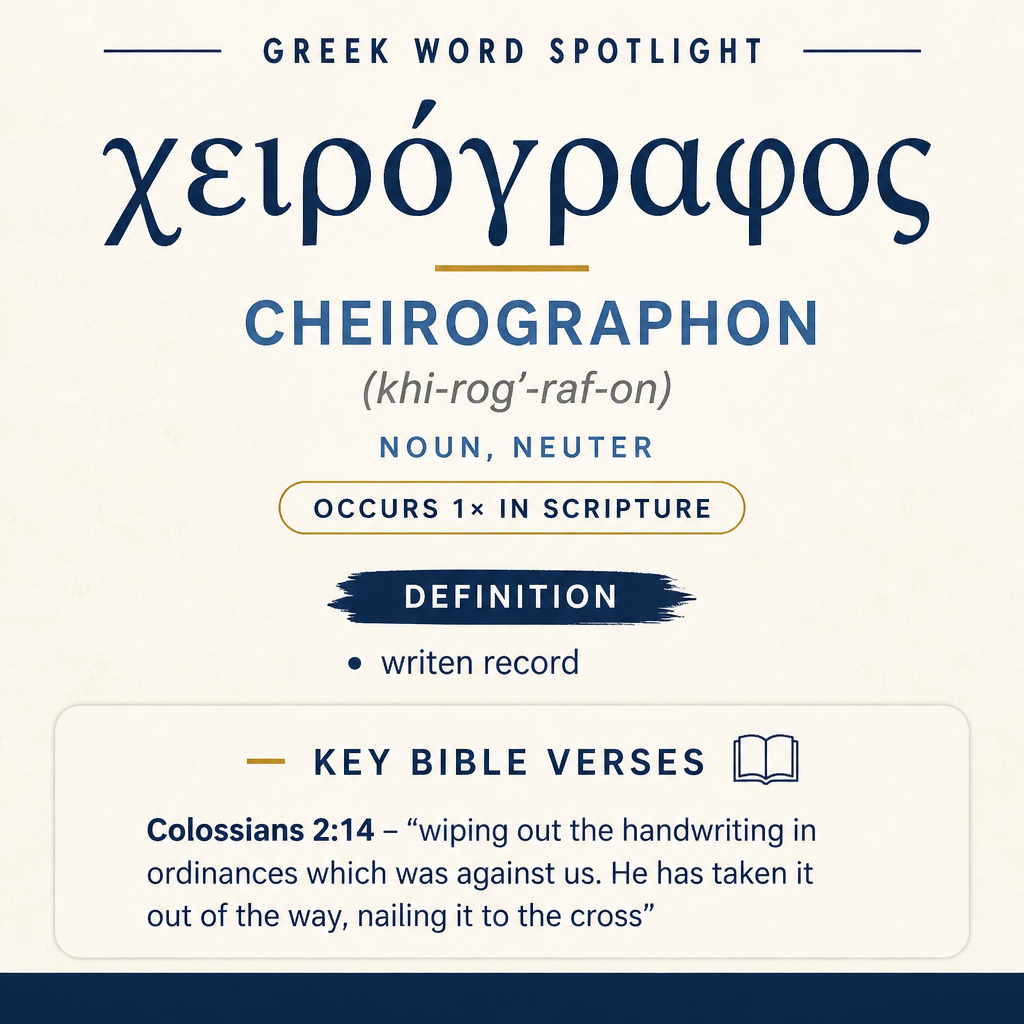
χειρόγραφος means “written record” and appears once in Scripture, in Colossians 2:14.
Verse Context
Colossians 2:14 speaks of “wiping out the handwriting in ordinances which was against us.” It says He took it out of the way, nailing it to the cross.
Learn More →χειρόγραφος refers to a written record, and it appears in the New Testament in Paul’s wording in Colossians 2:14. In that verse it is pictured as something that can be erased, removed, and treated as an object handled decisively.
Root and Related Words
χειρόγραφος is connected with the verb grapho (γράφω), “to write” (Strong’s G1125), and with cheir (χείρ), “hand” (Strong’s G5495). These related words anchor the term in the realm of writing and the hand, placing it within the world of tangible documents produced and handled in ordinary human life.

Occurrences
“wiping out the handwriting in ordinances which was against us. He has taken it out of the way, nailing it to the cross.” (Colossians 2:14)
In Colossians 2:14, χειρόγραφος stands as a concrete “written record” that is described with vivid, physical verbs. First, it is something that can be “wip[ed] out,” language that portrays the record as a surface bearing writing that can be erased. The clause “which was against us” frames the record as oppositional in effect; it stands over against “us” in a way that calls for its removal. The phrase “in ordinances” further situates the record in relation to ordinances: the record has a definable content and context, not a vague accusation but a written item tied to stated ordinances.
The verse then intensifies the imagery of removal: “He has taken it out of the way.” This continues to treat χειρόγραφος as an object that occupies space or stands in a path and can be actively cleared away. Finally, the climactic image “nailing it to the cross” presents the written record as something that can be fixed to wood with nails. Within the verse’s own pictures, the written record moves from being erased (“wiping out”), to being removed from its obstructing position (“taken it out of the way”), to being publicly dealt with through cruciform imagery (“nailing it to the cross”). The word therefore contributes not only the idea of writing but also the idea of an item that can be handled, acted upon, and decisively disposed of.
Sense and Usage
As a term for a written record, χειρόγραφος in Colossians 2:14 functions as a bridge between the abstract realm of ordinances and the tangible realm of a document. Ordinances can be spoken of as rules or requirements, but the verse chooses to picture their “handwriting” as something written down—an item that exists as a record. This gives the reader an image of something definite and traceable: not merely a general sense of obligation, but a written form that can be identified as a record and then dealt with as a record.
The verse’s sequence of actions clarifies how this “written record” is being imagined. “Wiping out” implies that the record’s written marks are cancelled or erased; the focus is not on altering a person’s memory but on removing writing from a written surface. “Taking it out of the way” then portrays the record as an obstacle, as though it stands between “us” and the freedom or access implied by its removal. The final action, “nailing it to the cross,” frames the record’s removal in a decisive, visible act. Within this single verse, the written record is not treated as a mere metaphor floating free from material reference; it is a thing with a location (“out of the way”) and with a fate (it can be wiped out and nailed).
Because the record is described as “against us,” the word also carries a relational force in context: the written record is not neutral paperwork but a record with an adverse posture toward its subjects. Yet the verse makes the controlling point that the written record’s status is changed by what is done to it. The actions performed on it—erasure, removal, and nailing—are portrayed as effective and final within the verse’s imagery. Thus, within Colossians 2:14, χειρόγραφος is a written record whose defining feature is not merely that it exists, but that it can be nullified and taken away through concrete, decisive action.
Imagery
The imagery of Colossians 2:14 treats χειρόγραφος as a physical document: something written, something that stands in the way, and something that can be fastened to a cross. The verse’s verbs depict a progression from cancellation (“wiping out”) to removal (“taken it out of the way”) to a final public handling (“nailing it to the cross”), so that the “written record” is portrayed as fully dealt with rather than merely ignored.
Sources: Lexical data from Strong’s Exhaustive Concordance and the Translators Brief Lexicon of Extended Strongs for Greek (STEPBible, CC BY). Occurrence data from the Translators Amalgamated Greek New Testament (STEPBible, CC BY). Scripture quotations from the World English Bible (public domain).