Exploring the Meaning of Cheimarrhos in Greek
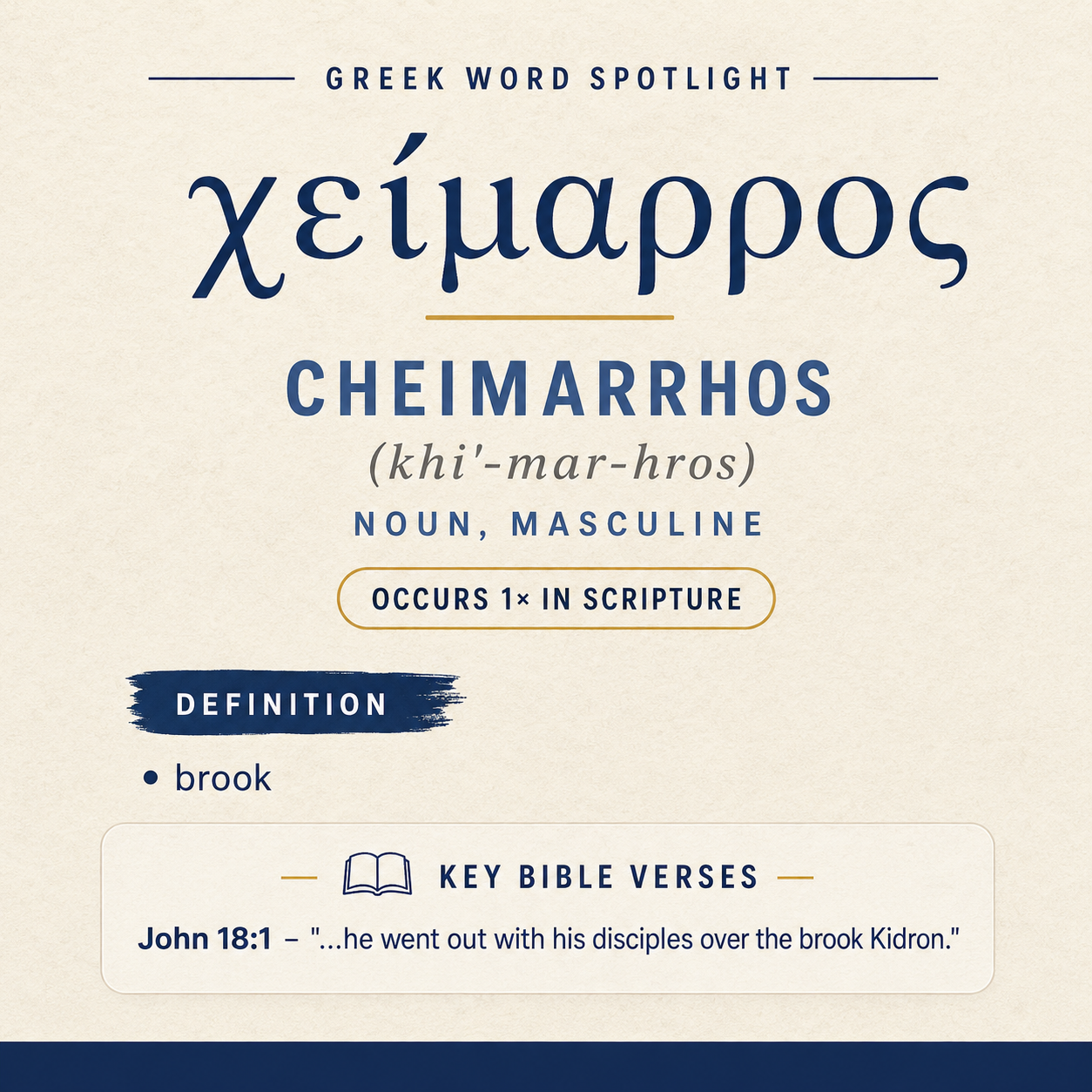
χείμαρρος means “brook” and appears once in Scripture in John 18:1 (“the brook Kidron”).
Context in John
In John 18:1, Jesus went out with his disciples over the brook Kidron, where there was a garden.
Learn More →χείμαρρος means “brook,” and it appears in the narrative setting of Jesus and His disciples crossing the brook Kidron on the night of His arrest (John 18:1). In that scene it functions as a concrete geographic feature that must be crossed in order to enter a garden.
Root and Related Words
χείμαρρος is associated with the verb rheo (ῥέω), “to flow” (Strong’s G4482), and with the noun cheimon (χειμών), “winter” (Strong’s G5494). These related words link the noun to ideas of flowing and winter in its lexical background.

Occurrences
When Jesus had spoken these words, he went out with his disciples over the brook Kidron, where there was a garden, into which he and his disciples entered. (John 18:1)
In John’s account, the brook is part of a sequence of movements: Jesus finishes speaking, “went out,” passed “over the brook Kidron,” and then entered a garden with His disciples. χείμαρρος here marks a natural boundary or low-lying channel that lies between where Jesus has been speaking and the place where He will be found and confronted. The narrative depends on the brook as a real feature of the terrain: it is something that can be crossed (“over”), and the crossing sets up the transition from public discourse to a more secluded location (“where there was a garden”).
The phrase “over the brook Kidron” gives the brook a directional function. John does not merely locate the garden; he traces the path that leads to it. χείμαρρος therefore contributes more than topographical color: it structures the scene by placing a small but definite obstacle between Jesus and the garden. The resulting picture is of purposeful movement into a place that can be entered, and the brook is one of the last named features before that entry.
Within the verse, the brook stands alongside two other spatial markers: “went out” and “where there was a garden.” The brook thus belongs to the chain of outsides and insides: leaving one place, crossing a natural feature, and entering another. By naming the brook as Kidron, the text situates the action in a specific, recognizable locale; by calling it a χείμαρρος, it classifies Kidron as a brook rather than as a larger body of water. That classification helps the reader envision the crossing as something plausible for a small group traveling on foot—an identifiable watercourse rather than an expansive sea or lake that would require a different kind of passage.
Sense and Usage
The sense “brook” in John 18:1 functions as a straightforward term for a watercourse encountered during travel. It appears with a proper name (“Kidron”) and with a preposition of movement (“over”), emphasizing that a brook can be a feature that shapes routes and divides spaces. In this usage, the brook is not described for its depth, speed, or condition; the focus remains on its role as a geographic threshold that must be crossed before arriving at a destination.
Because χείμαρρος is paired with “Kidron,” its sense is anchored to a known streambed rather than to an abstract category. The verse treats the brook as part of the ordinary landscape—something one passes over on the way to a garden—yet it also makes the brook a hinge in the narrative progression. The movement “over the brook” is the step that brings Jesus and His disciples to the place “into which” they enter. The word therefore carries the practical force of a landmark: it defines where the party is in relation to the garden and narrates how they get there.
The related words rheo (ῥέω), “to flow,” and cheimon (χειμών), “winter,” point to lexical associations that fit the idea of a brook as a channel connected with flowing water and, in its broader word-family, with winter. In John 18:1, however, the narrative usage remains concrete and restrained: the brook is simply crossed, and the story advances.
Imagery
John’s brief mention of χείμαρρος adds a quiet visual element to the transition into the garden: a watercourse lies in the path, and Jesus leads His disciples across it. The brook is not the center of attention, yet it frames the moment by placing a natural feature between Jesus’ spoken words and the next location where events will unfold.
Sources: Lexical data from Strong’s Exhaustive Concordance and the Translators Brief Lexicon of Extended Strongs for Greek (STEPBible, CC BY). Occurrence data from the Translators Amalgamated Greek New Testament (STEPBible, CC BY). Scripture quotations from the World English Bible (public domain).