
Exploring the Meaning of Cheiragogeo in Greek
χειραγωγέω means “to guide” and appears twice in Scripture, in Acts 9:8 and Acts 22:11.
Narrative Usage
In both verses, Saul is led by the hand because he cannot see, and is brought into Damascus.
Learn More →χειραγωγέω means “to guide” and appears in Acts in the two accounts of Saul’s entry into Damascus after the blinding encounter with light. In both scenes the action is concrete and physical: Saul is moved from one place to another under another person’s direction.

Root and Related Words
χειραγωγέω is connected with cheiragogos (χειραγωγός), “guide” (Strong’s G5497).
Occurrences
“Saul arose from the ground, and when his eyes were opened, he saw no one. They led him by the hand, and brought him into Damascus.” (Acts 9:8)
Here χειραγωγέω is embedded in a tightly sequenced report: Saul rises, opens his eyes, and yet “he saw no one.” The guiding happens precisely because sight is absent. The verb depicts more than simple accompaniment; it describes directed movement where another party supplies what Saul cannot supply for himself in that moment—orientation and safe passage. The phrase “by the hand” anchors the guidance in touch, and “brought him into Damascus” gives it a clear endpoint. In this scene, the guiding is not a general leading from behind or at a distance; it is guidance exercised at close range, bodily, and with an immediate practical purpose: to transition Saul from helpless standing to arriving in a city he cannot visually navigate.

The surrounding wording also clarifies the social shape of the action. The subject is plural—“They led him”—so the guidance is carried out by companions rather than by Saul alone. Saul is the one acted upon. The verb, as used here, therefore depicts guidance as a service rendered to someone incapacitated: it is guidance that assumes dependence and provides stability through direct contact. The narrative’s brevity gives the action a matter-of-fact feel, but the details (“his eyes were opened,” “he saw no one”) frame the guidance as necessary rather than optional.
“When I couldn’t see for the glory of that light, being led by the hand of those who were with me, I came into Damascus.” (Acts 22:11)
This occurrence retells the same journey, but from Saul’s own perspective (“I couldn’t see”). The inability to see is explicitly tied to “the glory of that light,” and the guiding is presented as the means by which the journey becomes possible: “being led by the hand… I came into Damascus.” The verb again portrays guidance as hands-on direction, a form of movement that does not rely on the guided person’s vision. As in Acts 9:8, the hand is the point of contact, but here the wording foregrounds the condition that makes such guidance essential: Saul’s sight has been overwhelmed, and guidance by others becomes the bridge between the encounter with light and arrival in the city.
The agents of the guidance are identified as “those who were with me,” emphasizing that guidance is mediated through accompanying witnesses rather than through an impersonal force. The construction “being led by the hand” places Saul in a passive, receptive posture: he is not choosing a route and asking others to follow; he is being conducted. The result clause “I came into Damascus” shows that the guiding is effective and purposeful, bringing him to a definite location. The scene thus portrays guidance as an act that supplies direction, safety, and progress when normal capacities—especially sight—are not functioning.
Sense and Usage
Across these two passages, “to guide” is expressed as guidance that is tactile (“by the hand”), interpersonal (performed by companions), and goal-directed (ending with entry into Damascus). The contexts tighten the sense of the verb by pairing it with blindness: Saul’s eyes are open but he “saw no one” (Acts 9:8), and he “couldn’t see for the glory of that light” (Acts 22:11). In both cases, guidance is the practical answer to disorientation. The verb does not stand for abstract instruction or verbal direction in these scenes; it denotes guidance enacted through physical leading, where the guide supplies immediate direction and steadiness.
The repeated mention of “the hand” also shapes how the guidance is experienced. Guidance here involves closeness and trust: the guided person permits another to direct his movement at the point of bodily control that most naturally steers walking. Because the guiding is done by “those who were with me” (Acts 22:11) and “They” (Acts 9:8), it is communal in execution, yet focused on one vulnerable person. The verb therefore carries the everyday imagery of escorting someone who cannot see—turning, stepping, and arriving—without depicting the route itself. What is emphasized is the transition from inability (“he saw no one,” “I couldn’t see”) to arrival (“brought him into Damascus,” “I came into Damascus”) through guided movement.
These two uses also show that the verb can frame the same event in two complementary ways. Acts 9:8 narrates externally: others act upon Saul, and the narrative reports their action. Acts 22:11 narrates internally: Saul recounts his own inability and describes himself as “being led.” In both, the verb retains the same concrete force, but the retelling underscores how guidance can be described either from the perspective of the guides (“They led him”) or from the perspective of the one guided (“being led”). The effect is to spotlight guidance as an action that is simultaneously something one does and something one undergoes.
Imagery in Context
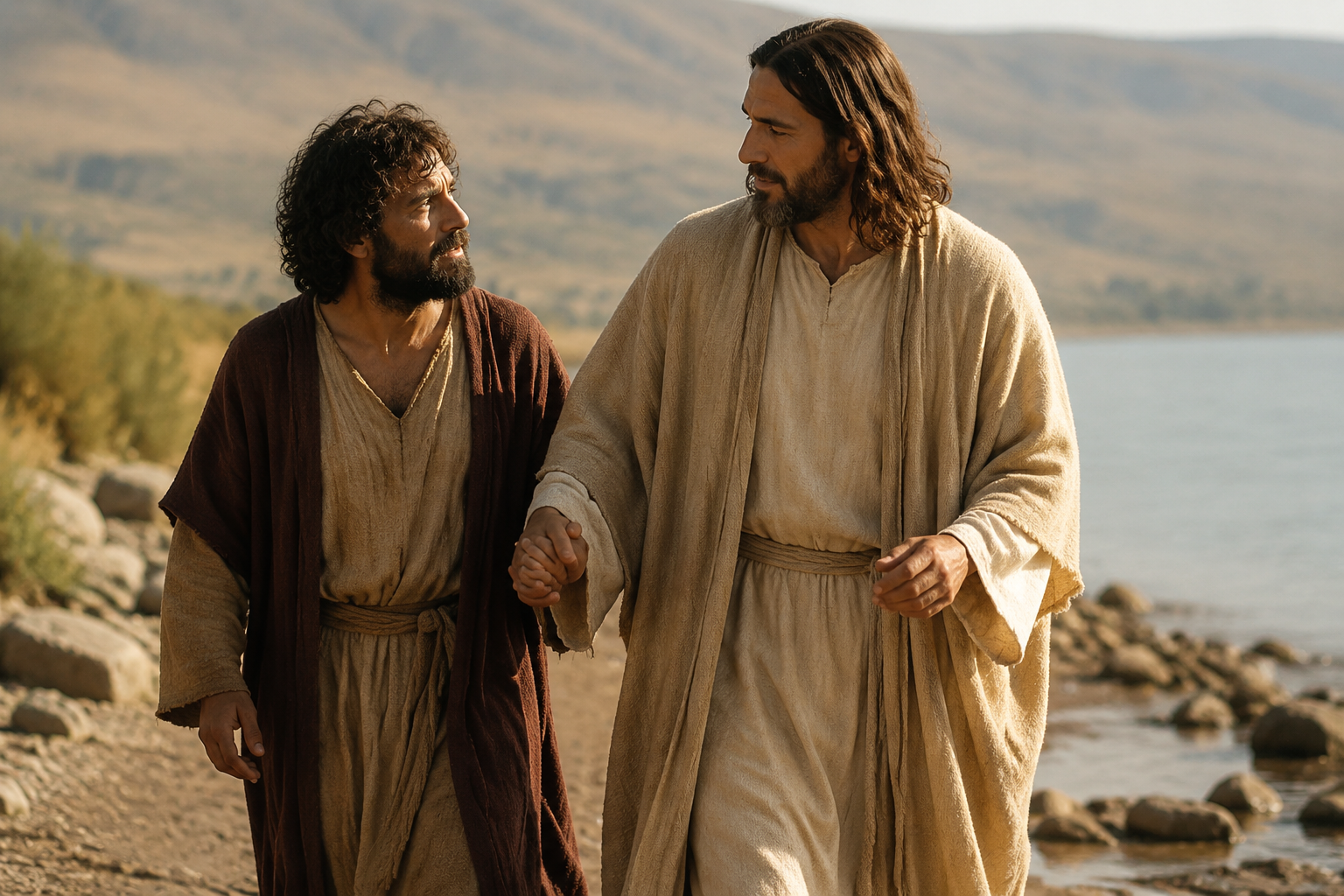
The imagery attached to χειραγωγέω in these passages is the simple but vivid picture of a blind man escorted by companions into a city. The scenes are framed by light so intense it leaves Saul unable to see, and by hands steadying him until he reaches Damascus (Acts 9:8; Acts 22:11). Guidance, as depicted here, is not an abstract idea but a bodily act that carries someone from the ground and the road into an inhabited place, step by step, under another’s direction.
Sources: Lexical data from Strong’s Exhaustive Concordance and the Translators Brief Lexicon of Extended Strongs for Greek (STEPBible, CC BY). Occurrence data from the Translators Amalgamated Greek New Testament (STEPBible, CC BY). Scripture quotations from the World English Bible (public domain).





