
Exploring the Meaning of Troas in Greek
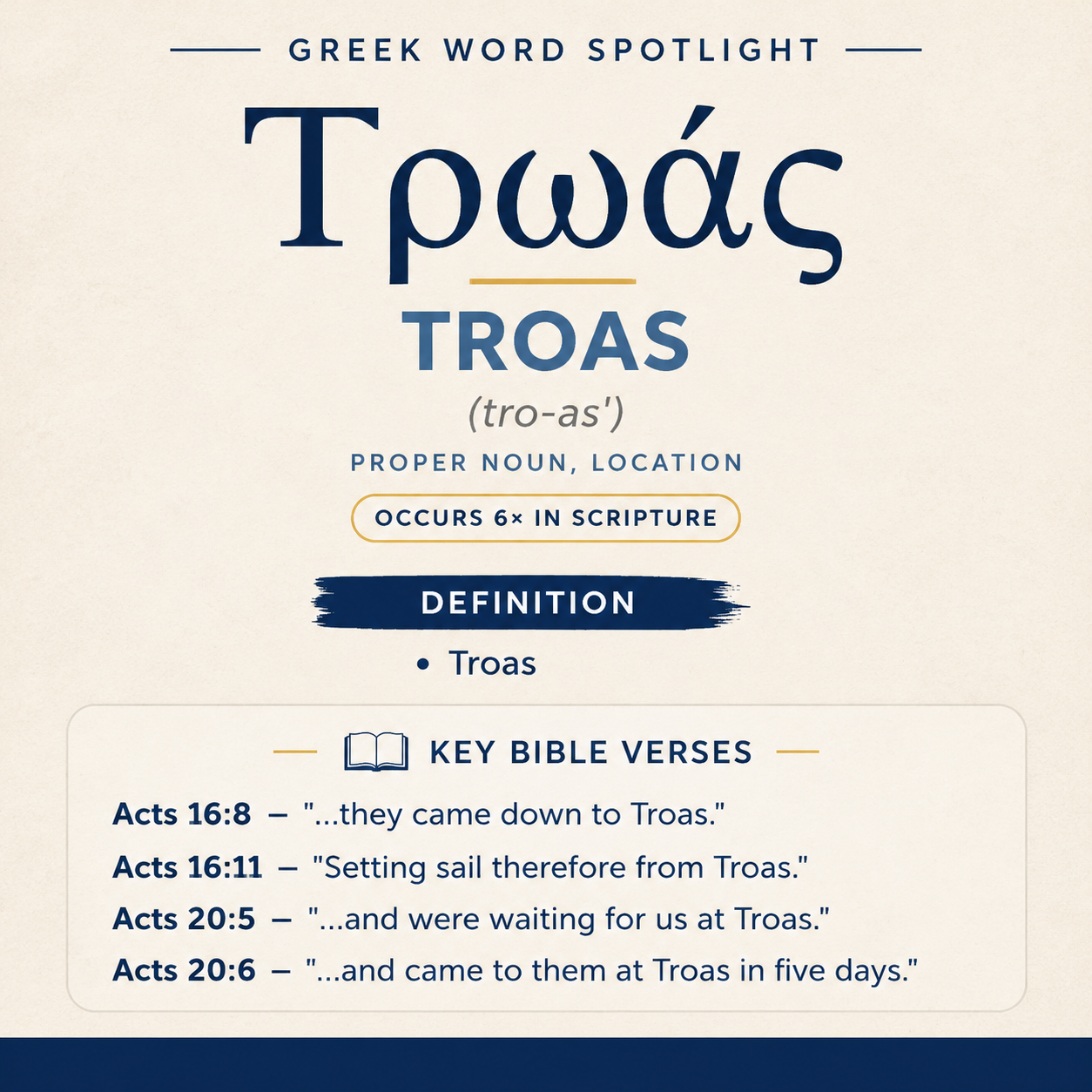
Τρωάς (Troas) means “Troas” and appears six times in Scripture: Acts 16:8, 16:11; Acts 20:5–6; 2 Corinthians 2:12; 2 Timothy 4:13.
Meaning
Τρωάς is the Greek name “Troas.” It is used as a geographic location in the New Testament passages listed.
Learn More →Acts References
In Acts, travelers come down to Troas (Acts 16:8) and later sail from Troas (Acts 16:11). Others wait there and the group arrives and stays in Troas (Acts 20:5–6).
Learn More →Paul’s Mentions
Paul came to Troas for the Good News of Christ, where a door was opened in the Lord (2 Corinthians 2:12). He also left a cloak at Troas with Carpus, along with books and parchments (2 Timothy 4:13).
Learn More →Troas is the name of a place that appears in Acts and in two Pauline letters as a concrete point on the map: a destination reached, a departure point used, and a location remembered. In these passages it functions as a stable geographic reference that helps track travel, waiting, ministry opportunity, and personal belongings.
Occurrences
“Passing by Mysia, they came down to Troas.” (Acts 16:8)
Here Troas marks the end-point of a particular leg of travel. The sentence is built around movement (“Passing by… they came down”), and Troas supplies the named location where that movement lands. It is presented as a place reached after bypassing one region (“Mysia”), giving the narrative a clear directional shape: they go past one area and descend to Troas as the next definite stop.
“Setting sail therefore from Troas, we made a straight course to Samothrace, and the day following to Neapolis;” (Acts 16:11)
Troas functions as the embarkation point for sea travel. The verse’s travel log style emphasizes sequence and route (“therefore… made a straight course… the day following”), and Troas anchors the itinerary as the place from which the voyage begins. In this scene Troas is not merely a dot on the map but the practical threshold between overland movement and a planned crossing to named destinations beyond it.
“But these had gone ahead, and were waiting for us at Troas.” (Acts 20:5)
Troas serves as a rendezvous location. The contrast between those who “had gone ahead” and “us” who follow makes Troas the agreed meeting-place that holds the group’s movements together. The word contributes the sense of coordinated travel: some arrive earlier, and Troas is where the waiting happens, implying that the next step depends on gathering there.
“We sailed away from Philippi after the days of Unleavened Bread, and came to them at Troas in five days, where we stayed seven days.” (Acts 20:6)
This occurrence places Troas within a more detailed time-and-travel framework. Troas is the destination reached after sailing away from Philippi, with travel time specified (“in five days”), and then it becomes the site of an extended stop (“we stayed seven days”). The word thus carries two narrative functions at once: it identifies where the travelers arrive, and it names the setting for a measured period of remaining in place, turning a travel waypoint into a temporary base.
“Now when I came to Troas for the Good News of Christ, and when a door was opened to me in the Lord,” (2 Corinthians 2:12)
Troas here is tied to purpose: arrival is framed “for the Good News of Christ.” The place-name is the concrete setting in which something significant for the speaker’s work occurs: “a door was opened to me in the Lord.” Troas functions as the where of an opened opportunity, locating that opening not in abstraction but in a particular city reached by travel (“when I came to Troas”). The verse uses the place-name to connect ministry activity with a specific locale rather than leaving it generalized.
“Bring the cloak that I left at Troas with Carpus when you come, and the books, especially the parchments.” (2 Timothy 4:13)
Troas is the place associated with an earlier moment of leaving items behind. The sentence is practical and detailed: a “cloak,” “the books,” and “especially the parchments,” with Troas identifying where the cloak was left and with whom it is kept (“with Carpus”). The place-name gives the request logistical clarity—where to retrieve the cloak—and also situates the personal dimension of the letter in a real, remembered location tied to possessions and trusted custody.
Sense and Usage
Across these six texts, Troas operates consistently as a fixed geographic label, but it participates in several distinct narrative roles. In Acts 16 it frames transitions: first as a destination reached after passing another region, then as the departure point for a sea route described with precision (“a straight course… the day following”). Troas therefore helps the narrative move from one kind of travel to another, grounding the account in named places that can bear the weight of sequence and direction.
In Acts 20, Troas becomes a coordinating hub. It is the place where companions wait (Acts 20:5), and then the place where the traveling party arrives “in five days” and remains “seven days” (Acts 20:6). The time markers in that verse attach themselves to Troas: it is a location that can be approached, reached, and inhabited for a set period. The word thus supports both the outward movement of the journey and the inward settling of a short-term stay. In this way, Troas functions as more than a passing mention; it helps structure the travel narrative by serving as a point of convergence and a setting for duration.
In the letters, Troas shifts from being primarily a travel coordinate to being a remembered setting for personal experience. In 2 Corinthians 2:12, Troas is where the speaker “came… for the Good News of Christ,” and where “a door was opened… in the Lord.” The place-name holds together arrival, intention, and the emergence of an opportunity. In 2 Timothy 4:13, Troas anchors a request about specific objects, including a cloak and reading materials. Here Troas is not described for its scenery or status; it is named because it is where something concrete was left and can be retrieved. Both letter occurrences show Troas as a location that remains meaningful after departure—either as the remembered site of an opened door or as the place where personal items are stored with a particular person.
Because Troas is a proper name, its communicative power in these passages lies in pinpointing. It identifies where actions occur—coming, sailing from, waiting at, staying, leaving items. The texts repeatedly pair Troas with verbs of movement and with practical details (routes, days, persons, objects). That pattern makes the place-name a tool for narrative clarity: it reduces ambiguity about where the group is, where they gather, how long travel took, and where something can be found.
Imagery
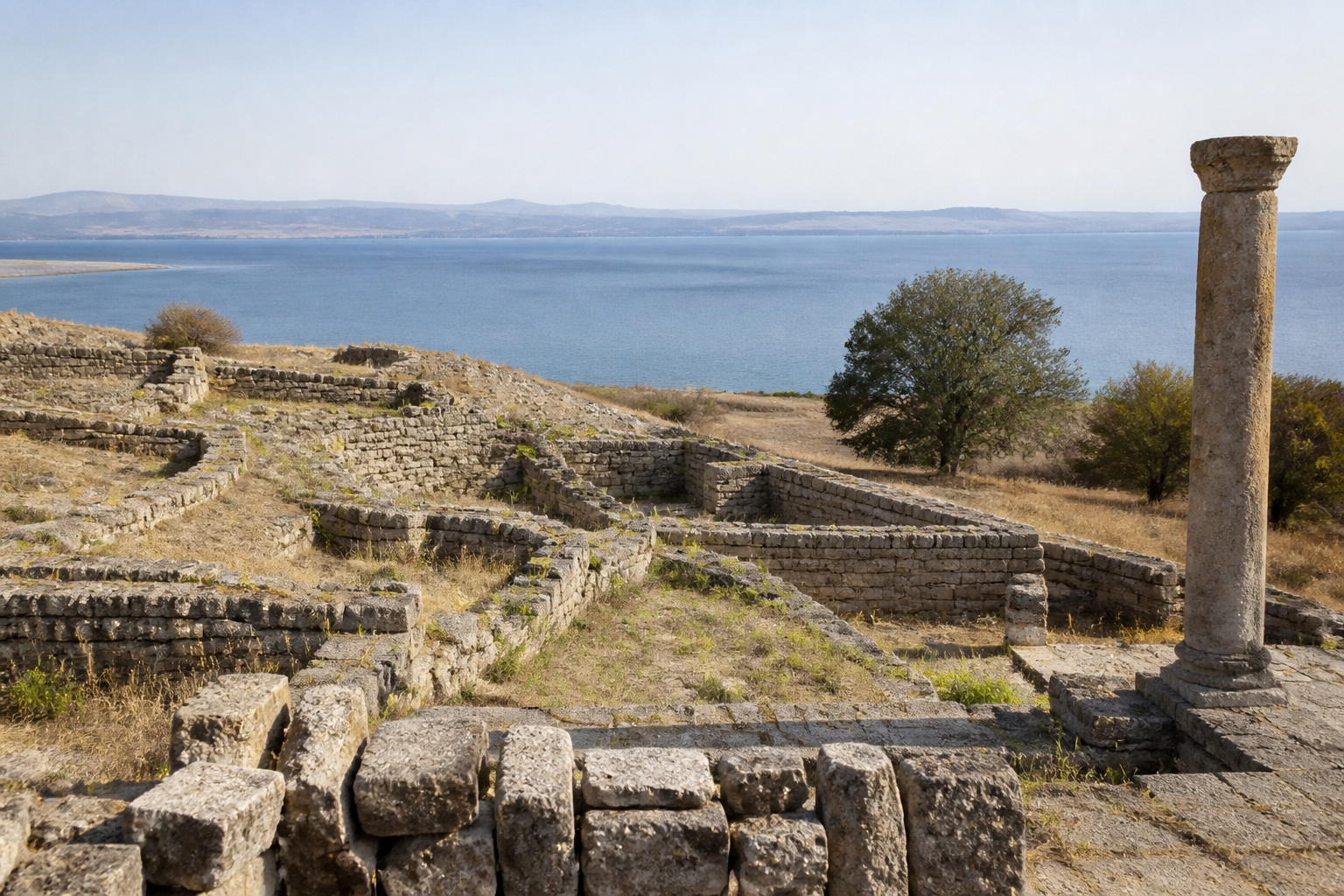
The passages evoke Troas through the imagery of travel and logistics rather than description. Troas is pictured as a place one can “come down” to, “set sail” from, “wait” at, “stay” in for days, arrive at after a measured voyage, and return to in memory when requesting a cloak and books. The cumulative picture is of a recognizable stop along a route—capable of receiving travelers, sending them onward, and holding the traces of their work and their belongings.
Sources: Lexical data from Strong’s Exhaustive Concordance and the Translators Brief Lexicon of Extended Strongs for Greek (STEPBible, CC BY). Occurrence data from the Translators Amalgamated Greek New Testament (STEPBible, CC BY). Scripture quotations from the World English Bible (public domain).




