
Exploring the Meaning of Tromos in Greek
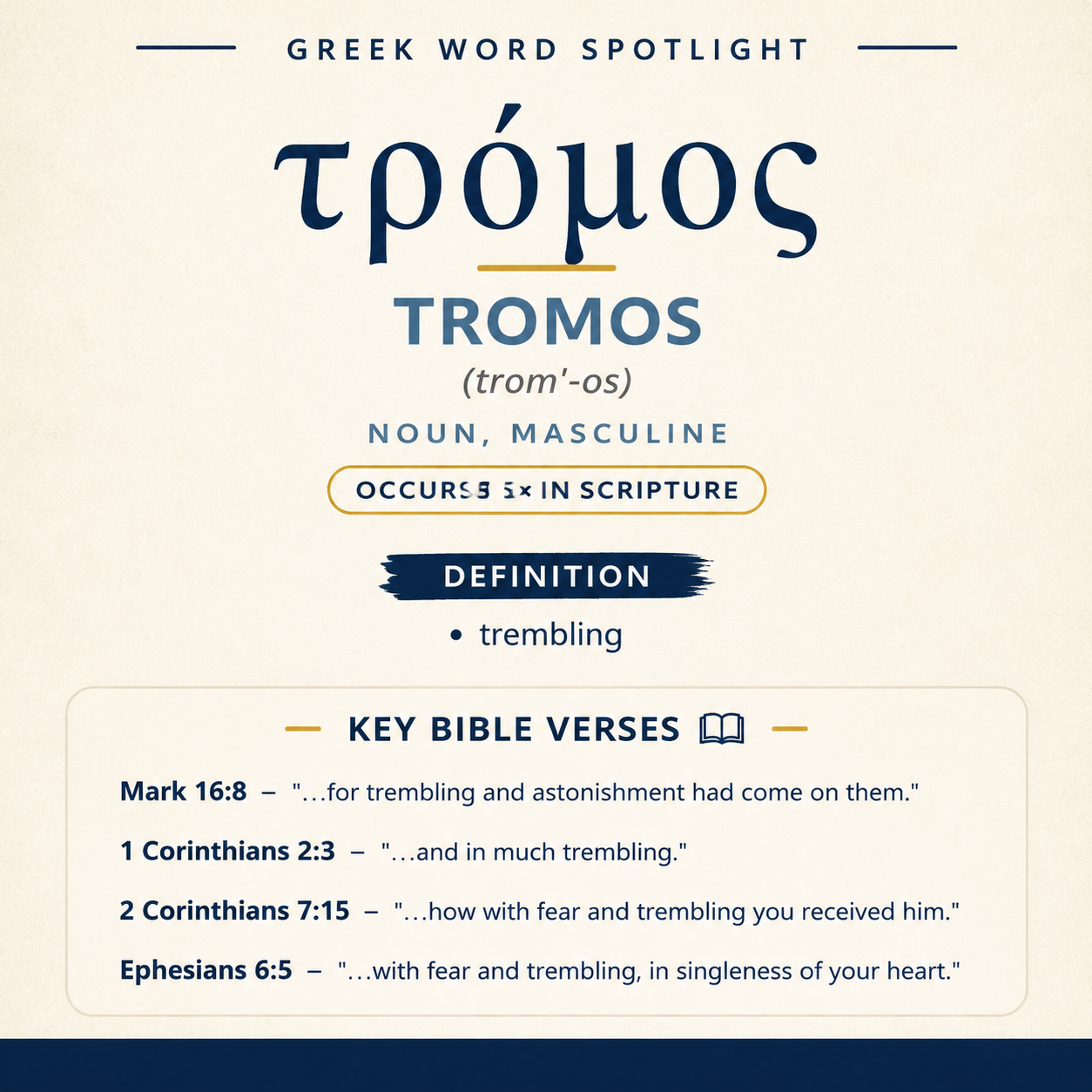
τρόμος means “trembling” and appears five times in Scripture: Mark 16:8; 1 Corinthians 2:3; 2 Corinthians 7:15; Ephesians 6:5; Philippians 2:12.
Scripture Occurrences
It occurs five times in Scripture. The references are Mark 16:8; 1 Corinthians 2:3; 2 Corinthians 7:15; Ephesians 6:5; Philippians 2:12.
Learn More →Textual Phrases
Mark 16:8 pairs it with “astonishment.” Several passages use the phrase “fear and trembling” (1 Corinthians 2:3; 2 Corinthians 7:15; Ephesians 6:5).
Learn More →τρόμος names “trembling,” a bodily reaction that appears both in a sudden moment of shock and in settled attitudes of reverent seriousness. It occurs in Mark 16:8 and in four Pauline settings where “fear and trembling” frames obedience, reception, and responsibility.
Root and Related Words
τρόμος is connected with the verb tremō (τρέμω), “to tremble” (Strong’s G5141).

Occurrences
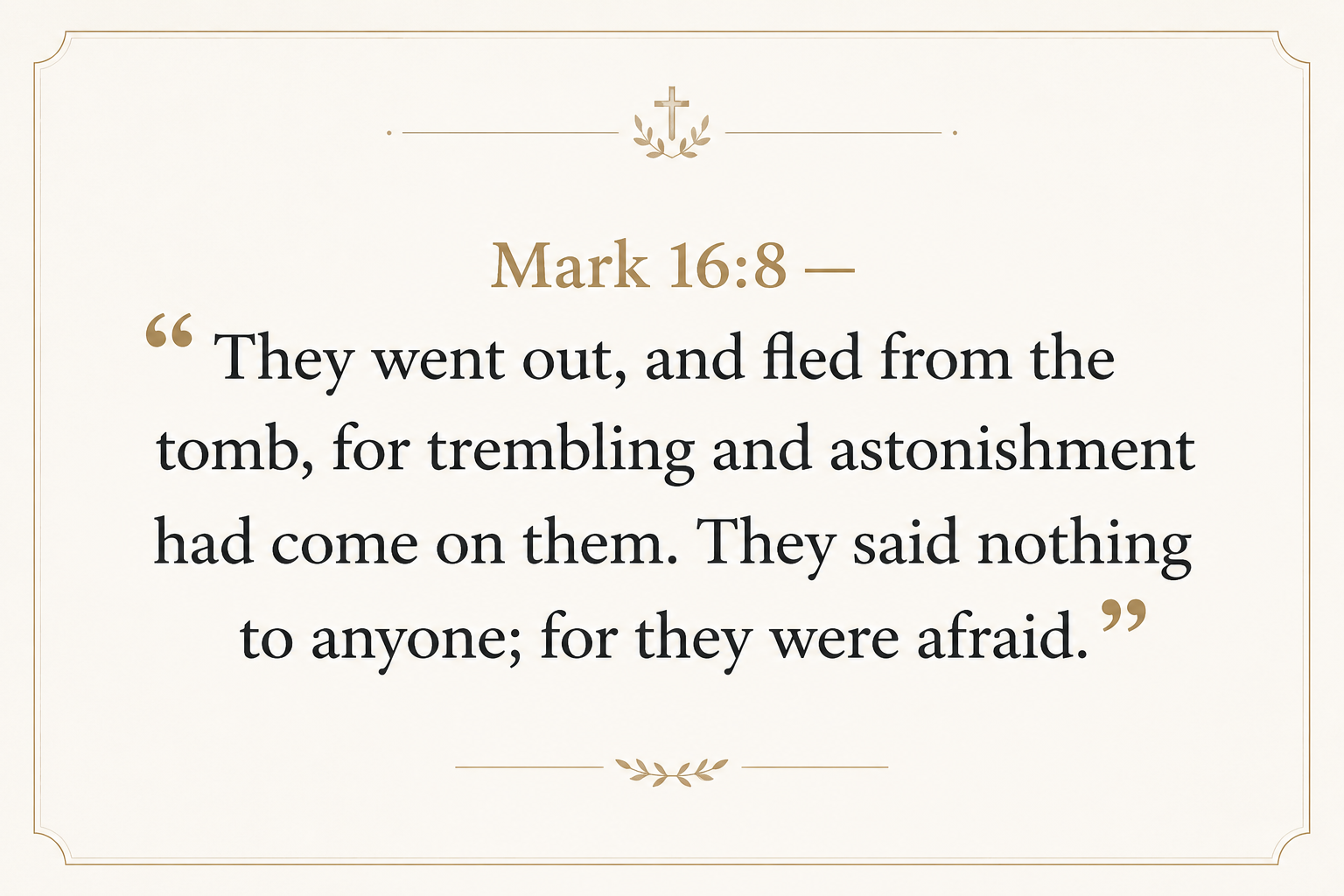
Mark 16:8 — “They went out, and fled from the tomb, for trembling and astonishment had come on them. They said nothing to anyone; for they were afraid.”
Here τρόμος is part of the immediate physical and emotional aftermath of what the women have encountered at the tomb. The verse pairs “trembling” with “astonishment,” presenting a reaction that overwhelms them (“had come on them”) and drives visible behavior: they “fled” and they “said nothing to anyone.” The closing clause, “for they were afraid,” places trembling alongside fear as a response that silences and propels them away from the scene rather than toward explanation.
1 Corinthians 2:3 — “I was with you in weakness, in fear, and in much trembling.”
In this personal recollection, τρόμος is intensified (“much trembling”) and set within a triad: “weakness,” “fear,” and trembling. The word functions as a concrete marker of Paul’s demeanor when he was “with you,” making his presence among them sound precarious and exposed rather than forceful. The line does not describe a single startling moment; it characterizes the way he carried himself during that time, placing trembling within the experience of human limitation and apprehension.
2 Corinthians 7:15 — “His affection is more abundantly toward you, while he remembers all of your obedience, how with fear and trembling you received him.”
Here τρόμος appears in the set phrase “with fear and trembling,” describing the Corinthians’ reception of “him.” Trembling is presented as part of the posture in which they “received” a messenger and the message he brought, and it is linked directly to “obedience.” The verse ties this remembered stance to relational outcome: “His affection is more abundantly toward you,” because he recalls not merely that they received him, but the manner—marked by fear and trembling—in which they did so.
Ephesians 6:5 — “Servants, be obedient to those who according to the flesh are your masters, with fear and trembling, in singleness of your heart, as to Christ,”
In this instruction, τρόμος again stands within “fear and trembling,” but now in a household setting of commanded obedience. The trembling is not portrayed as panic or flight; it is a way of carrying out obedience to “masters” that are specified as “according to the flesh.” The phrase is further shaped by two qualifiers: “in singleness of your heart” and “as to Christ.” In this sentence, trembling belongs to an inner orientation that accompanies outward service—an earnestness that is meant to characterize the servant’s obedience.
Philippians 2:12 — “So then, my beloved, even as you have always obeyed, not only in my presence, but now much more in my absence, work out your own salvation with fear and trembling.”
In Philippians, τρόμος frames a sustained task rather than a single action: “work out your own salvation.” The trembling is paired with “fear” and placed as the manner in which this work is to be carried out. The verse underscores continuity and intensified responsibility: the Philippians have “always obeyed,” and are to do so “much more” when Paul is absent. Within this exhortation, trembling marks the seriousness and carefulness with which ongoing obedience and effort are undertaken, especially when external oversight (“my presence”) is removed.
Sense and Usage
Across these five passages, τρόμος consistently communicates trembling as an embodied reaction that belongs to moments of fear, awe, or high-stakes responsibility. Mark 16:8 shows it as something that “had come on” the women, producing immediate, observable effects—fleeing and silence—within the shock of “astonishment” and the stated emotion of being “afraid.” In that setting, trembling is the outward sign of an inward disturbance, and the narrative treats it as powerful enough to govern what they do next.
In the Pauline occurrences, τρόμος appears four times, three of them in the compound expression “with fear and trembling.” This repeated pairing places trembling alongside fear as a characteristic mode of action and reception. Rather than describing involuntary shaking alone, the phrase functions as a way to depict seriousness of posture: the Corinthians “received him” in a manner that is remembered as obedient; servants are to obey their masters in this manner while maintaining “singleness of your heart”; and the Philippians are to “work out” salvation in this manner, especially in the apostle’s absence. In these uses, τρόμος is not presented as an obstacle to obedience but as a companion to it—an intensity that underscores the weightiness of what is being received, done, or lived out.
1 Corinthians 2:3 differs from the other Pauline cases by attaching a qualifier: “much trembling.” It locates trembling inside Paul’s own experience of ministry presence, joined to “weakness” and “fear.” The effect is to portray trembling as compatible with apostolic work; it can be part of the lived reality of speaking and being “with” a congregation. Taken together with the other letters, τρόμος can describe both the messenger’s condition (“I was with you…”) and the community’s response (“you received him…,” “be obedient…,” “work out…”), tying bodily tremor to situations felt to be spiritually and relationally consequential.
Within these verses, trembling is never isolated as a detached medical symptom; it is consistently embedded in context-laden scenes: the empty tomb and its aftermath, the remembered emotional texture of ministry, the reception of a representative, instructions for service within social structures, and the ongoing practice of obedience. The word therefore carries a vivid, physical coloration that makes “fear” tangible, while also serving as a verbal cue for earnestness—an attitude that treats the moment, the relationship, or the responsibility as weighty enough to affect the body.
Imagery
The imagery associated with τρόμος shifts from sudden shock to sustained seriousness. Mark 16:8 paints trembling as something that overtakes a person so forcefully that it produces flight and silence: the body reacts before words come. In the letters, the phrase “with fear and trembling” places that bodily reaction into the sphere of obedience and reception, making trembling a sign of heartfelt earnestness—“singleness of your heart”—and of the gravity felt when receiving an emissary or carrying out a charge when the apostle is absent.
Sources: Lexical data from Strong’s Exhaustive Concordance and the Translators Brief Lexicon of Extended Strongs for Greek (STEPBible, CC BY). Occurrence data from the Translators Amalgamated Greek New Testament (STEPBible, CC BY). Scripture quotations from the World English Bible (public domain).




