
Exploring the Meaning of Tristegon in Greek
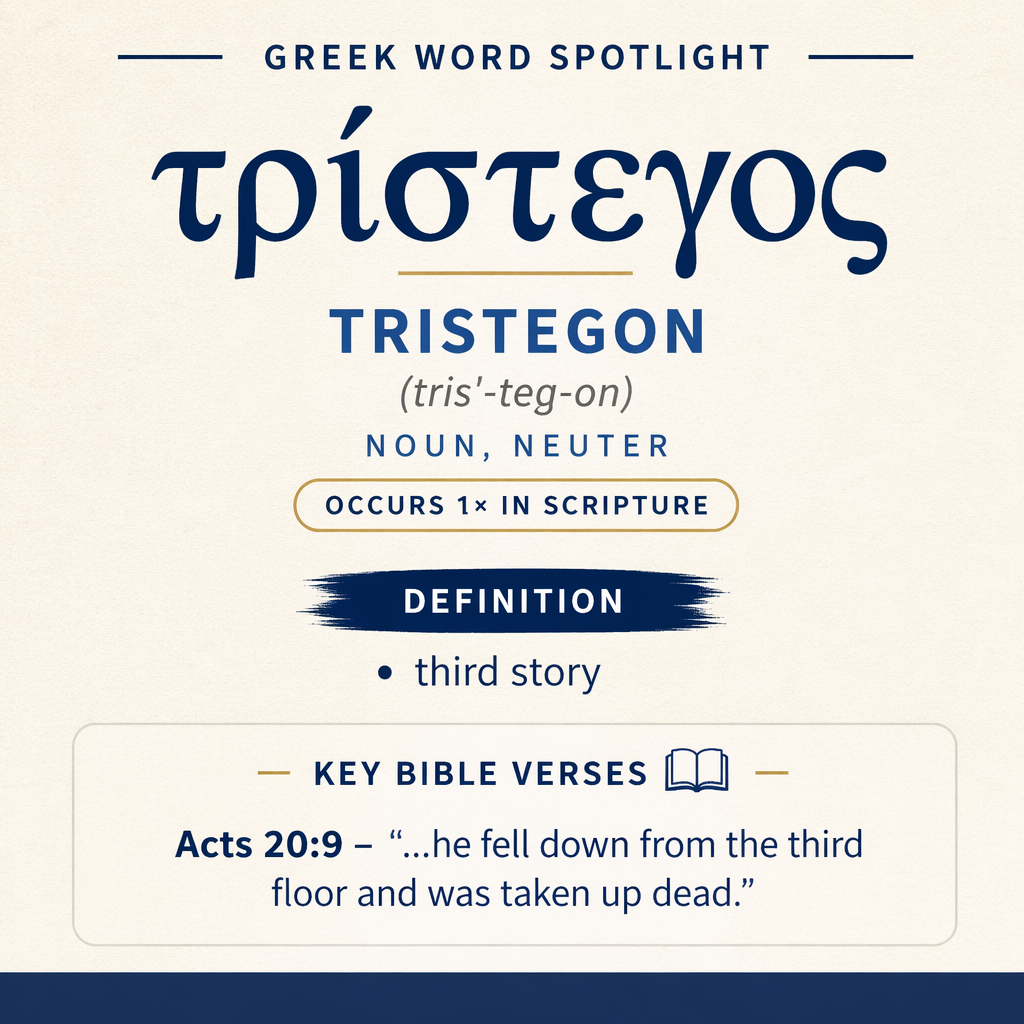
τρίστεγος means “third story” and appears once in Scripture in Acts 20:9.
Biblical Occurrence
This word occurs 1 time in Scripture. Its occurrence is in Acts 20:9.
Learn More →τρίστεγος refers to a “third story,” and it appears in a single narrative setting in Acts where a fall from an upper level becomes a key detail in the account. The word serves as a concrete locator within an ordinary architectural space, anchoring the event in a specific vertical height.
Root and Related Words
τρίστεγος is formed with treis (τρεῖς), “three” (Strong’s G5140), and stege (στέγη), “roof” (Strong’s G4721). The compound structure ties the idea of “three” to the built environment associated with a roofed structure, yielding a term for a particular level within a multi-storey building.

Occurrences
“A certain young man named Eutychus sat in the window, weighed down with deep sleep. As Paul spoke still longer, being weighed down by his sleep, he fell down from the third floor and was taken up dead.” (Acts 20:9)
In this scene, τρίστεγος supplies the narrative’s spatial precision at the moment the story turns from listening to crisis: Eutychus “sat in the window,” sleep overcame him, and he “fell down from the third floor.” The word identifies the elevation from which the fall occurred, so the reader does not imagine a stumble at ground level but a drop from a high interior level. That location works with the other physical details in the verse—the window as the precarious seat, the prolonged speaking, and the progressive description of drowsiness (“weighed down with deep sleep” … “being weighed down by his sleep”)—to make the outcome (“was taken up dead”) narratively plausible within the story’s own terms. The “third floor” is not a decorative note: it functions as the concrete circumstance that intensifies the danger of the fall and explains why the gathering’s ordinary setting becomes the site of a sudden death.
At the same time, τρίστεγος quietly shows the meeting taking place in a substantial building with multiple levels. The event is not outdoors or in a single-room dwelling; it happens in a setting where a person can sit at a window above the ground. The word therefore contributes to the scene’s realism: it maps the action into a recognizable piece of architecture and defines the direction of the movement (“fell down”) as a descent from a clearly specified height.

Sense and Usage
Because τρίστεγος appears only here, its sense is learned in a single, sharply focused use: it marks a particular storey of a building—specifically the third. In Acts 20:9, the word is used in an explanatory way, not as the main subject but as a situational modifier that answers a practical question the narrative raises: from where did he fall? By specifying “the third floor,” the account sets a measurable boundary for the reader’s imagination. The fall is not left vague; it is located in the vertical layout of the building.
This use also illustrates how a “story” functions as a unit of everyday orientation. The verse does not give a street, a building name, or a room description beyond “the window,” yet the single term τρίστεγος supplies sufficient spatial information to make the movement intelligible: sitting at a window on an upper level, becoming fully overtaken by sleep, then dropping down. The word thus operates as a practical locator—one that makes the narrative’s sequence coherent without pausing to describe construction, stairs, or external features. The level number alone conveys the height and the seriousness.
Within the verse’s flow, the placement of τρίστεγος near the verb of falling (“he fell down from the third floor”) underscores that the point of mentioning the storey is the fall’s consequence. The narrative does not introduce “third floor” as an incidental backdrop at the beginning; it introduces it at the instant it is needed to interpret the result. In this way, τρίστεγος contributes to the story’s cause-and-effect logic: prolonged speaking and heavy sleep lead to a fall; the fall is from a third storey; therefore the outcome is grave.
Imagery
Acts 20:9 attaches τρίστεγος to a vivid, ordinary image: a window seat high above the ground inside a multi-level building. The word calls up the plain verticality of urban life—floors stacked above one another—and, in this passage, that verticality becomes the line along which the action moves: a listener’s body drops from a defined height, and the gathering’s attention shifts from a long speech to a deadly fall.
Sources: Lexical data from Strong’s Exhaustive Concordance and the Translators Brief Lexicon of Extended Strongs for Greek (STEPBible, CC BY). Occurrence data from the Translators Amalgamated Greek New Testament (STEPBible, CC BY). Scripture quotations from the World English Bible (public domain).




