Exploring the Meaning of Trischilioi in Greek
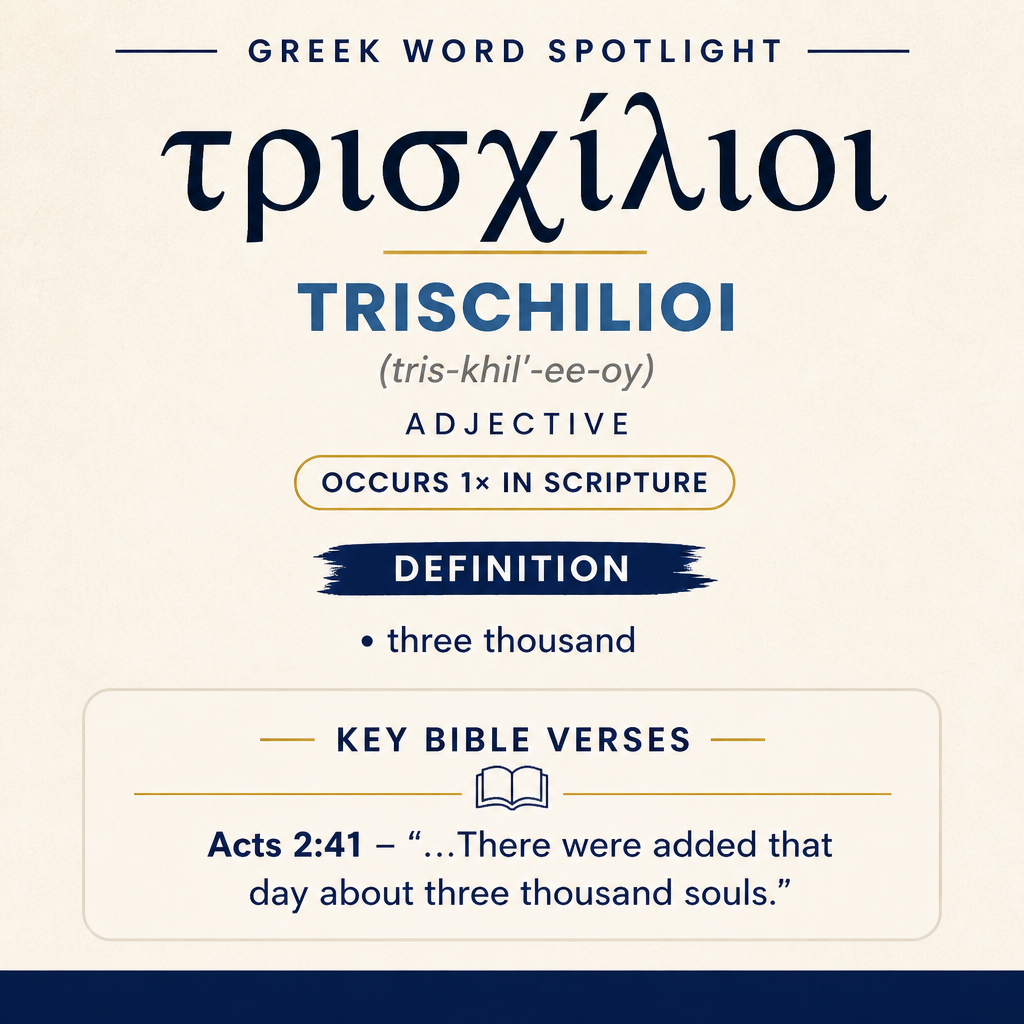
τρισχίλιοι means “three thousand” and appears once in Scripture in Acts 2:41.
Biblical Usage
It occurs one time in Scripture. In Acts 2:41, it describes about three thousand souls added that day.
Learn More →Key Occurrence
Acts 2:41 records that those who received the word were baptized. About three thousand souls were added that day.
Learn More →τρισχίλιοι means “three thousand” and appears in the account of the first Christian baptisms after Peter’s proclamation in Jerusalem. In its single New Testament occurrence, it gives a rounded, approximate count of those newly added to the community on that day.
Root and Related Words
τρισχίλιοι (Trischilioi) is formed from τρίς (tris), “three times” (Strong’s G5151), and χίλιοι (chilioi), “thousand” (Strong’s G5507). The compound structure ties a small, definite multiplier (“three”) to a large base unit (“thousand”), yielding a large numerical expression suitable for public reporting and group description.
Occurrences
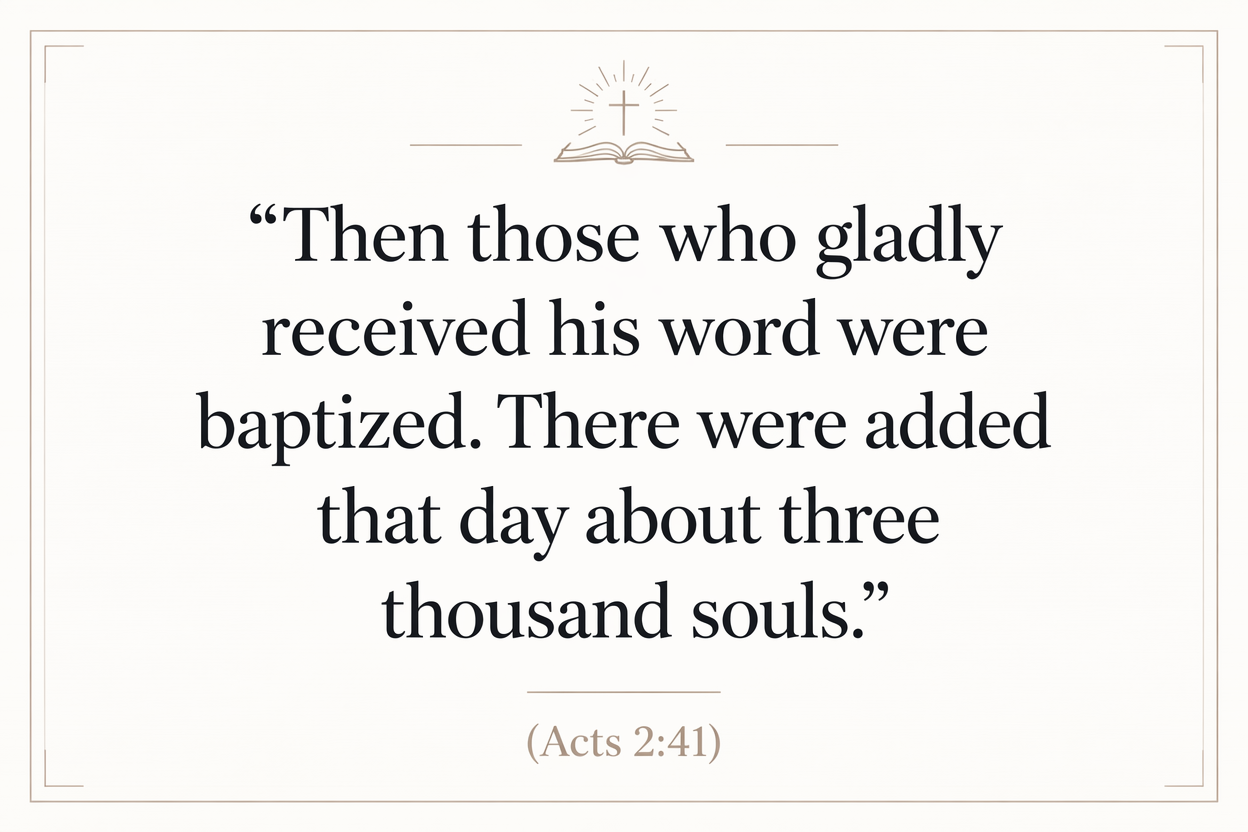
“Then those who gladly received his word were baptized. There were added that day about three thousand souls.” (Acts 2:41)
In Acts 2:41, τρισχίλιοι functions as the numerical headline of the verse’s outcome: a concrete tally attached to a sequence of actions—receiving a message, undergoing baptism, and being “added” to a group. The wording frames the number as the scale of response to “his word” and the visible result of baptism: what began as an address culminates in a measurable increase in people. By appearing with “about” and with “souls,” the term marks a mass of individuals rather than an abstract statistic; the verse treats them as persons who have participated in the same event (“were baptized”) and have been incorporated into the same community (“were added that day”).
The placement of the number at the close of the verse gives it rhetorical weight. The narrative does not linger on the logistics of baptizing such a crowd; instead, τρισχίλιοι serves as a summary measure that allows the reader to grasp the magnitude of the day’s result. The verse’s flow makes the count the final, memorable piece of information: the reception of the word leads to baptism, and baptism is followed by addition, which is then quantified. In this scene, τρισχίλιοι is not merely arithmetic; it is the narrative’s way of rendering the day’s impact in a single, compact figure.
Sense and Usage
The sense “three thousand” in Acts 2:41 operates as a crowd-scale number: large enough to signal a major event, yet stated in a way that reads as a report rather than an exact census. The text’s phrasing—“about three thousand souls”—shows the word’s suitability for approximate counting in a public setting. It belongs to the language of outcomes (“There were added…”) rather than the language of planning or prediction; it quantifies what has already happened and is being remembered or recorded.
Because the verse ties the number directly to people who “gladly received his word” and “were baptized,” τρισχίλιοι carries an implicit grouping function: it gathers many individual responses into a single collective. The number stands as a bridge between individual action and communal identity. The verse names personal engagement (“received his word”), a shared rite (“were baptized”), and then a corporate result (“were added”), with τρισχίλιοι giving that corporate result a clear scale. In this way, “three thousand” is not an isolated detail; it is integrated into the verse’s logic of reception → baptism → addition.
The word also works with “that day” to anchor the increase in time. Rather than presenting a gradual accumulation, the verse connects the numerical expansion to a single day’s events. τρισχίλιοι thus helps depict sudden growth: a defined moment in which a large number of people join at once. The narrative effect is to make the day itself stand out as remarkable, with the count offering a simple metric of its significance.
Imagery
Acts 2:41 pairs τρισχίλιοι with the concrete acts of receiving, baptizing, and being added, so the number evokes the visual scale of many persons moving through a shared public moment. “Three thousand souls” suggests not only quantity but also a gathered crowd—individuals counted together because they have undergone the same response and the same baptism on the same day.
Sources: Lexical data from Strong’s Exhaustive Concordance and the Translators Brief Lexicon of Extended Strongs for Greek (STEPBible, CC BY). Occurrence data from the Translators Amalgamated Greek New Testament (STEPBible, CC BY). Scripture quotations from the World English Bible (public domain).