Exploring the Meaning of Triakosioi in Greek
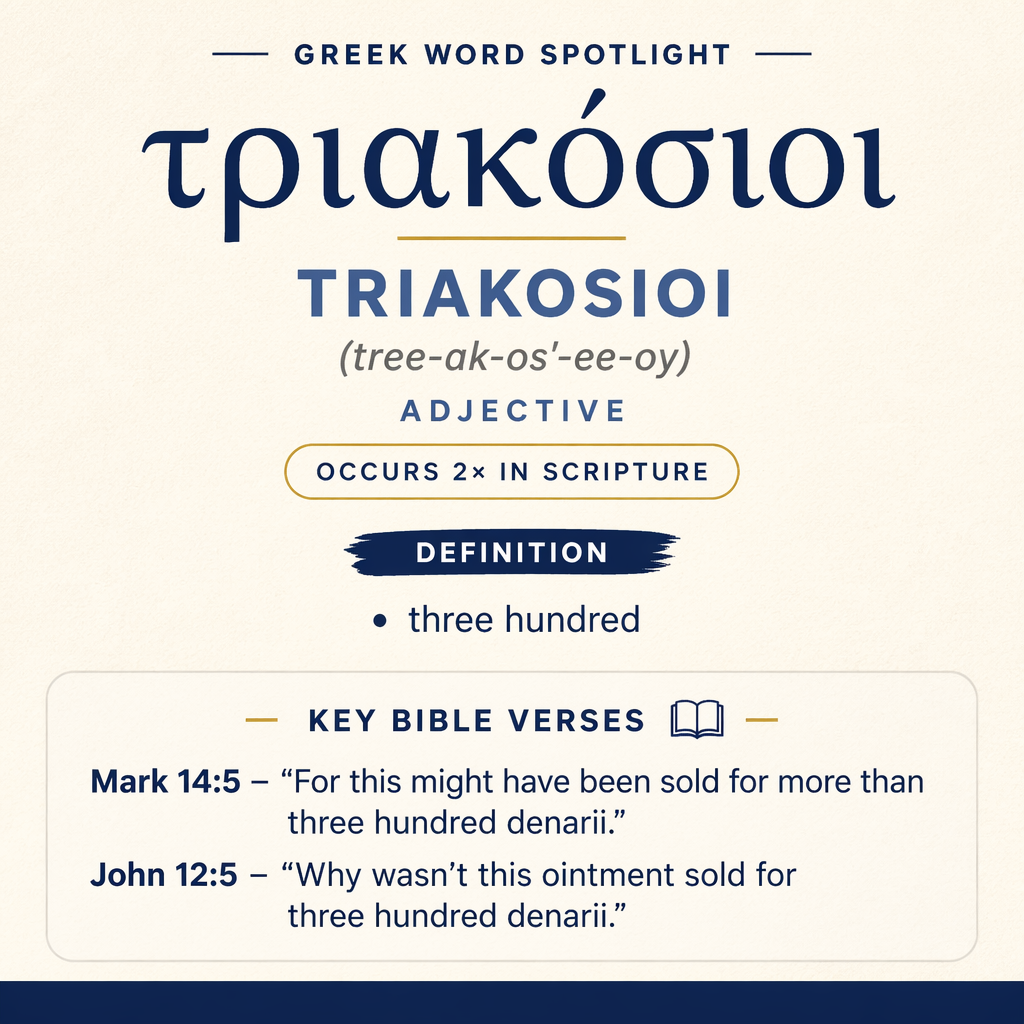
τριακόσιοι means “three hundred” and appears in Mark 14:5 and John 12:5.
Core Meaning
τριακόσιοι is defined as “three hundred.” It is used with denarii in both occurrences.
Learn More →Scripture Occurrences
This word occurs 2 times in Scripture. The references are Mark 14:5 and John 12:5.
Learn More →Verse Context
In Mark 14:5, it refers to “more than three hundred denarii.” In John 12:5, it refers to “three hundred denarii.”
Learn More →τριακόσιοι means “three hundred,” and it appears in two Gospel scenes where the value of costly ointment is estimated in denarii. In both settings the number is used in a spoken objection that contrasts an expensive act with the alternative of giving to the poor.
Root and Related Words
τριακόσιοι is connected with τρεῖς (treis), “three” (Strong’s G5140), and ἑκατόν (hekaton), “hundred” (Strong’s G1540). The form expresses a quantity by combining the ideas of “three” and “hundred” into a single numeral adjective.

Occurrences
Mark 14:5 — “For this might have been sold for more than three hundred denarii, and given to the poor.” So they grumbled against her.
Here τριακόσιοι functions inside a monetary comparison: “more than three hundred denarii.” The speaker frames the ointment as an asset with a high market value and places that value alongside an ethical alternative: it could have been “given to the poor.” The addition of “more than” sets three hundred as a baseline figure, implying that the amount is not merely a round statistic but a threshold meant to make the complaint sting—high enough to sound decisive in an argument about waste. Within the verse, the number serves as the pivot between two kinds of action: selling a luxury item versus allowing it to be used as it has been. The closing line, “So they grumbled against her,” shows that the estimate is not neutral accounting; τριακόσιοι becomes part of a charge leveled at “her,” providing a concrete sum around which indignation gathers.

John 12:5 — “Why wasn’t this ointment sold for three hundred denarii, and given to the poor?”
In John’s wording τριακόσιοι again anchors the stated alternative: the ointment could have been sold for “three hundred denarii,” with the proceeds directed to “the poor.” Unlike Mark’s “more than three hundred,” this formulation names the figure directly, presenting it as a straightforward valuation that supports the question “Why wasn’t…?” The number contributes precision and plausibility to the objection: it does not complain in vague terms about extravagance but attaches a specific monetary estimate to the ointment, as though the correct course of action could be measured and settled by a clear price. The sentence structure ties the sale price and the charitable giving closely together (“sold for three hundred denarii, and given to the poor”), so τριακόσιοι is the numerical hinge that connects commerce to generosity in the speaker’s proposed scenario.
Sense and Usage
Across these two occurrences, τριακόσιοι serves as a concrete, countable quantity deployed in speech to evaluate an object’s worth. The scenes share a consistent pattern: the number is attached to “denarii,” and it appears in a counterfactual proposal (“might have been sold…”; “wasn’t… sold…?”). In other words, the word is not used to count people, animals, or items on hand, but to present an estimated sale value for ointment. The numeral therefore functions rhetorically: it makes the proposed alternative feel definite, calculable, and actionable. By putting a large, single figure into the complaint, the speaker can portray the present action as a missed opportunity and can frame the situation as a moral calculation involving the poor.
The slight difference between the two passages also shows how the same quantity can be used with different rhetorical force. Mark’s “more than three hundred denarii” treats three hundred as a minimum, heightening the claim that the loss is substantial; John’s “three hundred denarii” uses the figure as a stable valuation, lending the question a tone of practical reasoning. In both, τριακόσιοι stands at the intersection of value and intention: it quantifies what the ointment could bring if sold and thereby becomes a tool for arguing about what should have been done. The result is that “three hundred” is not merely descriptive; it carries argumentative weight within the complaint, serving to justify disapproval and to support the proposed redirection of resources.
Because τριακόσιοι is a numeral adjective, it naturally depends on the noun it modifies to supply the domain being measured. In these verses the domain is explicitly monetary (“denarii”), which keeps the meaning grounded in economic valuation rather than in measurement of time, distance, or population. The number’s role is to give the valuation a sharp edge: rather than saying the ointment was expensive, the speakers can name a figure, making the alternative of helping the poor feel immediate and tangible. Thus τριακόσιοι works as a way of fixing attention on an apparently measurable sum, turning a contested action into a dispute over quantifiable worth.
Imagery
In both passages τριακόσιοι evokes the mental picture of money changing hands: ointment assessed, a sale imagined, and denarii counted out with the poor as the proposed recipients. The number “three hundred” supplies a specific scale to that picture, making the imagined transfer of wealth feel substantial enough to fuel grumbling in Mark and pointed questioning in John.
Sources: Lexical data from Strong’s Exhaustive Concordance and the Translators Brief Lexicon of Extended Strongs for Greek (STEPBible, CC BY). Occurrence data from the Translators Amalgamated Greek New Testament (STEPBible, CC BY). Scripture quotations from the World English Bible (public domain).