Exploring the Meaning of Teknogoneo in Greek
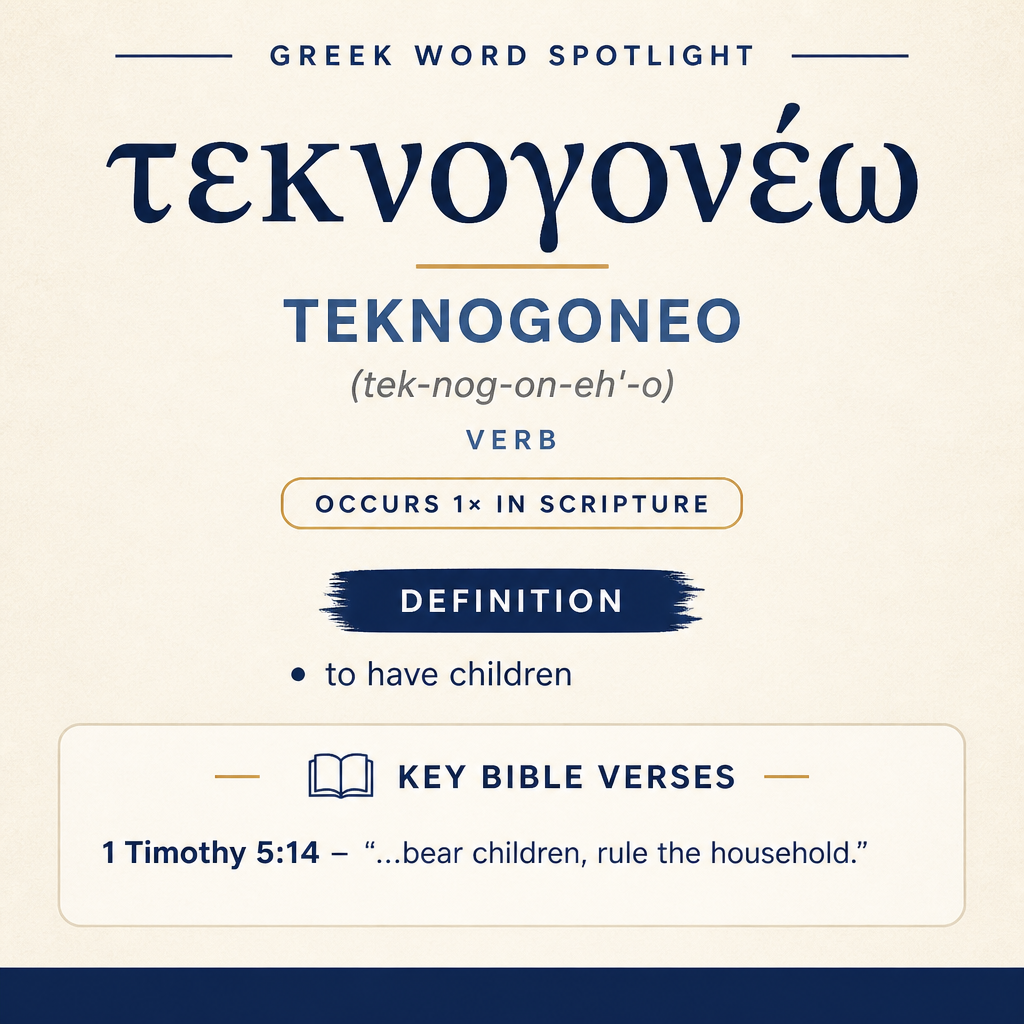
τεκνογονέω means “to have children” and appears once in Scripture, in 1 Timothy 5:14.
Biblical Occurrence
This verb occurs 1 time in Scripture. Its only listed occurrence is 1 Timothy 5:14.
Learn More →Verse Context
In 1 Timothy 5:14, it appears in the instruction that younger widows should marry and bear children.
Learn More →τεκνογονέω means “to have children” and appears once in the New Testament, in Paul’s instruction about “the younger widows” in 1 Timothy 5:14. In that setting it is presented as part of an ordered set of practical actions.
Root and Related Words
τεκνογονέω is associated with τέκνον (teknon), “child” (Strong’s G5043), and with γίνομαι (ginomai), “to be” (Strong’s G1096). The compound shape of the verb aligns it with the noun for “child” and with a verb of becoming/being, forming a verb that speaks of children coming to be.

Occurrences
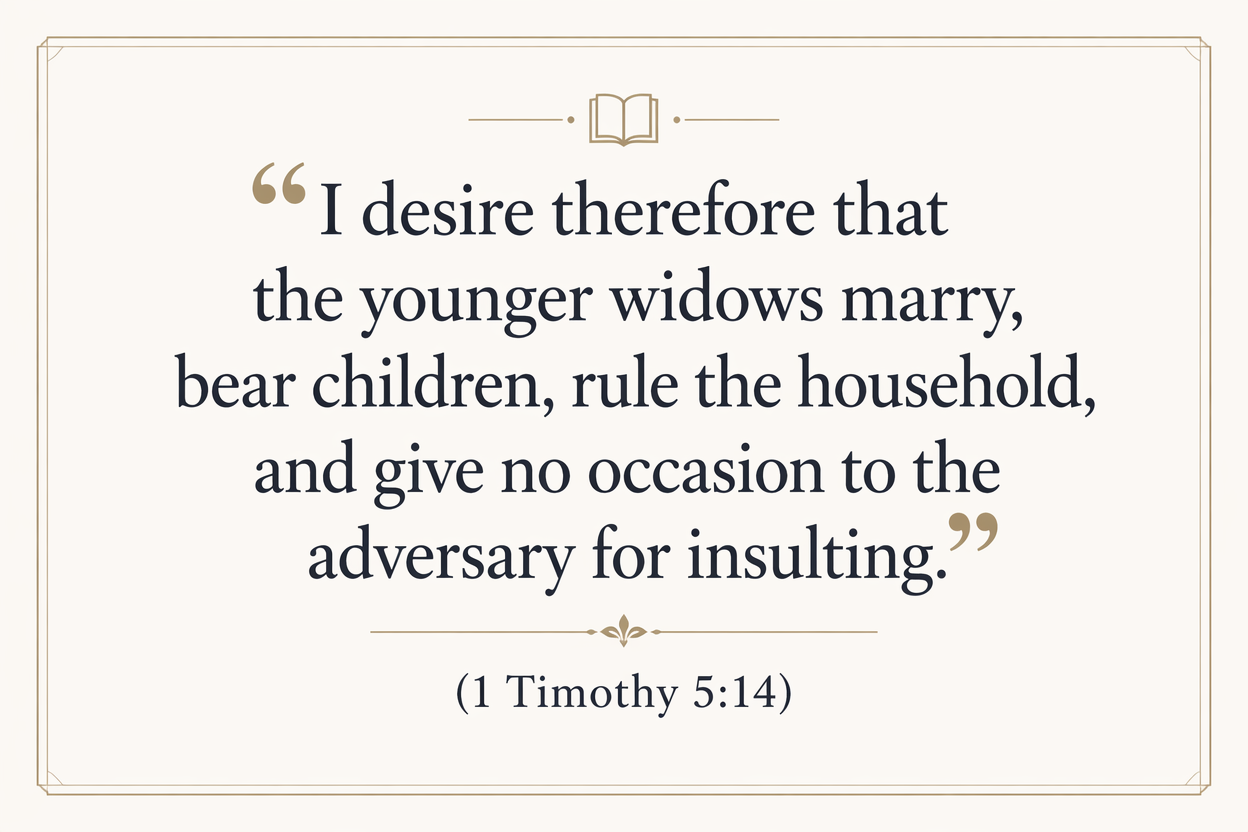
“I desire therefore that the younger widows marry, bear children, rule the household, and give no occasion to the adversary for insulting.” (1 Timothy 5:14)
Here τεκνογονέω (“bear children”) stands between “marry” and “rule the household,” placed within a sequence of actions that together describe a settled domestic pattern. The verse is not primarily describing biology in isolation; it frames childbearing as one element within a larger household life in which a woman is pictured as taking up responsibilities (“rule the household”) and thereby closing off opportunities for hostile speech (“give no occasion to the adversary for insulting”). In this sentence, the act of having children is presented as an ordinary, public marker of a stable home—an action that, along with marriage and household management, contributes to a life arrangement that is less exposed to reproach.
The immediate rhetoric is directive (“I desire therefore”), and the verb functions as one of the concrete, socially recognizable steps in that directive. Because the list is compact and coordinated, “bear children” is not treated as a private wish but as a practice embedded in a visible pattern of conduct. The final clause about “occasion” and “insulting” places the whole list under the horizon of reputation and accusation: the activities named are set forth as a way of leaving the adversary less material to exploit.
Sense and Usage
The sense “to have children” operates in 1 Timothy 5:14 as a life-course verb: it assumes the formation of a household (“marry”), the growth of that household through children (“bear children”), and the ongoing administration of the home (“rule the household”). Within that chain, τεκνογονέω has a naturally forward-looking force. It gestures toward continuity and the establishment of ordinary family life, not as an end in itself in this verse, but as a component of a broader aim—removing “occasion” for an opponent’s “insulting.”
The wording also shows how the action is conceptualized: it is not expressed in terms of a child as an object received, but as children coming to be within the married household. That fits the way the verse frames the younger widows’ future—moving from a potentially unsettled social position into a structured domestic sphere. The verb’s placement makes it part of a practical portrait: marriage leads into children, children into household governance, and the whole pattern into reduced vulnerability to slander.
Because τεκνογονέω occurs here in a coordinated list, it should be read with the same practical concreteness as the neighboring imperatives. It names a real-life action that can be seen and recognized, and so it naturally supports the verse’s concern with “occasion” for criticism. In this single use, the verb does not invite abstraction; it remains anchored in the ordinary rhythms of home-making and family formation that the verse commends.
Imagery
Although the verb itself is simple, the verse places it inside a scene of domestic stability: marriage, children, and the ordering of a household. The imagery is that of a home whose life is full and structured, leaving less room for an adversary to turn daily circumstances into “occasion” for “insulting.”
Sources: Lexical data from Strong’s Exhaustive Concordance and the Translators Brief Lexicon of Extended Strongs for Greek (STEPBible, CC BY). Occurrence data from the Translators Amalgamated Greek New Testament (STEPBible, CC BY). Scripture quotations from the World English Bible (public domain).