Understanding the Significance of Ginomai in Greek
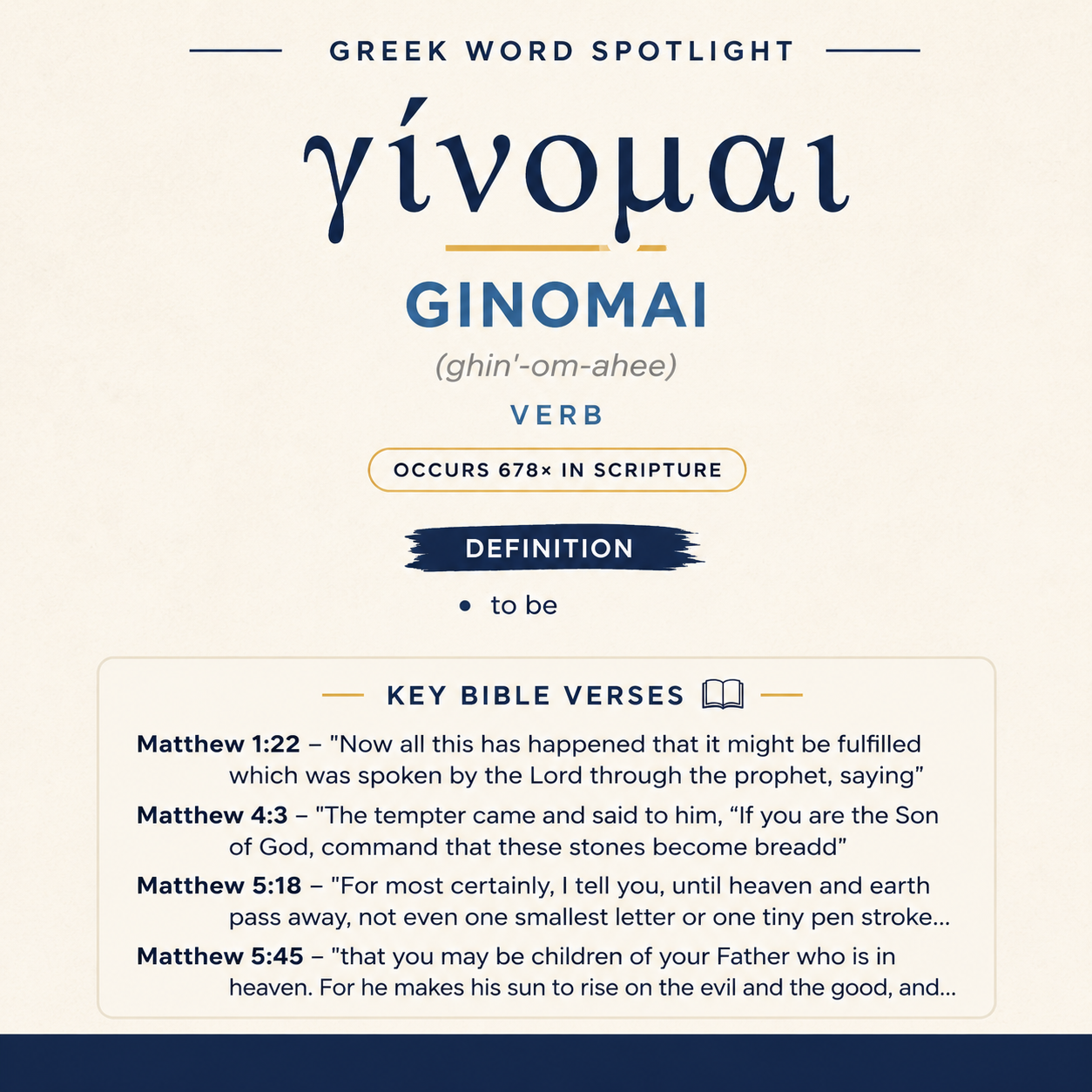
γίνομαι means “to be” and appears 678 times in Scripture, including Matthew 1:22; 4:3; 5:18,45; 6:10,16; 7:28; 8:13.
Sample Occurrences
It appears in passages such as Matthew 1:22 and Matthew 8:13. Additional examples include Matthew 4:3 and Matthew 6:10.
Learn More →γίνομαι expresses the state of “to be” as it plays out in concrete events, commands, and outcomes. In the passages below, it is heard where something comes about, is done, or is brought into the condition the speaker names.
Occurrences
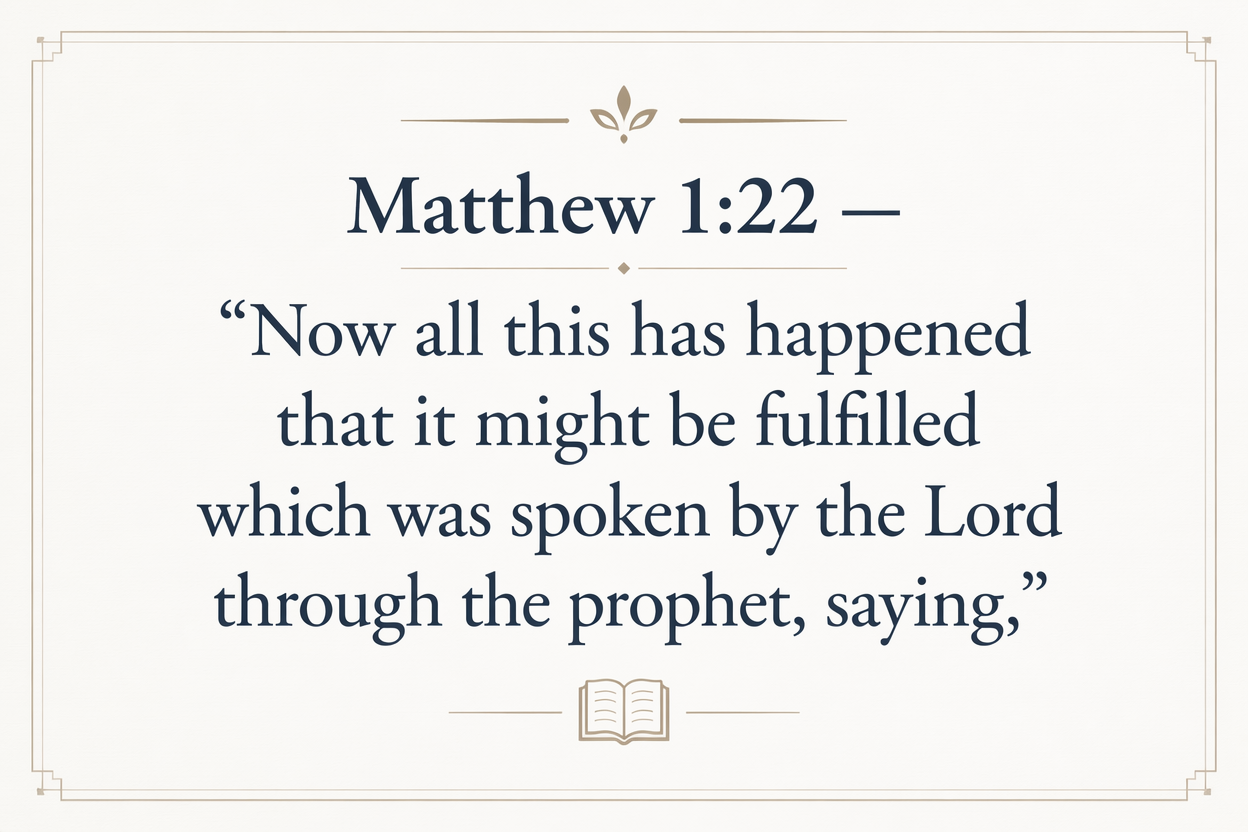
Matthew 1:22 — “Now all this has happened that it might be fulfilled which was spoken by the Lord through the prophet, saying,”
Here γίνομαι stands behind the narrator’s framing of the story as an event that has come to be. The clause gathers earlier actions into a single completed happening (“all this has happened”) and places that happening in relation to fulfillment: what has come about is not random but fits a spoken purpose. The word thus functions as a hinge between the narrated circumstances and the claim that those circumstances are the kind of thing that can be spoken beforehand and later come to be.
Matthew 4:3 — “The tempter came and said to him, “If you are the Son of God, command that these stones become bread.””
In the tempter’s challenge, γίνομαι marks a proposed change of state: stones are to be in the condition of bread. The focus is not on the process of making but on the resultant being—what the stones would be if the command were issued. Within the sentence, this “becoming” is presented as something that could be compelled by command, linking identity (“If you are the Son of God”) with the capacity to bring a new state into being.
Matthew 5:18 — “For most certainly, I tell you, until heaven and earth pass away, not even one smallest letter or one tiny pen stroke shall in any way pass away from the law, until all things are accomplished.”
γίνομαι contributes to the idea of completion as an achieved state: “until all things are accomplished.” The saying looks forward to a point at which the full scope of “all things” has come to be in the sense of having reached its intended end. The word therefore supports a timeline: certain elements do not “pass away” up to the point when the named completion has become true.
Matthew 5:45 — “that you may be children of your Father who is in heaven. For he makes his sun to rise on the evil and the good, and sends rain on the just and the unjust.”
In “that you may be children,” γίνομαι expresses a condition to be realized: to be in the category of “children of your Father who is in heaven.” The statement connects that being with the described actions of the Father—sunrise and rain given without partiality. The verb thus serves an ethical and relational frame: a certain kind of conduct is directed toward a resulting identity or recognized standing (“may be children”) that matches the Father’s indiscriminate giving.
Matthew 6:10 — “Let your Kingdom come. Let your will be done on earth as it is in heaven.”
In this prayer, γίνομαι lies in the petition “Let your will be done,” where the speaker asks that the divine will be as a realized fact “on earth as it is in heaven.” The word’s force is that of bringing a desired reality into actual being. The parallel with “Let your Kingdom come” places “being done” alongside “coming” as ways of speaking about what is awaited: not merely wished for, but asked to become the situation on earth.
Matthew 6:16 — ““Moreover when you fast, don’t be like the hypocrites, with sad faces. For they disfigure their faces, that they may be seen by men to be fasting. Most certainly I tell you, they have received their reward.”
Here γίνομαι supports the appearance of a condition: “that they may be seen by men to be fasting.” The issue is not whether fasting is occurring, but how the state “to be fasting” is made visible to observers. The description of “sad faces” and “disfigure their faces” shows the strategy: to present themselves as being in that state for the sake of being noticed. In context, the verb helps expose the gap between the inner reality of fasting and the outward display aimed at human recognition.
Matthew 7:28 — “When Jesus had finished saying these things, the multitudes were astonished at his teaching,”
γίνομαι frames a transition point: a discourse reaches its endpoint (“had finished”), and a response arises (“were astonished”). The verb’s contribution is to mark that a set of sayings has come to be complete—an event boundary after which the crowd’s reaction can be narrated. It gives the scene a sense of sequence: teaching occurs, it comes to an end, and astonishment follows.
Matthew 8:13 — “Jesus said to the centurion, “Go your way. Let it be done for you as you have believed.” His servant was healed in that hour.”
In “Let it be done for you,” γίνομαι expresses the centurion’s request reaching the state of realized outcome. The following line, “His servant was healed in that hour,” anchors “being done” in a concrete result within the same scene. The phrase “as you have believed” ties the coming-to-be of the outcome to the centurion’s belief as the stated measure: the desired reality is asked to become true in a manner corresponding to what has been believed.
Matthew 8:16 — “When evening came, they brought to him many possessed with demons. He cast out the spirits with a word, and healed all who were sick;”
γίνομαι appears in the time marker “When evening came,” setting the scene by indicating that evening has come to be—the day has reached that point. This simple temporal use matters because it introduces a summary of activity that belongs to that time: people bringing the afflicted, and Jesus’ decisive actions (“cast out… healed all”). The verb thereby situates the work of healing and deliverance within a particular moment that has arrived.
Matthew 8:24 — “Behold, a violent storm came up on the sea, so much that the boat was covered with the waves, but he was asleep.”
In this narrative, γίνομαι marks the sudden emergence of a circumstance: “a violent storm came up.” The result is immediate and tangible—“the boat was covered with the waves.” The verb thus serves to introduce an urgent situation that has come to be around the disciples, setting up the tension between the storm’s overpowering presence and Jesus’ calm (“he was asleep”).
Matthew 8:26 — “He said to them, “Why are you fearful, O you of little faith?” Then he got up, rebuked the wind and the sea, and there was a great calm.”
γίνομαι stands behind “there was a great calm,” describing the new state that follows Jesus’ rebuke. The sea and wind, previously the setting of a “violent storm,” are now characterized by calmness that simply is. The verb’s contribution is the presentation of the calm as an established reality—what the scene has become after the rebuke—without detailing the mechanics beyond the spoken rebuke.
Matthew 9:10 — “As he sat in the house, behold, many tax collectors and sinners came and sat down with Jesus and his disciples.”
Here γίνομαι helps set the stage by describing the situation as it is taking place: “As he sat in the house.” That being-seated forms the backdrop for what “behold” introduces—others “came and sat down with Jesus and his disciples.” The verb shapes the scene as a social setting already in progress, into which a surprising company enters and takes their place at table.

Sense and Usage
Across these passages, “to be” is not a bare statement of existence so much as the verb used to anchor events and conditions in time and reality. It can frame a narrated fulfillment (“all this has happened”), mark a proposed transformation (“stones become bread”), and name a completion that stands as a boundary in time (“until all things are accomplished”). It also expresses a hoped-for or requested reality: the prayer asks that God’s will come to be enacted on earth, and Jesus speaks a result into being for the centurion (“Let it be done for you”).
The same verb can describe identity as a realized condition (“that you may be children of your Father”), showing that “to be” can refer to belonging and status rather than only to physical circumstances. It can also expose the difference between reality and display: the hypocrites arrange their faces so that they “may be seen… to be fasting,” where “to be” is presented to observers as a public label. In narrative transitions, γίνομαι marks what has come about in the flow of the story—an evening arriving, a storm arising, a calm settling in—so that the reader experiences the scene as a series of states that become true and then give way to new ones.
Imagery
In these texts, γίνομαι repeatedly ties “being” to the visible world: stones contemplated as bread, a boat swallowed by waves, and a sea that, after a word, becomes “a great calm.” Even when the focus is less physical—fulfillment, identity as children, the will being done—the verb presses those themes toward concrete realization: what is spoken is expected to become the case, what is asked is sought as an actual condition, and what is displayed can be mistaken for what truly is.
Sources: Lexical data from Strong’s Exhaustive Concordance and the Translators Brief Lexicon of Extended Strongs for Greek (STEPBible, CC BY). Occurrence data from the Translators Amalgamated Greek New Testament (STEPBible, CC BY). Scripture quotations from the World English Bible (public domain).