Exploring the Meaning of Sunergeo in Greek
συνεργέω means “to work with” and occurs 5 times in Scripture: Mark 16:20; Romans 8:28; 1 Corinthians 16:16; 2 Corinthians 6:1; James 2:22.
Core Meaning
συνεργέω means “to work with.” It expresses joint action or cooperation in the passages where it appears.
Learn More →Scripture Occurrences
This verb occurs five times in Scripture. Its references are Mark 16:20; Romans 8:28; 1 Corinthians 16:16; 2 Corinthians 6:1; and James 2:22.
Learn More →How It’s Used
Mark 16:20 presents the Lord working with the preachers and confirming the word by signs. James 2:22 says faith worked with works, and by works faith was perfected.
Learn More →συνεργέω expresses the idea of one party working alongside another, bringing coordinated action into view. In the New Testament it appears in scenes of mission, exhortation, providential confidence, shared labor in ministry, and the relationship between faith and deeds.

Root and Related Words
συνεργέω (Sunergeo) is related to συνεργός (synergos), “co-worker” (Strong’s G4904). The verbal form presents the activity that corresponds to what the noun names: the doing of work in partnership, rather than simply the presence of a helper.

Occurrences
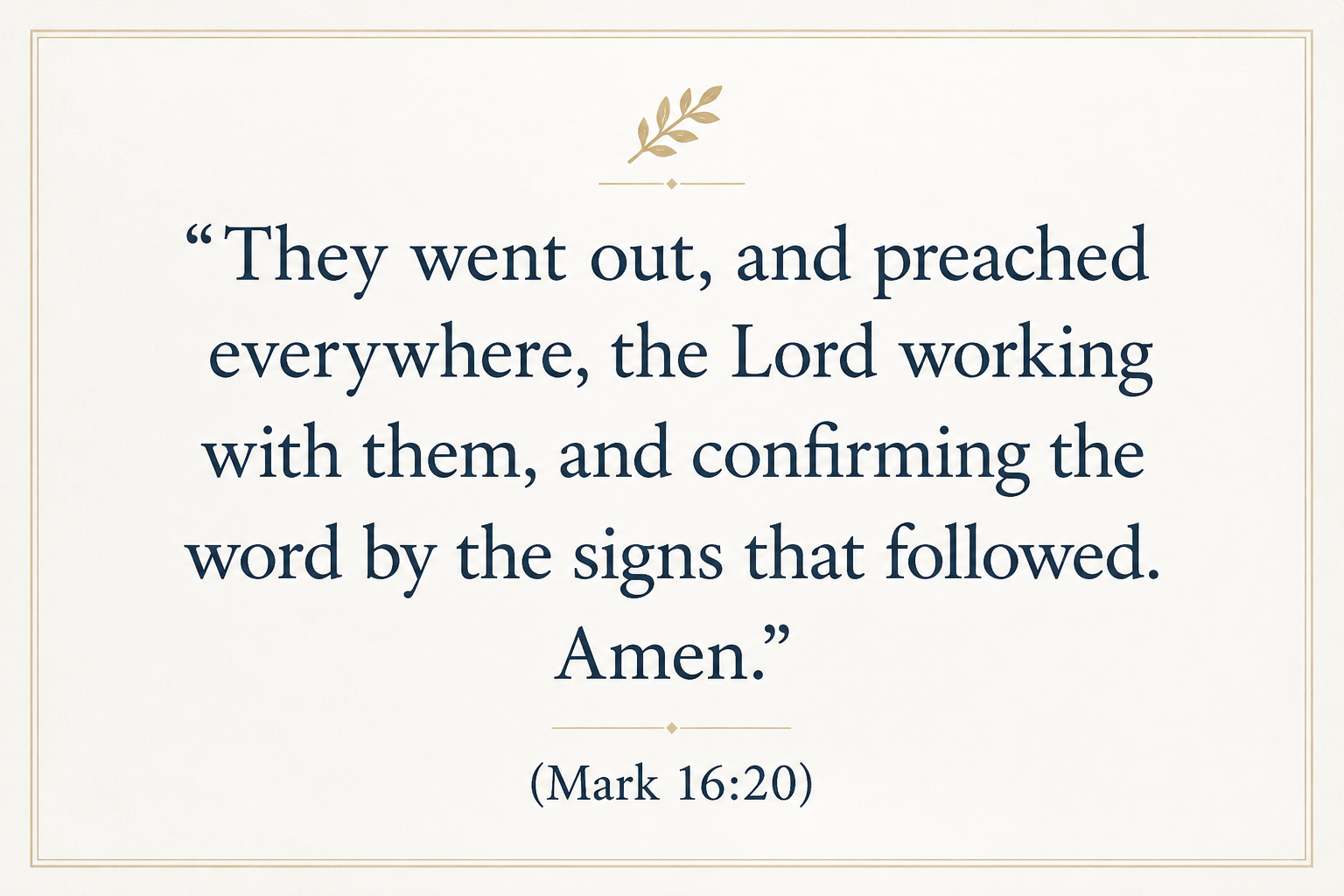
“They went out, and preached everywhere, the Lord working with them, and confirming the word by the signs that followed. Amen.” (Mark 16:20)
Here συνεργέω frames proclamation as shared action: the disciples “preached everywhere,” and the Lord is portrayed as acting alongside them in that same outward movement. The phrase “working with them” places divine activity in close cooperation with human preaching, and the following clause—“confirming the word by the signs that followed”—describes a concrete outcome that accompanies that cooperation. The verb therefore helps bind together the human act (“preached”) and the divine act (“confirming”), presenting them as coordinated rather than isolated.
“We know that all things work together for good for those who love God, for those who are called according to his purpose.” (Romans 8:28)
In this statement of assurance, συνεργέω depicts multiple factors as acting in concert: “all things” are pictured as jointly at work with a unified direction toward “good.” The sentence does not describe a single agent doing the work; instead it portrays a convergence—events, circumstances, and realities taken together—moving as a coordinated whole. The beneficiaries are specified: “those who love God,” further identified as “those who are called according to his purpose.” Within the line of thought, the verb contributes a sense of ordered cooperation among many elements, so that “good” is not the result of one isolated cause but of a combined working.
“that you also be in subjection to such, and to everyone who helps in the work and labors.” (1 Corinthians 16:16)
In an appeal about recognizing certain people, the verb sets a category of persons who “help in the work and labors.” The language joins assistance (“helps”) to strenuous effort (“labors”), suggesting that cooperation is not passive endorsement but active participation alongside others already engaged. The call for “subjection” is directed not only toward a particular group (“such”) but also “to everyone” characterized by this cooperative labor. συνεργέω, as it stands behind “helps,” supports a picture of ministry as shared work in which the community owes due regard to those who enter into the task with others.
“Working together, we entreat also that you do not receive the grace of God in vain,” (2 Corinthians 6:1)
Here συνεργέω introduces an exhortation with a participial idea: “Working together, we entreat.” The appeal (“we entreat”) is grounded in a relationship of cooperation rather than distance; the speakers are not merely issuing an order but approaching their audience from within a shared undertaking. The content of the entreaty concerns the reception of “the grace of God,” and the warning “do not receive…in vain” gives urgency to the cooperative setting. The verb therefore colors the tone of the sentence: the admonition is delivered from the standpoint of joint labor, as if the success of the appeal belongs to a shared enterprise.
“You see that faith worked with his works, and by works faith was perfected.” (James 2:22)
This occurrence uses συνεργέω to describe the relationship between “faith” and “works”: faith “worked with his works.” The statement presents faith not as a detached inward reality but as acting in tandem with deeds; the cooperation is reciprocal in the sense that the two are placed side by side in the same process. The second clause—“and by works faith was perfected”—ties the cooperative working to a resulting completion. The verb thus underscores coordination: faith is pictured as engaged, operating alongside the works rather than merely existing apart from them.
Sense and Usage
Across these passages, συνεργέω consistently presents activity as coordinated rather than solitary. In Mark 16:20, the partnership is explicit and personal: “the Lord” acts alongside “them,” and the cooperation is evidenced by the confirmation of the preached word through accompanying signs. In 2 Corinthians 6:1, the cooperative stance shapes the rhetoric of exhortation: the speakers entreat as participants in a shared effort bound up with the audience’s response to grace.
Romans 8:28 broadens the frame from persons working side by side to “all things” acting in a combined way. The wording still communicates convergence and coordination, but the subject is comprehensive, gathering every factor into a single cooperative movement toward “good” for a defined people. This use shows that the verb can express coordination among many components, not only mutual labor between identifiable coworkers.
In 1 Corinthians 16:16, the verb’s contribution lies in how it defines a group within the community: “everyone who helps in the work and labors.” The cooperation described is practical and effortful, tied to “work” and “labors,” and it carries relational implications—others are to recognize and yield appropriate regard to such workers. In James 2:22, the verb describes an internal coordination within a person’s life: “faith” and “works” are not treated as competing tracks but as collaborative realities operating together, with the outcome that faith reaches its intended maturity “by works.”
Taken together, these uses show συνεργέω functioning in varied contexts—mission, pastoral appeal, communal organization, moral reasoning, and broad confidence—yet always with the same basic picture: multiple agents or elements acting in concert so that the result is attributed to their joint operation. The verb is especially well-suited to highlight outcomes that emerge from partnership: confirmation in Mark, good in Romans, recognized laborers in Corinth, meaningful reception of grace in 2 Corinthians, and perfected faith in James.
Imagery
The passages give συνεργέω vivid, concrete settings: preachers moving outward while the Lord acts alongside them (Mark 16:20), and strenuous “work and labors” that call for communal respect (1 Corinthians 16:16). Even where the language is more conceptual—“all things” converging for good (Romans 8:28) and faith acting in tandem with works (James 2:22)—the verb still carries an image of coordinated effort, like multiple hands on one task, producing a unified outcome.
Sources: Lexical data from Strong’s Exhaustive Concordance and the Translators Brief Lexicon of Extended Strongs for Greek (STEPBible, CC BY). Occurrence data from the Translators Amalgamated Greek New Testament (STEPBible, CC BY). Scripture quotations from the World English Bible (public domain).