Exploring the Meaning of Sumphonos in Greek
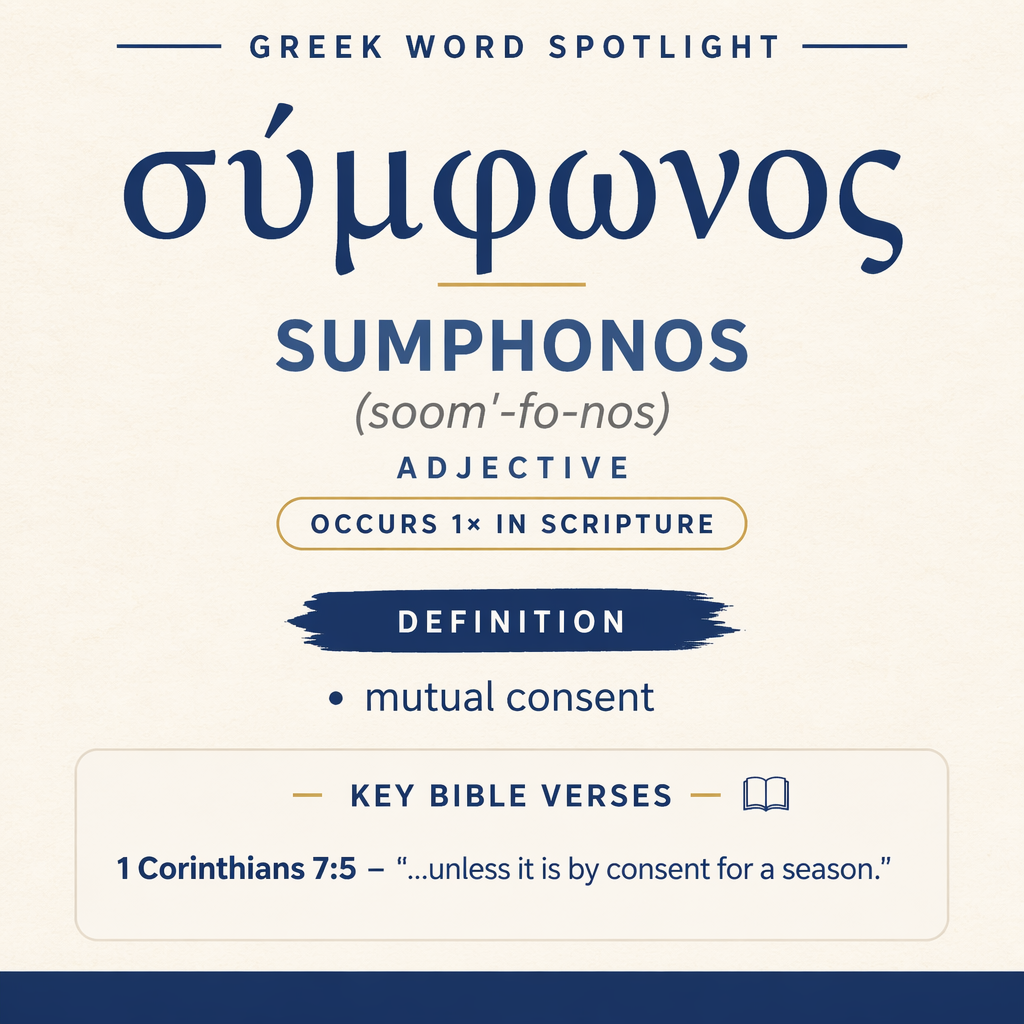
σύμφωνος means “mutual consent” and appears once in Scripture in 1 Corinthians 7:5.
Scripture Occurrence
It occurs one time in Scripture. The occurrence is in 1 Corinthians 7:5.
Learn More →Verse Context
In 1 Corinthians 7:5, it describes refraining “by consent for a season” for fasting and prayer.
Learn More →σύμφωνος expresses “mutual consent,” and it appears in a single New Testament context where agreement sets the terms for a temporary change in marital practice. The word serves Paul’s careful boundary-setting about when and how a couple may refrain from normal conjugal relations.
Root and Related Words
σύμφωνος is associated with syn (σύν), “with” (Strong’s G4862), and phone (φωνή), “voice/sound: voice” (Strong’s G5456). Together these related elements frame the word’s idea in terms of being “with” and “voice,” supplying a conceptual backdrop for consent as something shared rather than unilateral.

Occurrences
“Don’t deprive one another, unless it is by consent for a season, that you may give yourselves to fasting and prayer, and may be together again, that Satan doesn’t tempt you because of your lack of self-control.” (1 Corinthians 7:5)
Here σύμφωνος marks the one allowable condition for a couple to “deprive one another”: it must be “by consent.” The instruction is framed in reciprocal language—“one another”—and the consent named by σύμφωνος fits that mutuality: the exception is not grounded in one spouse’s private preference or spiritual ambition, but in a shared decision.
The consent also has a defined scope. It is “for a season,” and it is connected to a specific purpose: “that you may give yourselves to fasting and prayer.” σύμφωνος therefore functions as a gatekeeper for both the timing and the intention of abstinence. The verse then adds an expected return: “and may be together again,” presenting reunion as the normal outcome. Consent, in this setting, does not authorize an open-ended deprivation; it authorizes a limited, jointly chosen interval.
Finally, the clause “that Satan doesn’t tempt you because of your lack of self-control” places the mutual consent within pastoral realism. The danger envisioned is not merely relational tension but spiritual vulnerability arising from “lack of self-control.” σύμφωνος contributes a stabilizing safeguard: the temporary abstinence is to occur only where both parties willingly align, so that the practice remains measured and does not become a context for temptation fueled by frustration or isolation.
Sense and Usage
The definition “mutual consent” is worked out in 1 Corinthians 7:5 as an interpersonal requirement that protects reciprocity. Paul’s imperative begins negatively—“Don’t deprive one another”—and then carves out a narrow exception. σύμφωνος names the relational shape of that exception: consent belongs to both spouses together, matching the “one another” structure of the command. In other words, the permitted abstinence is not simply something that happens within a marriage; it is something that must be agreed upon within the marriage.
Because the verse ties the abstinence to “fasting and prayer,” σύμφωνος also shows that a spiritual aim does not override mutuality. Even a practice associated with devotion is placed under the requirement of consent. The word’s sense therefore operates as a check against spiritualizing unilateral decisions—decisions that would contradict the reciprocal obligations implied by “Don’t deprive one another.”
At the same time, the verse’s time-bound language (“for a season”) and its expectation of reunion (“may be together again”) clarify what mutual consent does in practice: it structures a temporary arrangement. Consent is not treated as a one-time permission slip detached from ongoing realities; it belongs to an agreed interval with a clear endpoint in view. The moral reasoning given—avoiding temptation tied to “lack of self-control”—shows why this mutuality matters: the couple’s shared agreement helps prevent the exception from creating conditions that undermine the very self-control the passage assumes is fragile.
Within this single attested use, σύμφωνος therefore carries a distinctly practical force. It does not appear as an abstract ideal floating above the situation. It is the concrete criterion that transforms a potential “deprive” into a permitted, purposeful pause: mutual consent, limited in time, oriented toward prayerful focus, and followed by restoration of normal marital togetherness.
Imagery
The verse evokes the picture of a couple voluntarily setting aside ordinary intimacy “for a season” to “give yourselves to fasting and prayer,” and then returning to shared life “again.” σύμφωνος belongs to the hinge of that movement: agreement that both restrains and guides, holding the interval of abstinence together so it remains mutual and does not become deprivation.
Sources: Lexical data from Strong’s Exhaustive Concordance and the Translators Brief Lexicon of Extended Strongs for Greek (STEPBible, CC BY). Occurrence data from the Translators Amalgamated Greek New Testament (STEPBible, CC BY). Scripture quotations from the World English Bible (public domain).