Exploring the Meaning of Sumphonia in Greek
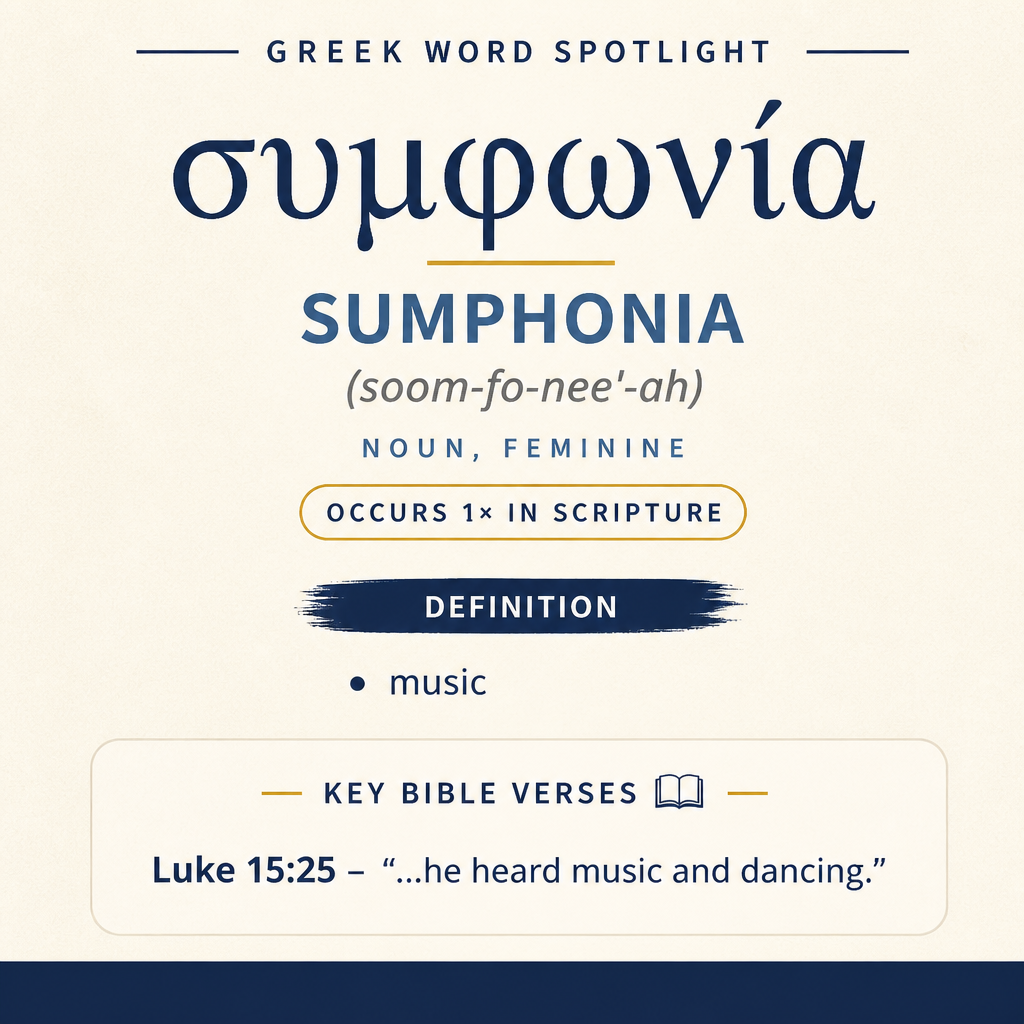
συμφωνία (Sumphonia) means “music” and appears once in Scripture, in Luke 15:25.
Context in Luke
In Luke 15:25, the elder son hears music and dancing as he nears the house.
Learn More →συμφωνία refers to “music” and appears once in the New Testament, in Luke 15:25. In that scene it is something heard near a house, paired with dancing as part of a festal soundscape.
Root and Related Words
συμφωνία is related to sumphōnos (σύμφωνος), “mutual consent” (Strong’s G4859). The relationship points to a conceptual link between music as coordinated sound and the idea of being in agreement.

Occurrences
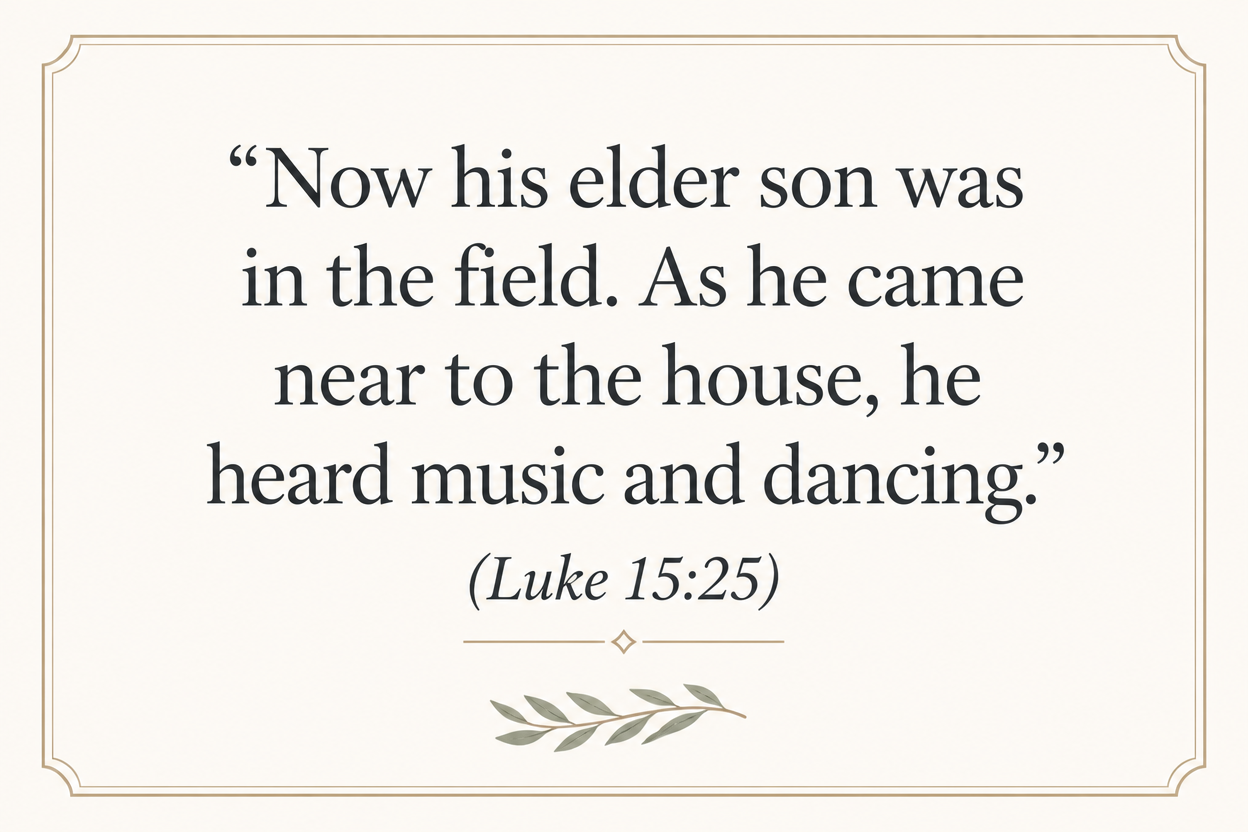
“Now his elder son was in the field. As he came near to the house, he heard music and dancing.” (Luke 15:25)
In Luke 15:25, συμφωνία is presented as an audible marker of what is happening inside the house before the elder son sees anything. The elder son is “in the field,” and the narrative traces a movement of approach: “As he came near to the house, he heard…” The word therefore contributes to the story by functioning as an early signal—sound travels outward, so the celebration is perceptible at a distance. The pairing “music and dancing” sets the scene as lively and communal, not quiet or private. In the flow of the sentence, “music” is not an ornament added after the fact; it is the first thing named that reaches him, shaping his initial perception of the household event.
The collocation with “dancing” also anchors the word in a context of bodily movement and public rejoicing. The elder son’s relation to the event is mediated through hearing: he is outside, approaching, and the first description of the inside atmosphere is acoustic. συμφωνία thus helps establish a contrast between the open field and the busy house: one setting is associated with work and distance, the other with gathered activity. By naming the sound as “music,” the verse portrays the house not merely as occupied but as celebrating, and it prepares for the social and emotional tensions that follow from the elder son encountering evidence of festivity.
Sense and Usage
Within its lone attestation, συμφωνία denotes music as a recognizable, organized sound that can be “heard” and that characterizes an event. It is not described in terms of instruments, melody, volume, or style; its function is narrative and situational, identifying the kind of occasion underway. The word stands alongside “dancing,” so the music is implied to be suitable for dance and to accompany it, presenting a coordinated celebration rather than an incidental noise.
Because the verse places the elder son “near to the house” when he hears it, the music is framed as something that fills a space and crosses a boundary—from inside the house to the approaching listener outside. In this way, συμφωνία works as an environmental cue: it depicts a household moment that is outward-facing enough to be overheard and unmistakable enough to be interpreted as festal. The narrative does not require the reader to know the source of the music; the presence of music itself communicates the household’s mood and activity.
The related word sumphōnos (σύμφωνος), “mutual consent,” suggests an association between music and agreement or concord. Without importing additional senses into συμφωνία, this connection can illuminate how “music” in Luke 15:25 naturally evokes coordination: multiple elements (sounds, rhythms, participants) working together. In the verse, that coordinated activity is heard from a distance and stands as a public sign of something happening within the home.
Imagery
Luke 15:25 casts συμφωνία in the imagery of a house whose celebration can be detected before it can be seen. The elder son’s approach turns the music into a kind of threshold experience: he is still outside, yet the sound draws him into the reality of what is taking place inside. The verse’s simple juxtaposition of “music and dancing” paints a vivid scene of audible joy emanating from a household gathering.
Sources: Lexical data from Strong’s Exhaustive Concordance and the Translators Brief Lexicon of Extended Strongs for Greek (STEPBible, CC BY). Occurrence data from the Translators Amalgamated Greek New Testament (STEPBible, CC BY). Scripture quotations from the World English Bible (public domain).