Exploring the Meaning of Sumphero in Greek
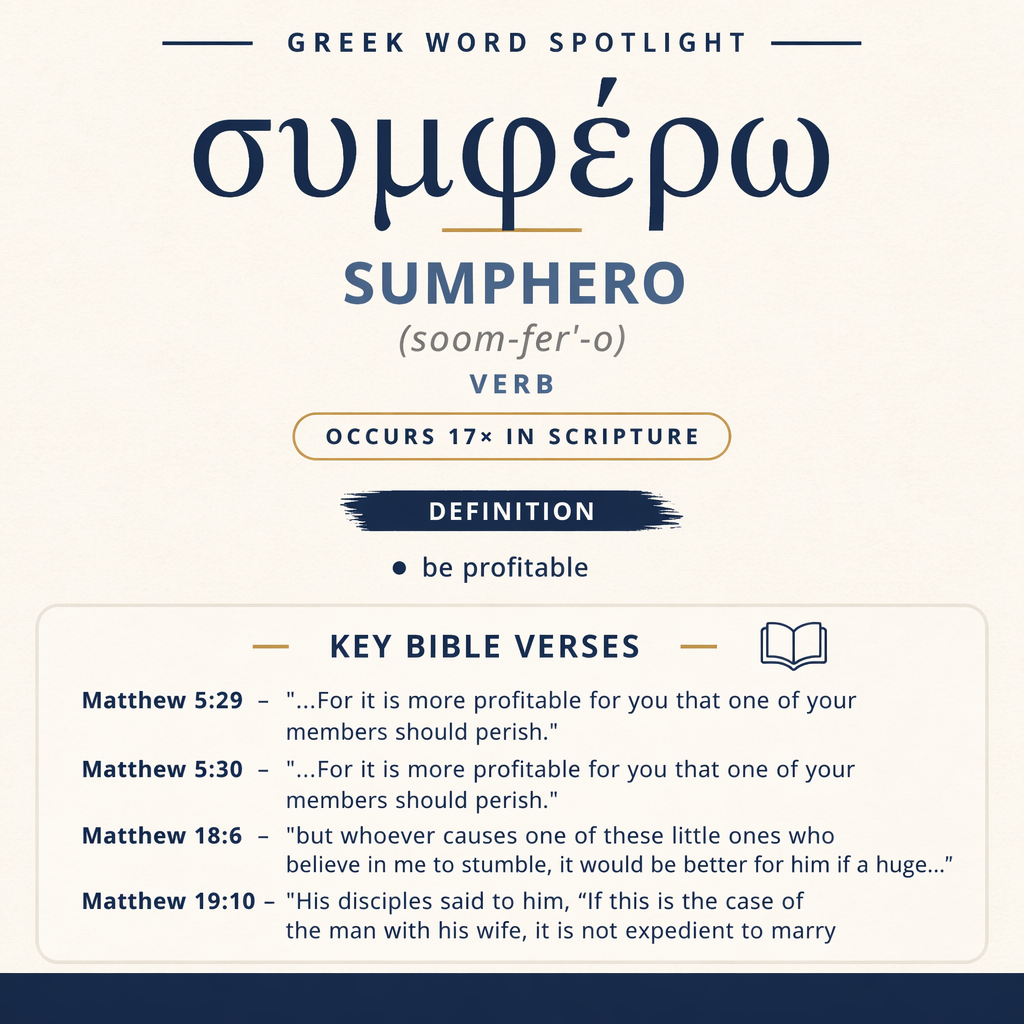
συμφέρω means “be profitable” and occurs 17 times in Scripture, including in Matthew 5, Matthew 18–19, John 11, John 16, John 18, and Acts 19.
Core Meaning
συμφέρω is defined as “be profitable.” In several passages it is rendered “more profitable,” “advantageous,” or “expedient.”
Learn More →Gospel Examples
In Matthew 5:29–30 it frames drastic self-denial as “more profitable.” In John 16:7 Jesus says it is to the disciples’ advantage that he goes away.
Learn More →Further Occurrences
In Matthew 19:10 the disciples call marriage “not expedient” in that case. In John 11:50 and John 18:14 it describes Caiaphas’s claim that one man should perish for the people.
Learn More →Sumphero expresses the idea of what is profitable—what yields advantage, benefit, or gain in view of some outcome. In the passages where it appears, it often frames a hard comparison: one course is judged “more profitable” than another because of what it prevents or what it secures.
Occurrences
Matthew 5:29: “If your right eye causes you to stumble, pluck it out and throw it away from you. For it is more profitable for you that one of your members should perish, than for your whole body to be cast into Gehenna.”
Here Sumphero marks a severe but carefully argued preference: losing “one of your members” is presented as the profitable option when weighed against “your whole body” being cast into Gehenna. The word supplies the logic of advantage: the recommended action is not described as pleasant, but as the course that turns out better in consequence. Profitability is measured by the comparative outcome (“one…should perish” versus “your whole body”).
Matthew 5:30: “If your right hand causes you to stumble, cut it off, and throw it away from you. For it is more profitable for you that one of your members should perish, than for your whole body to be cast into Gehenna.”
The same reasoning is repeated with a different body part, reinforcing that Sumphero can function as the hinge of an argument about costly prevention. The “profit” is not monetary; it is the advantage of avoiding a worse end. The word’s force is comparative and practical: what counts as profitable is what spares the person from the greater loss.
Matthew 18:6: “but whoever causes one of these little ones who believe in me to stumble, it would be better for him if a huge millstone were hung around his neck, and that he were sunk in the depths of the sea.”
In this warning, the idea of advantage is expressed as “it would be better for him,” again setting up a grim comparison of outcomes. The profitable (or advantageous) scenario, paradoxically, is the one involving a “huge millstone” and being “sunk in the depths of the sea,” because the alternative implied by the warning is worse. Sumphero drives the evaluative claim: one fate is judged preferable in view of the moral harm of causing “little ones who believe in me” to stumble.
Matthew 19:10: “His disciples said to him, “If this is the case of the man with his wife, it is not expedient to marry.””
Here the word is used in the disciples’ assessment of marriage under the “case” just discussed: they conclude that marrying is “not expedient.” The contribution of Sumphero is to frame the decision in terms of benefit: they are weighing whether marriage is a profitable course. The line shows how the term can be used for practical conclusions, not only for warnings of judgment.
John 11:50: “nor do you consider that it is advantageous for us that one man should die for the people, and that the whole nation not perish.””
Sumphero appears in calculated political-religious counsel: “advantageous for us” is defined by a proposed exchange—“one man should die for the people” so “the whole nation not perish.” The word frames the argument as a matter of communal profit, with “us” as beneficiaries. It highlights how “profit” can be argued from group survival and perceived necessity, even when the means involve another’s death.
John 16:7: “Nevertheless I tell you the truth: It is to your advantage that I go away, for if I don’t go away, the Counselor won’t come to you. But if I go, I will send him to you.”
In this promise, Sumphero grounds a difficult claim: the departure of the speaker is “to your advantage.” The verse itself supplies the reasoning: “for if I don’t go away, the Counselor won’t come to you.” Profitability here is not immediate comfort but the beneficial outcome of the Counselor coming. The word functions as reassurance, turning a feared loss (“I go away”) into a profitable transition because of what follows (“I will send him to you”).
John 18:14: “Now it was Caiaphas who advised the Jews that it was expedient that one man should perish for the people.”
This recollection reprises the earlier counsel, compressing it into a summary: “it was expedient” that “one man should perish for the people.” Sumphero again marks the logic of advantage, now presented as advice given to “the Jews.” The word contributes a chilling clarity: the proposed death is framed not as justice but as profitable policy for “the people.”
Acts 19:19: “Many of those who practiced magical arts brought their books together and burned them in the sight of all. They counted their price, and found it to be fifty thousand pieces of silver.”
In this scene, the context is explicitly economic: the value of the books is “counted,” reaching “fifty thousand pieces of silver,” yet they are burned publicly. The presence of Sumphero in this episode aligns with the theme of profit and loss, now embodied in a costly action that rejects financial worth. The word’s contribution is to color the moment as a decision about what truly benefits: what could have been kept for its price is destroyed in the open, implying a re-evaluation of what counts as gain.
Acts 20:20: “how I didn’t shrink from declaring to you anything that was profitable, teaching you publicly and from house to house,”
Here Sumphero describes the content of instruction: “anything that was profitable.” The speaker ties profitability to what he “declared” and “taught,” both “publicly and from house to house.” The term frames teaching as beneficial for the hearers, and the phrase “didn’t shrink” emphasizes completeness: profit is not selective advice but “anything” beneficial that needed to be declared.
1 Corinthians 6:12: ““All things are lawful for me,” but not all things are expedient. “All things are lawful for me,” but I will not be brought under the power of anything.”
Sumphero is used to qualify a slogan about what is “lawful.” The contrast—lawful versus expedient—shows that profitability is a different test than mere permission. The following line (“I will not be brought under the power of anything”) sketches how the profitability test works in practice: what seems allowed may still be disadvantageous if it results in being mastered.
1 Corinthians 7:35: “This I say for your own profit; not that I may ensnare you, but for that which is appropriate, and that you may attend to the Lord without distraction.”
Here the word directly labels the aim of counsel: “for your own profit.” The verse then clarifies the kind of profit intended: it is not to “ensnare” but to promote what is “appropriate” and enable undistracted attention. Sumphero thus frames guidance as serving the hearers’ advantage, measured by freedom from distraction rather than by external gain.
1 Corinthians 10:23: ““All things are lawful,” but not all things are profitable. “All things are lawful,” but not all things build up.”
This statement parallels 1 Corinthians 6:12 but adds an explanatory counterpart: “not all things build up.” Sumphero anchors the distinction between what can be done and what should be done for benefit. Profitability is linked with constructive effect; the second clause gives the kind of outcome that fits the profitable category—what “build[s] up.”

Sense and Usage
Across these passages, Sumphero regularly functions as an evaluative verdict rendered after comparing outcomes. In Matthew 5:29–30, profitability is judged by the scale of loss: a lesser loss is chosen to avoid the greater catastrophe. Matthew 18:6 uses the same evaluative pattern but intensifies it: what is “better” is framed as a dreadful fate because it stands as the preferable alternative to being responsible for another’s stumbling.
In John, the term becomes a tool in two sharply different kinds of reasoning. John 11:50 and 18:14 show “advantage” argued from the standpoint of group preservation: one person’s death is presented as the profitable exchange to prevent the nation from perishing. John 16:7 also speaks of advantage, but its reasoning is pastoral and forward-looking: a departure that feels like loss is declared profitable because it secures the coming of the Counselor. In each case the word presses the listener to interpret present events by their resulting benefit.
Acts and 1 Corinthians demonstrate that Sumphero can describe both actions and instruction. Acts 19:19 places profit language near explicit valuation (“fifty thousand pieces of silver”) while narrating a choice that rejects that valuation through public burning; the scene embodies a reordering of what counts as beneficial. Acts 20:20 applies the term to teaching that is beneficial to its audience, highlighting profit as a criterion for what is worth declaring. In 1 Corinthians 6:12 and 10:23, profitability serves as an ethical filter over “lawful” behavior, and 1 Corinthians 7:35 presents “your own profit” as the purpose of counsel aimed at appropriateness and undistracted devotion. Together these uses show profitability operating as a practical measure: not merely what is permitted, but what yields the best end for the person or community in view.
Imagery
The passages attach “profit” language to vivid pictures of loss and gain. Some images are bodily and urgent—an eye plucked out, a hand cut off (Matthew 5:29–30)—where profitability is framed as avoiding Gehenna. Others are starkly physical warnings—a millstone and the depths of the sea (Matthew 18:6)—where “better” is still terrifying. In Acts 19:19, the profitable is set against counted silver and a bonfire of books, while in John 16:7 advantage is pictured as the sequence of departure and arrival: “I go away… I will send him to you.” These images give the term weight: what is profitable is not abstract, but bound to concrete outcomes that can be lost, avoided, secured, or received.
Sources: Lexical data from Strong’s Exhaustive Concordance and the Translators Brief Lexicon of Extended Strongs for Greek (STEPBible, CC BY). Occurrence data from the Translators Amalgamated Greek New Testament (STEPBible, CC BY). Scripture quotations from the World English Bible (public domain).