Exploring the Meaning of Sumphuo in Greek
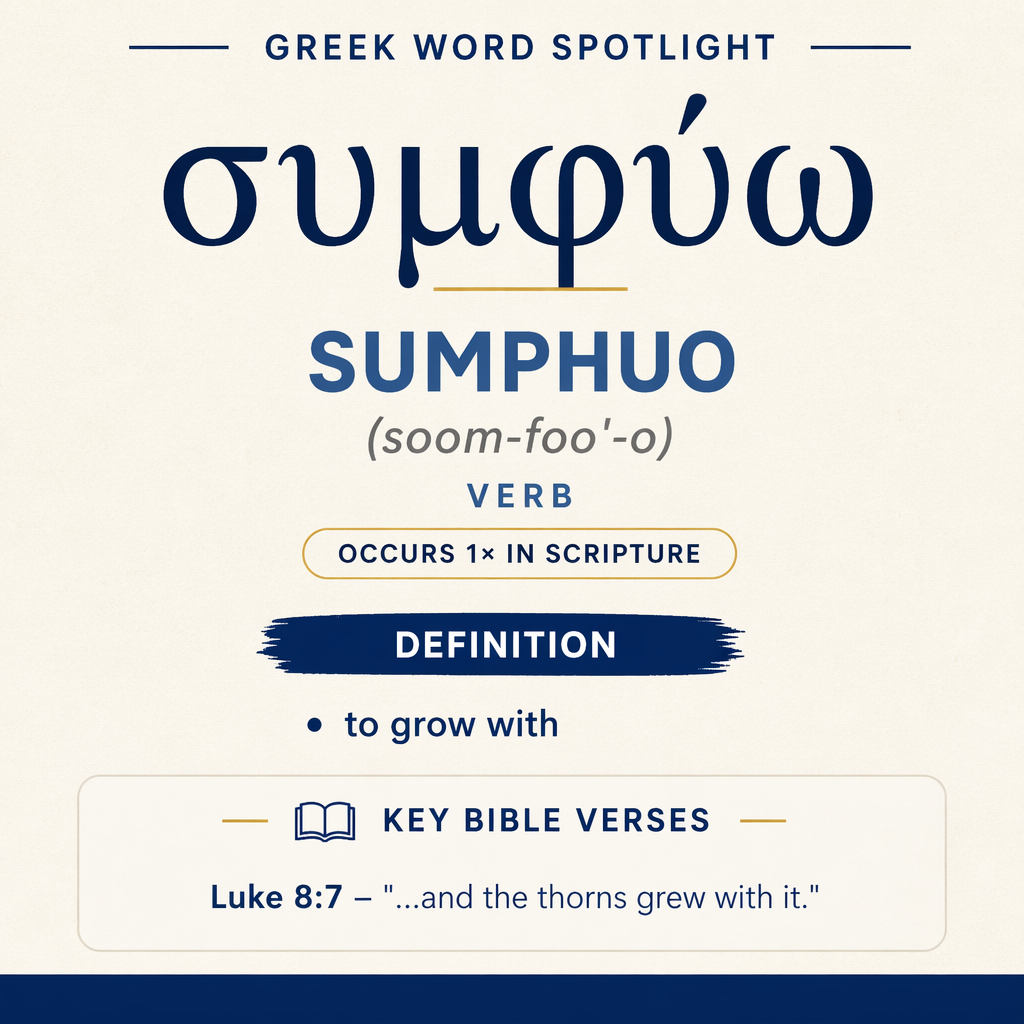
συμφύω means “to grow with” and appears once in Scripture, in Luke 8:7.
Scripture Occurrence
This verb occurs 1 time in Scripture. Its only reference is Luke 8:7.
Learn More →Luke 8:7 Context
In Luke 8:7, the thorns “grew with” what fell among them. The thorns then choked it.
Learn More →συμφύω means “to grow with.” It appears once, in Luke 8:7, within Jesus’ imagery of seed and competing plants in the same ground.
Root and Related Words
συμφύω is built from syn (σύν), “with” (Strong’s G4862), and phyo (φύω), “to grow” (Strong’s G5453). The combined form expresses growth that occurs in company—one growth happening alongside another.

Occurrences
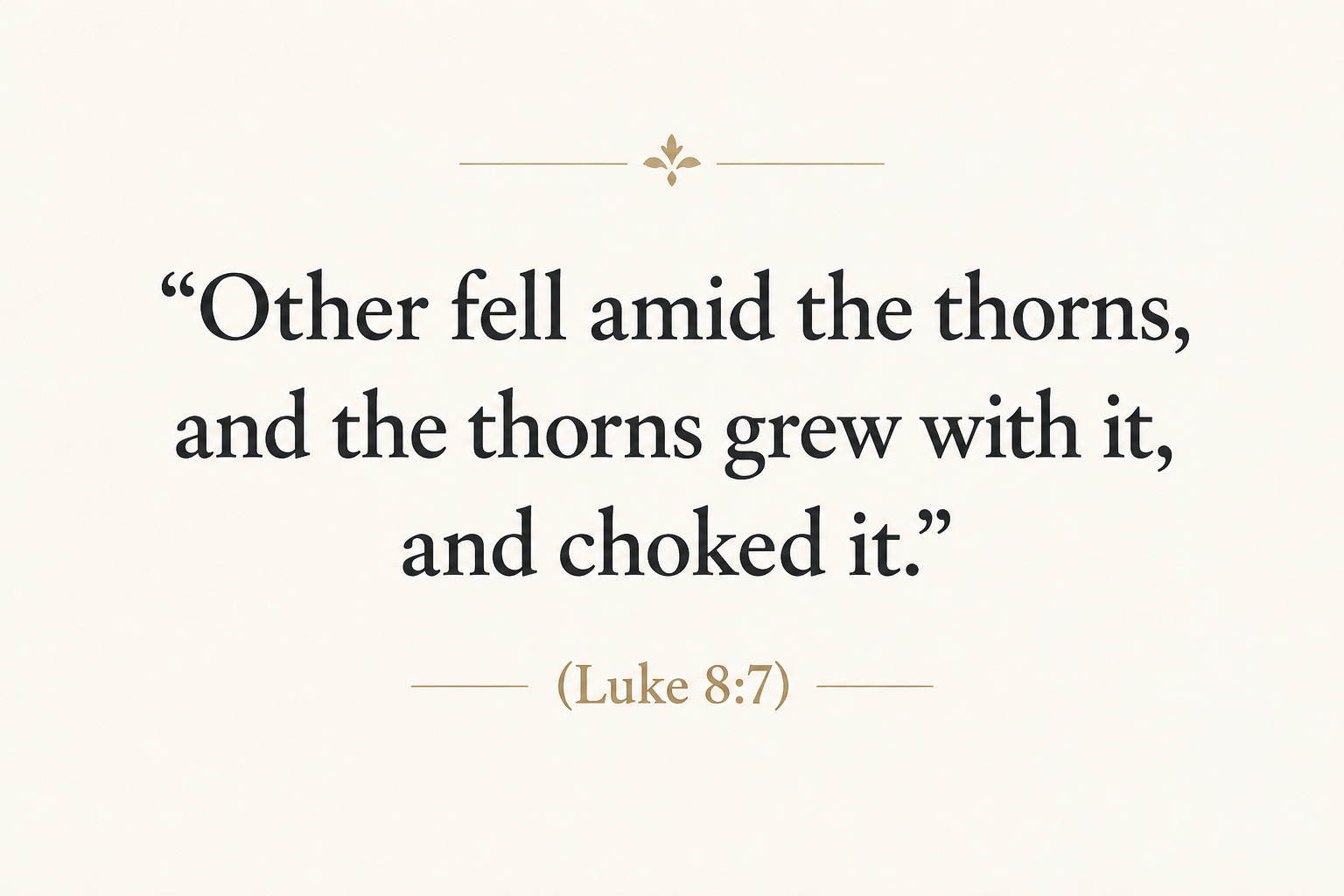
“Other fell amid the thorns, and the thorns grew with it, and choked it.” (Luke 8:7)
In this line, the verb marks a particular kind of growth: the thorns do not merely exist near the seed; they develop in the same time and space as the young plant. The scene includes two living growths sharing one patch of soil—“it” (the sown seed’s plant) and “the thorns.” By saying the thorns “grew with it,” the wording frames the problem as simultaneous development rather than a later intrusion. The choking that follows is presented as the outcome of this co-growing condition: the thorns rise alongside the plant and, as they do, their presence becomes constricting and destructive to the plant’s life.
Sense and Usage
The force of “to grow with” is relational: it describes growth as something that can occur in tandem, with one organism’s development running alongside another’s. In Luke 8:7 this “with” is not cooperative; it is competitive. The verb thus functions as a bridge between the initial sowing (“fell amid the thorns”) and the final result (“choked it”), showing that the choking is not a sudden act disconnected from the growth stage but an effect produced as the thorns and the plant mature together.
Because the subject of the verb is “the thorns,” the expression highlights how competing growth can be active and aggressive without any explicit action verb of attack until the end. The thorns’ co-growth itself becomes the means by which they gain the capacity to choke. The phrase also implies a shared environment: the seedling and the thorns occupy the same place (“amid the thorns”), and the verb portrays what that shared setting naturally yields—concurrent growth that results in the stronger, obstructive vegetation dominating.
Within the sentence’s simple progression—fell, grew with, choked—συμφύω contributes the middle term that clarifies process. “Choked it” could be read as an abrupt reversal, but “grew with it” supplies the developmental logic: as both grew together, the thorns’ increasing presence led to the plant being overwhelmed. The imagery therefore carries a sense of entangling proximity: growth “with” is close enough to become constricting, not merely parallel at a distance.
Imagery
The verb evokes a picture of intertwined life in the same soil: tender growth rising while thorny growth rises beside it. In Luke 8:7, that shared upward movement—two growths in one space—sets the stage for the final, grim contrast between what tries to emerge and what ultimately constricts.
Sources: Lexical data from Strong’s Exhaustive Concordance and the Translators Brief Lexicon of Extended Strongs for Greek (STEPBible, CC BY). Occurrence data from the Translators Amalgamated Greek New Testament (STEPBible, CC BY). Scripture quotations from the World English Bible (public domain).