Exploring the Meaning of Salpizo in Greek
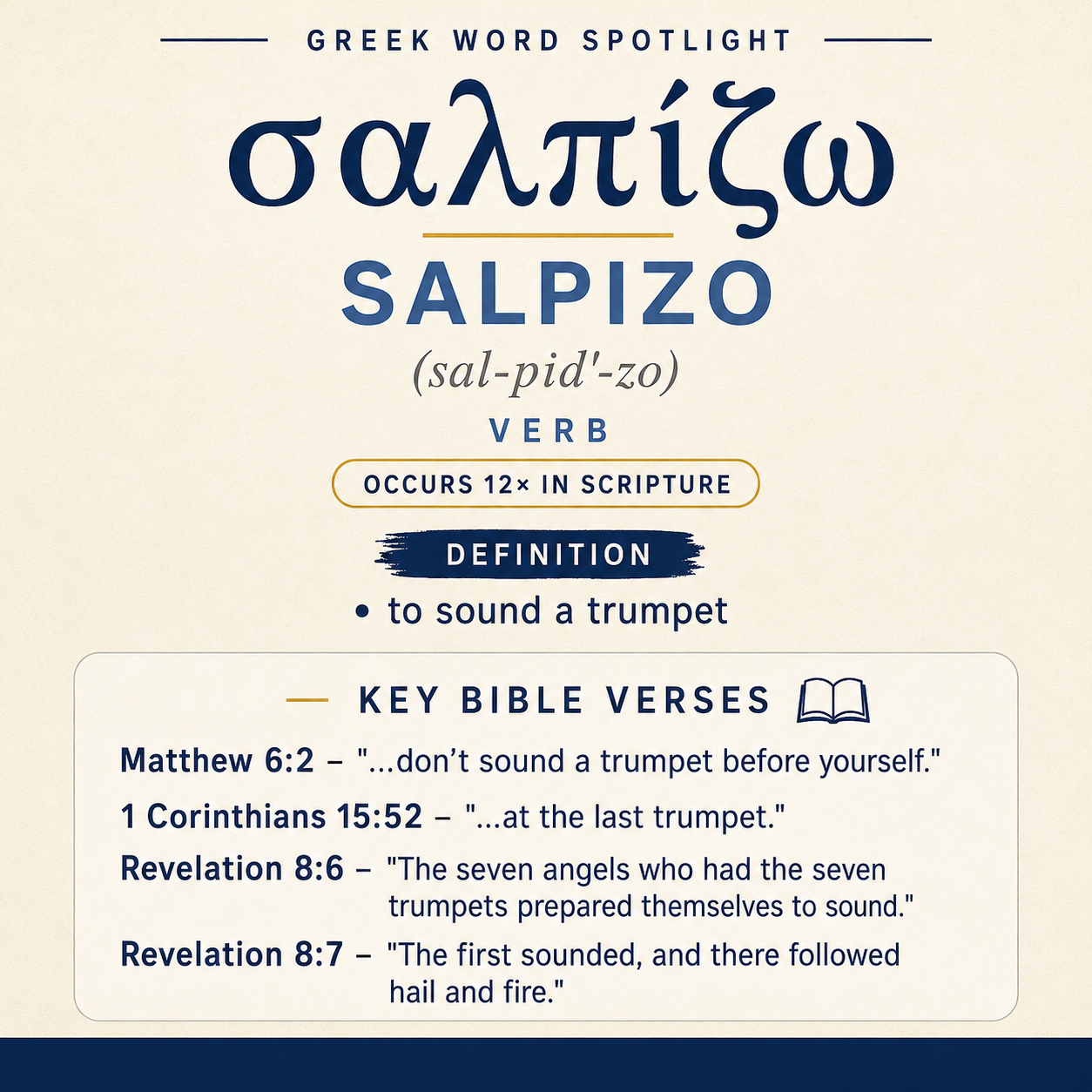
σαλπίζω means “to sound a trumpet,” occurring 12 times in Scripture, including Matthew 6:2, 1 Corinthians 15:52, and Revelation 8:6–13.
Core Meaning
σαλπίζω means “to sound a trumpet.” It describes the action of a trumpet being sounded.
Learn More →Scripture Occurrences
This verb occurs 12 times in Scripture. It appears in Matthew 6:2, 1 Corinthians 15:52, and repeatedly in Revelation 8:6–13.
Learn More →Revelation Trumpets
In Revelation 8:6, seven angels with seven trumpets prepare to sound. In Revelation 8:7–13, successive angels sound, followed by described events.
Learn More →σαλπίζω expresses the act of sounding a trumpet. In the passages where it appears, it ranges from a human attempt to broadcast piety to the ordered trumpet-blasts that mark decisive turns in apocalyptic judgment and consummation.
Occurrences
Matthew 6:2 — “Therefore when you do merciful deeds, don’t sound a trumpet before yourself, as the hypocrites do in the synagogues and in the streets, that they may get glory from men. Most certainly I tell you, they have received their reward.”
Here the verb is framed as a self-advertising announcement. The scene places the sounding “before yourself” alongside public locations (“in the synagogues and in the streets”), so that the trumpet-blast functions as a deliberate signal intended to draw observers and secure “glory from men.” The rebuke turns the action into a vivid picture of performative generosity: a loud, attention-commanding act that competes with the quiet reality of “merciful deeds.”
1 Corinthians 15:52 — “in a moment, in the twinkling of an eye, at the last trumpet. For the trumpet will sound and the dead will be raised incorruptible, and we will be changed.”
The sounding of the trumpet is attached to a precise moment (“in a moment, in the twinkling of an eye”) and to an eschatological marker (“at the last trumpet”). The verb introduces an event that triggers transformation: when the trumpet sounds, “the dead will be raised incorruptible,” and a corporate change follows (“we will be changed”). In this setting, the act of sounding is not mere noise; it is the audible pivot accompanying resurrection and change.
Revelation 8:6 — “The seven angels who had the seven trumpets prepared themselves to sound.”
The verb stands at the threshold of a sequence. The angels possess “the seven trumpets” and “prepared themselves,” presenting the sounding as an intentional, staged action. The emphasis falls on readiness: a controlled transition from preparation to the act of sounding, which will set ensuing events in motion.
Revelation 8:7 — “The first sounded, and there followed hail and fire, mixed with blood, and they were thrown to the earth. One third of the earth was burned up, and one third of the trees were burned up, and all green grass was burned up.”
The first trumpet-sounding is immediately followed by a cascade of effects described as “followed,” with destructive phenomena thrown “to the earth.” The verb marks the initiating signal for what happens next: the blast is the dividing line between the angel’s act and the earthly consequences, quantified in thirds and extending from land to trees to “all green grass.”
Revelation 8:8 — “The second angel sounded, and something like a great burning mountain was thrown into the sea. One third of the sea became blood,”
The second sounding shifts the arena from earth to sea. The verb again functions as the trigger for what “was thrown” and what “became” afterward. The imagery is enormous (“something like a great burning mountain”), and the trumpet-blast signals the start of the sea’s transformation, again measured in “one third.”
Revelation 8:10 — “The third angel sounded, and a great star fell from the sky, burning like a torch, and it fell on one third of the rivers, and on the springs of the waters.”
With the third sounding, the consequences descend from the sky to freshwater sources. The verb introduces the moment when the star’s fall is narrated (“fell from the sky … and it fell”), and it frames the targeted impact on “one third of the rivers” and “the springs of the waters.” The trumpet-sounding is the signal that precedes this focused strike on waters people depend on.
Revelation 8:12 — “The fourth angel sounded, and one third of the sun was struck, and one third of the moon, and one third of the stars; so that one third of them would be darkened, and the day wouldn’t shine for one third of it, and the night in the same way.”
The fourth sounding reaches the heavenly lights. The verb introduces a sequence of being “struck” and then the resulting “darkened” condition, extending to the pattern of day and night. The trumpet-blast is presented as the initiating act for cosmic dimming, again described with careful fractional repetition (“one third”).
Revelation 8:13 — “I saw, and I heard an eagle, flying in mid heaven, saying with a loud voice, “Woe! Woe! Woe for those who dwell on the earth, because of the other voices of the trumpets of the three angels, who are yet to sound!””
This verse does not narrate the sounding itself, but it places the action in suspense: three trumpet “voices” remain “yet to sound.” The eagle’s “loud voice” interprets those future trumpet-soundings as impending “Woe” upon “those who dwell on the earth,” so the verb’s coming actions are anticipated as weighty and dreadful, with the trumpet characterized as having a “voice.”
Revelation 9:1 — “The fifth angel sounded, and I saw a star from the sky which had fallen to the earth. The key to the pit of the abyss was given to him.”
The fifth sounding is paired with John’s immediate perception (“and I saw”), linking the trumpet-blast with the unveiling of a new stage in the vision. The scene centers on authority and access: a “key to the pit of the abyss” is given. The verb therefore signals a transition into a realm described as “the abyss,” with the sounding marking the moment when the next development is set before the seer.
Revelation 9:13 — “The sixth angel sounded. I heard a voice from the horns of the golden altar which is before God,”
The sixth sounding leads directly to an auditory sequel: “I heard a voice.” The connection between the trumpet action and the voice “from the horns of the golden altar” places the sounding within a liturgical-heavenly setting (“before God”). The verb cues a new communication that emerges in response to the trumpet-blast, as the narrative shifts from angelic action to an authoritative voice at the altar.
Revelation 10:7 — “but in the days of the voice of the seventh angel, when he is about to sound, then the mystery of God is finished, as he declared to his servants, the prophets.”
Here the sounding is imminent (“about to sound”) and is tied to “the days of the voice of the seventh angel.” The verb anchors a time window during which something reaches completion: “the mystery of God is finished.” The trumpet-sounding is thus associated not only with discrete effects in creation but with a climax in divine purpose, framed as the finishing point of what had been “declared.”
Revelation 11:15 — “The seventh angel sounded, and great voices in heaven followed, saying, “The kingdom of the world has become the Kingdom of our Lord, and of his Christ. He will reign forever and ever!””
The seventh sounding is followed by “great voices in heaven,” so the trumpet-blast acts as the cue for proclamation. The content of the voices interprets the moment in royal terms: the world’s kingdom “has become” the kingdom “of our Lord, and of his Christ,” with an unending reign declared. The verb marks the turning point at which heavenly acclamation announces a final, comprehensive shift in rule.
Sense and Usage
Across these occurrences, σαλπίζω consistently denotes an audible trumpet-blast, but the contexts assign that blast distinct communicative roles. In Matthew 6:2, the sounding is a social signal manufactured to attract attention; it is linked to place (“synagogues,” “streets”) and motive (“that they may get glory from men”), so the act becomes a public broadcast of the self. The verb, placed in a prohibition (“don’t sound a trumpet”), portrays trumpet-sounding as a means of self-presentation rather than a neutral action.
In 1 Corinthians 15:52, the sounding becomes a temporal and eschatological marker. It is associated with the “last trumpet” and coordinates with instantaneous transformation: the blast accompanies the raising of the dead and the changing of the living. The action is therefore not directed toward human applause but functions as a decisive signal that coincides with resurrection and change.
Revelation concentrates the verb within a structured series. First, readiness is emphasized: “prepared themselves to sound” (Revelation 8:6) sets trumpet-sounding in an ordered ritual-like sequence carried out by angels. Then each sounding punctuates a new stage of impact—on land vegetation (8:7), sea (8:8), rivers and springs (8:10), heavenly lights (8:12), and then developments tied to the abyss (9:1) and to a voice from the altar (9:13). The verb works like a narrative hinge: “The [nth] angel sounded, and…” introduces consequences that “followed,” “were thrown,” “fell,” or were heard as further “voices.” Even where the act is future (“yet to sound,” 8:13; “about to sound,” 10:7), the anticipated trumpet-blasts carry a recognized “voice,” and that voice is linked with woe, completion, and proclamation.
Imagery
These passages invest trumpet-sounding with the feel of a public, unmistakable announcement. In Matthew, it evokes the noisy display of religion in crowded spaces; in 1 Corinthians, it marks the instant of universal change; in Revelation, each blast stands at the head of a new wave of narrated reality—earth, sea, sky, and heaven itself responding as “great voices in heaven followed” (Revelation 11:15). The repeated pattern of sounding and aftermath gives the verb a sharp, declarative force: the trumpet does not whisper but signals moments that cannot be ignored.
Sources: Lexical data from Strong’s Exhaustive Concordance and the Translators Brief Lexicon of Extended Strongs for Greek (STEPBible, CC BY). Occurrence data from the Translators Amalgamated Greek New Testament (STEPBible, CC BY). Scripture quotations from the World English Bible (public domain).