Exploring the Meaning of Salamis in Greek
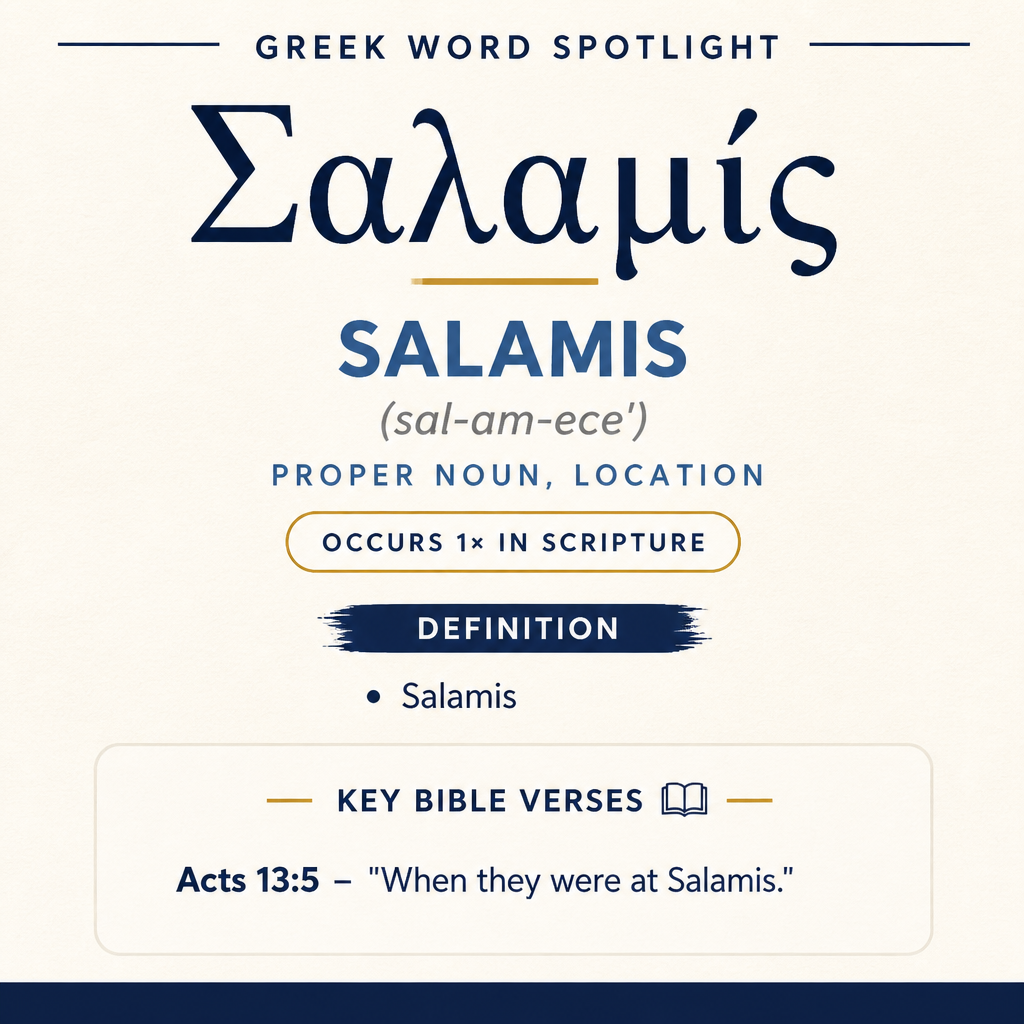
Σαλαμίς means “Salamis” and appears in Acts 13:5.
Acts Context
In Salamis, they proclaimed God’s word in the Jewish synagogues, with John as their attendant.
Learn More →Σαλαμίς refers to Salamis and appears once in the New Testament, in Acts 13:5. In that verse it functions as a concrete place-name that anchors the opening movements of the mission narrative in a specific locale.
Root and Related Words
Strong’s connects Σαλαμίς (Salamis) with the related word salos (σάλος), meaning “tossing” (Strong’s G4535). This relationship is presented as derivational, linking the place-name to that Greek term.
Occurrences
“When they were at Salamis, they proclaimed God’s word in the Jewish synagogues. They also had John as their attendant.” (Acts 13:5)
Here Salamis is the stated location where the action unfolds: “When they were at Salamis….” The name is not decorative; it marks a point on the route where proclamation begins in an identifiable setting. The verse immediately pairs the place with two activities: first, public proclamation (“they proclaimed God’s word”), and second, the choice of venue (“in the Jewish synagogues”). By placing those actions “at Salamis,” the narrative ties the message to a real, located start-point rather than treating it as a detached or purely abstract announcement.
The wording also gives Salamis a kind of narrative weight through what follows it. The verse does not merely say that they arrived; it specifies what they did upon arrival. Salamis, in this line, becomes the place where proclamation and synagogue-setting meet, the locale in which the missionaries’ practice—proclaiming God’s word within Jewish synagogue life—is first depicted in this immediate context. The place-name frames the missionary activity as occurring within established communal spaces (“the Jewish synagogues”), and so Salamis stands as the first named setting for that synagogue-centered proclamation in the verse’s sequence.
In addition, Salamis is where the team’s composition is briefly clarified: “They also had John as their attendant.” The note about John is attached to the same sentence anchored by the place-name, so Salamis functions as the narrative backdrop for both the act of proclamation and the presence of an assistant. The locale thus helps situate not only what was said and where it was said, but also who was present and how the group was supported as it carried out its work.
Sense and Usage
As used in Acts 13:5, Σαλαμίς operates as a straightforward geographical identifier: the name of the place where the described events occur. In the flow of the verse, the place-name does three main kinds of work.
First, it localizes the proclamation of “God’s word.” The verse’s opening clause is a temporal-locative frame (“When they were at Salamis”), which prepares the reader to expect actions tied to a particular stop along a journey. By naming Salamis, the narrative presents proclamation as something that happens in real settings and at specific points along a route, rather than as an undefined activity occurring nowhere in particular.
Second, Salamis functions as an organizing marker for the mission’s method. Immediately after naming the place, the text identifies the setting of proclamation as “the Jewish synagogues.” The place-name therefore contributes to the depiction of a pattern: at this locale, their proclamation is expressed through synagogue preaching. Salamis is not explained or described within the verse; it is simply treated as a known destination, and its primary contribution is to serve as the coordinate at which synagogue proclamation is reported.
Third, the name provides a stable reference point for the mention of John’s role. “They also had John as their attendant” follows the note about synagogues and remains within the same sentence. The result is that Salamis becomes the locale in which both the verbal ministry (“they proclaimed”) and the practical support (“John as their attendant”) are narrated together. In this way, Σαλαμίς, though a brief element in the clause, helps bind together message, venue, and team arrangement into a single, place-situated snapshot.
Because the word is a place-name, its semantic value in context is carried less by descriptive content and more by narrative function: it anchors action, sets a scene, and allows the reader to follow a sequence of movements and events. In Acts 13:5, the sense “Salamis” is expressed by naming the location and then immediately narrating what took place there; the place-name is the hinge that connects arrival to proclamation.
Imagery
Acts 13:5 attaches Salamis to a vivid, concrete picture: a named location where God’s word is proclaimed “in the Jewish synagogues,” with John present as an attendant. The imagery is not of the place itself described in physical detail, but of activity in a defined setting—public proclamation in synagogue spaces—made specific by the simple but decisive naming of Salamis.
Sources: Lexical data from Strong’s Exhaustive Concordance and the Translators Brief Lexicon of Extended Strongs for Greek (STEPBible, CC BY). Occurrence data from the Translators Amalgamated Greek New Testament (STEPBible, CC BY). Scripture quotations from the World English Bible (public domain).