
Exploring the Meaning of Rhomaisti in Greek
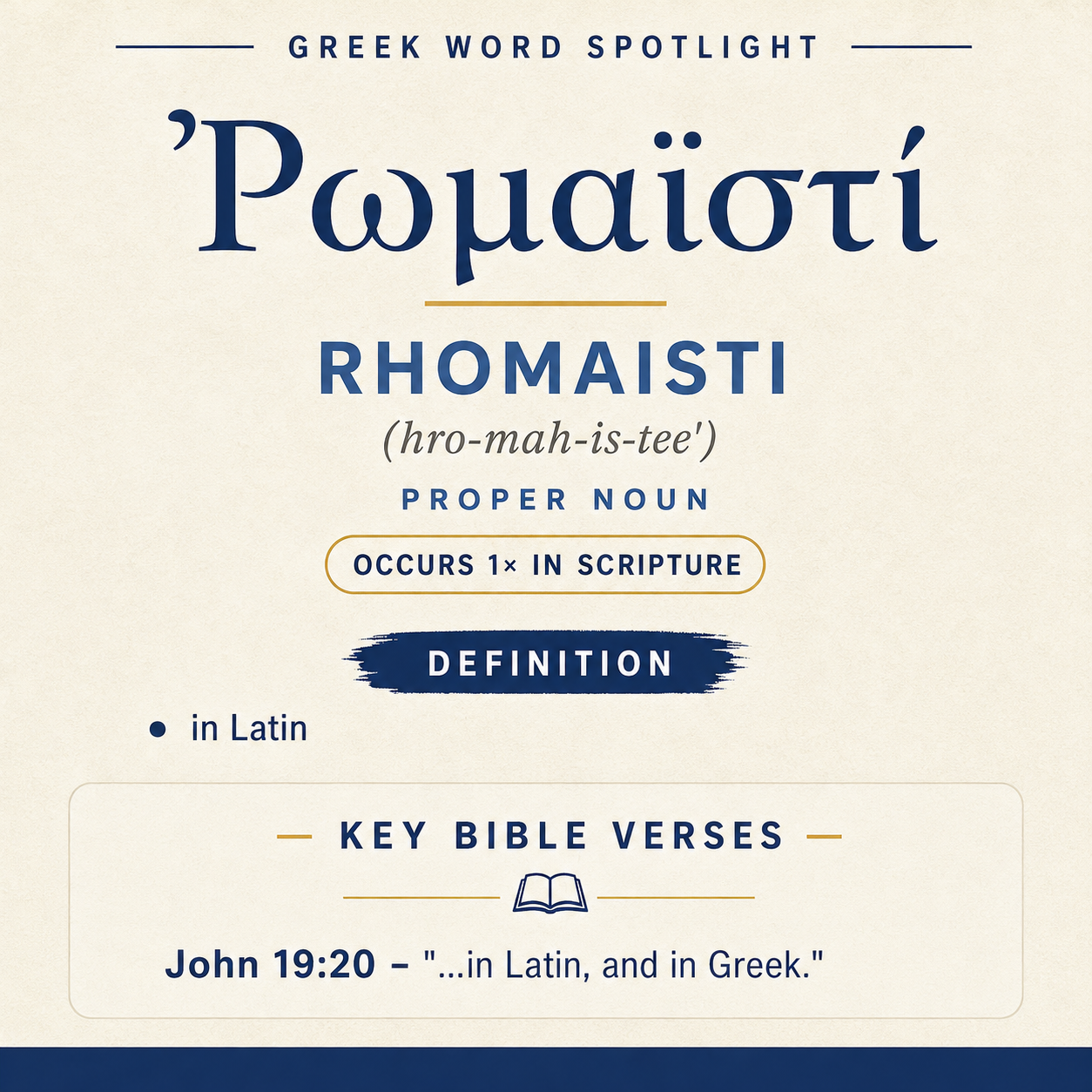
Ῥωμαϊστί means “in Latin” and appears once in Scripture, in John 19:20.
Verse Context
In John 19:20, it describes the language in which the title was written.
Learn More →Ῥωμαϊστί means “in Latin” and appears in the crucifixion narrative to describe one of the languages used for the public title associated with Jesus. Its single New Testament occurrence highlights Latin as part of a multilingual setting at the execution site.
Root and Related Words
Ῥωμαϊστί (Rhōmaisti) is related to Ῥώμη (Rhōmē), “Rome” (Strong’s G4516). The relationship links the adverbial language-label to the place-name associated with Rome.

Occurrences
“Therefore many of the Jews read this title, for the place where Jesus was crucified was near the city; and it was written in Hebrew, in Latin, and in Greek.” (John 19:20)
Here Ῥωμαϊστί specifies that the “title” was written “in Latin” alongside Hebrew and Greek. The verse itself frames the notice as publicly accessible: “many of the Jews read this title,” and the accessibility is explained by location—“the place where Jesus was crucified was near the city.” Within that public, near-the-city setting, the mention of Latin functions as a concrete descriptor of the inscription’s linguistic form. It does not describe who authored the title, nor what it said, but rather the medium of language in which it was presented.

The listing of languages—“in Hebrew, in Latin, and in Greek”—places Latin within a triad. In this scene, Ῥωμαϊστί contributes a sense of official visibility: the title is not confined to a single local tongue but is presented in multiple written forms. The adverb “in Latin” works like a label on the inscription, marking one of its readable versions. Because the narrative emphasizes that “many…read this title,” Ῥωμαϊστί participates in the portrayal of the notice as broadly legible to different audiences who might pass by a crucifixion site “near the city.”
Sense and Usage
As used in John 19:20, Ῥωμαϊστί is a language-marker attached to written communication. It identifies Latin not as an ethnic identity or a geographic region but as the linguistic mode in which something is written. In this context the word belongs to the practical domain of public signage: it is one element in the narrator’s explanation for why the title was widely read. The verse’s logic moves from readership (“many…read”) to proximity (“near the city”) and then to multilingual presentation (“in Hebrew, in Latin, and in Greek”). Within that chain, “in Latin” helps explain how a single title could be read by many in a setting where more than one language might be in use.
The placement of Latin between Hebrew and Greek also makes Ῥωμαϊστί function as part of a deliberate enumeration. The narrative does not argue for Latin’s significance in itself; instead, it uses the language list to underscore the public, outward-facing character of the inscription. The word’s contribution is therefore situational and descriptive: it anchors the title in a real-world linguistic landscape where a written notice can appear in multiple scripts or idioms. In this verse, Ῥωμαϊστί communicates that Latin is one of the explicit written forms present on the title, reinforcing the scene’s emphasis on public readability at a prominent location.
Imagery
John 19:20 evokes the image of a posted title at a crucifixion site “near the city,” readable by passersby. Within that image, Ῥωμαϊστί adds the detail that one of the visible versions of the writing is in Latin, contributing to the impression of a public notice presented in more than one language.
Sources: Lexical data from Strong’s Exhaustive Concordance and the Translators Brief Lexicon of Extended Strongs for Greek (STEPBible, CC BY). Occurrence data from the Translators Amalgamated Greek New Testament (STEPBible, CC BY). Scripture quotations from the World English Bible (public domain).




