
Exploring the Meaning of Rhetos in Greek
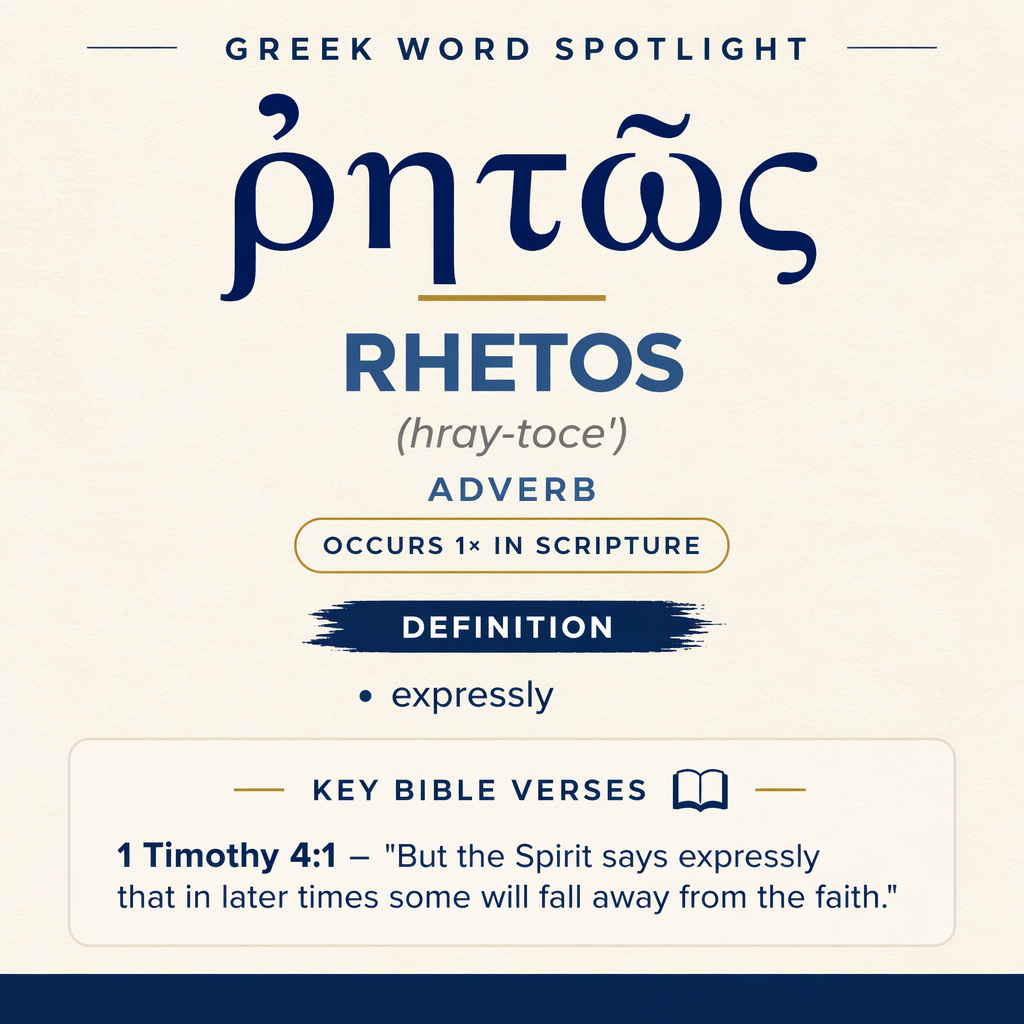
ῥητῶς means “expressly” and appears once in Scripture in 1 Timothy 4:1.
Scripture Occurrence
It occurs 1 time in Scripture. The occurrence is in 1 Timothy 4:1.
Learn More →Verse Context
In 1 Timothy 4:1, it modifies the statement: “But the Spirit says expressly…”. It introduces what the Spirit declares about later times.
Learn More →ῥητῶς means “expressly,” and it appears once in the New Testament, in Paul’s warning to Timothy about future departures from the faith. In its lone setting it marks the Spirit’s message as directly stated, not inferred.
Root and Related Words
ῥητῶς derives from rheo (ἐρέω), “to say” (Strong’s G4483). The adverbial form expresses how something is communicated: as something spoken in a way that is explicit and plainly voiced.

Occurrences
“But the Spirit says expressly that in later times some will fall away from the faith, paying attention to seducing spirits and doctrines of demons,” (1 Timothy 4:1)
Here ῥητῶς modifies the verb of speaking: “the Spirit says expressly.” The adverb frames the content that follows (“that in later times…”) as a message delivered with directness. Paul is not introducing a vague impression or a general mood; he presents the Spirit’s communication as something stated in an explicit manner.

Within the sentence, the adverb prepares the reader for a specific forecast: “in later times some will fall away from the faith.” The clause is not merely descriptive; it is announced as a clearly articulated warning. In the same breath, the verse names the competing influences that accompany this falling away: “seducing spirits and doctrines of demons.” By attaching “expressly” to the Spirit’s speech, the line emphasizes that the danger is not hidden or accidental; the warning is cast as something made plain in advance.
ῥητῶς also affects how the reader hears the relationship between the Spirit’s saying and the subsequent human response described. The verse portrays a movement from an explicit divine utterance (“the Spirit says expressly”) to a human turning (“some will fall away from the faith”) and then to a reorientation of attention (“paying attention to seducing spirits and doctrines of demons”). The adverb strengthens the contrast: the Spirit’s message is delivered in a straightforward way, yet some will still redirect their attention elsewhere.
Sense and Usage
The force of “expressly” in 1 Timothy 4:1 is to characterize speech as explicit, setting an expectation of clarity. It belongs to the manner of communication rather than to the content itself: the content is the warning about later times, falling away, and the lure of seducing spirits and demonic teachings, but ῥητῶς marks the way the message is said—openly and directly.
In this context, “expressly” functions like a marker of unambiguous disclosure. It positions the prophecy as something stated in a way that does not require the audience to piece it together from hints. That does not add new information beyond the warning; instead it governs how the warning is to be received: as a plain declaration.
The placement of ῥητῶς also heightens the rhetorical weight of the verse. Paul introduces the Spirit as the speaker and then underscores the directness of what the Spirit says before the warning is even heard. The adverb thereby strengthens the seriousness of the forecast, not by intensifying the predicted events themselves, but by stressing that the prediction is communicated in an explicit manner. The result is a sentence that reads as a clear alert: later apostasy and deceptive teaching are not presented as remote possibilities but as matters spoken out plainly.
Imagery
Although ῥητῶς is not a visual term, the verse that contains it evokes the scene of an unmistakable announcement set against an approaching period of spiritual deception. “The Spirit says expressly” suggests a clear, direct utterance standing in contrast with “seducing spirits and doctrines of demons,” which are portrayed as rival voices drawing attention away from the faith.
Sources: Lexical data from Strong’s Exhaustive Concordance and the Translators Brief Lexicon of Extended Strongs for Greek (STEPBible, CC BY). Occurrence data from the Translators Amalgamated Greek New Testament (STEPBible, CC BY). Scripture quotations from the World English Bible (public domain).





