Exploring the Meaning of Poimnion in Greek
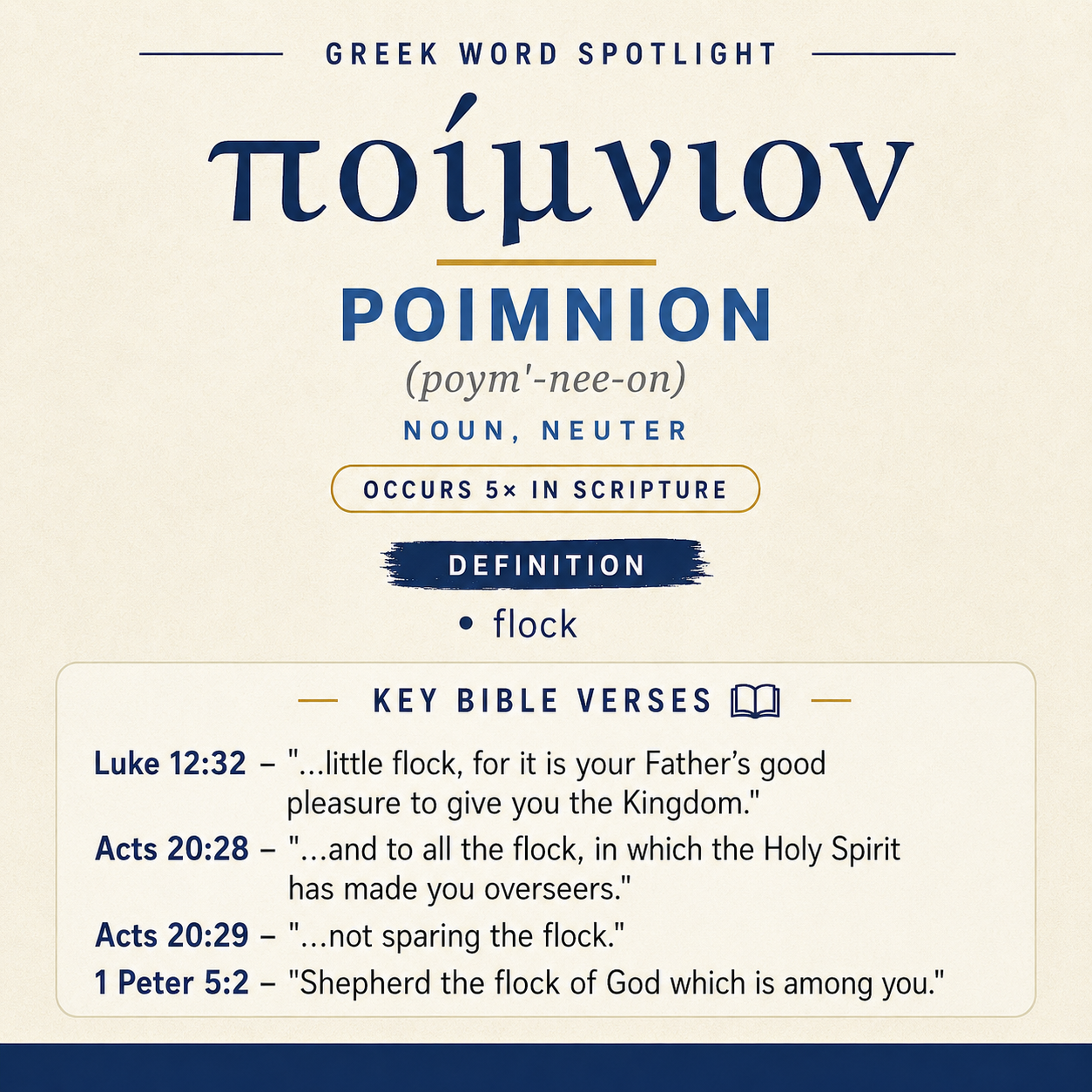
ποίμνιον means “flock” and appears five times in Scripture: Luke 12:32; Acts 20:28–29; 1 Peter 5:2–3.
Core Meaning
ποίμνιον refers to a “flock.” It is used of God’s people in these passages.
Learn More →Luke Context
In Luke 12:32, Jesus addresses believers as a “little flock.” The Father is pleased to give them the Kingdom.
Learn More →Church Oversight
In Acts 20:28–29 and 1 Peter 5:2–3, leaders are told to shepherd and oversee the flock. The flock is warned against “vicious wolves,” and leaders must be examples, not domineering.
Learn More →ποίμνιον refers to a “flock,” and in the New Testament it appears in sayings and exhortations that picture God’s people as a flock under care, protection, and oversight. The term occurs in Jesus’ address to disciples, in Paul’s farewell warning to elders, and in Peter’s instructions to leaders.
Root and Related Words
ποίμνιον (Poimnion) derives from ποίμνη (poimnē), “flock” (Strong’s G4167).
Occurrences
“Don’t be afraid, little flock, for it is your Father’s good pleasure to give you the Kingdom.” (Luke 12:32)
Here ποίμνιον is directly addressed: “little flock.” The word contributes an intimate, pastoral image for the hearers as a single gathered group, small enough to be spoken to as one unit and cared for as one. In the sentence, the flock-image anchors a reassurance—“Don’t be afraid”—and connects that comfort to the Father’s intention: “to give you the Kingdom.” The flock is not portrayed as self-securing; it is spoken of as receiving a gift rooted in the Father’s “good pleasure.” The diminutive description (“little”) sharpens the emotional force of the command against fear: the community’s size or vulnerability does not alter the Father’s generosity toward it.

“Take heed, therefore, to yourselves, and to all the flock, in which the Holy Spirit has made you overseers, to shepherd the assembly of the Lord and God which he purchased with his own blood.” (Acts 20:28)
In Paul’s charge, ποίμνιον names those who fall under the elders’ responsibility: “all the flock.” The word frames leadership in relational and moral terms. First, the overseers must “take heed…to yourselves,” then extend vigilant attention “to all the flock,” implying that care for the community cannot be separated from the leaders’ own watchfulness. The flock is also placed within divine agency: it is the sphere “in which the Holy Spirit has made you overseers.” Finally, the flock-image is paired with an explicit shepherding task: “to shepherd the assembly of the Lord and God.” In this verse, “flock” and “assembly” are brought together, with shepherding language bridging them; the word emphasizes that the assembly is not merely an organization but a living community requiring protection and guidance. The statement that God “purchased” the assembly “with his own blood” heightens the gravity of the elders’ relation to the flock: the flock is precious because of the cost named in the verse.
“For I know that after my departure, vicious wolves will enter in among you, not sparing the flock.” (Acts 20:29)
Still within the same farewell context, ποίμνιον becomes the object of a threat: “not sparing the flock.” The flock-image sharpens the contrast between those who are cared for and the predatory intruders, “vicious wolves.” The word contributes a sense of collective vulnerability: the flock is a target, and the danger is described as entering “among you,” indicating infiltration rather than a distant hazard. The phrase “not sparing” portrays the flock as subject to harm if unprotected. In the flow from Acts 20:28 to 20:29, the word helps connect responsibility and warning: the overseers’ shepherding duty is set against the reality of coming aggressors who will not treat the flock gently.
“Shepherd the flock of God which is among you, exercising the oversight, not under compulsion, but voluntarily, not for dishonest gain, but willingly;” (1 Peter 5:2)
Peter uses ποίμνιον in a directive: “Shepherd the flock of God which is among you.” The word identifies the community entrusted to local leaders, and the phrase “of God” marks whose flock it is, even as it is “among you” geographically and relationally present. The command pairs shepherding with “exercising the oversight,” aligning the flock-image with concrete leadership action. Peter then places ethical boundaries on how this oversight is practiced: it must not be “under compulsion,” but “voluntarily”; not “for dishonest gain,” but “willingly.” In this setting, “flock” accentuates the personal nature of leadership: one does not oversee a flock rightly through coercion or exploitation. The flock is treated as a community to be tended with integrity of motive.
“not as lording it over those entrusted to you, but making yourselves examples to the flock.” (1 Peter 5:3)
In the continuation of the same exhortation, ποίμνιον again names the people affected by leaders’ posture: they must lead “not as lording it over those entrusted to you,” but as “examples to the flock.” The word helps keep the focus on the community’s wellbeing rather than on leaders’ power. “Those entrusted to you” and “the flock” mutually interpret one another: the flock is a trust, not a possession, and leadership is framed by accountability and example. The phrase “examples to the flock” shows that the flock learns not only from instruction but from embodied patterns of life; the flock-image makes the leaders’ conduct visible and influential within a close-knit community.
Sense and Usage
Across these passages, “flock” functions as a communal designation: it gathers many individuals under a single picture of belonging and care. In Luke 12:32 the term is used vocatively (“little flock”), strengthening reassurance by portraying the hearers as one group addressed by a protecting Father who gives the Kingdom. In Acts 20:28–29, “the flock” appears within a leadership charge and an imminent-warning scene; the word highlights that the community requires attentive oversight and is exposed to predatory harm (“vicious wolves”) if neglected. In 1 Peter 5:2–3, “the flock of God” is the setting in which leadership character is tested; shepherding and oversight are inseparable from motives (“not under compulsion…not for dishonest gain”) and from manner (“not as lording it over…examples”).
The term also carries a consistent relational orientation. A flock is not described here as a loose crowd but as an entity that can be addressed, watched over, threatened, and guided. That coherence allows the writers to speak both tenderly and urgently: tenderly, by calming fear and pointing to the Father’s pleasure; urgently, by charging overseers to take heed and by warning that violent entrants may appear. The word therefore supports both comfort and accountability in these contexts: comfort to the flock itself, and accountability to those who are called to shepherd it.
Imagery in Context
These texts use flock-imagery to depict a community whose safety and health depend on faithful care. Luke speaks to a “little flock” receiving a royal gift; Acts places the flock amid spiritual and moral danger, where “vicious wolves” threaten and overseers must “take heed”; Peter presents the flock as “of God” and “among you,” where leaders must reject domination and instead become “examples.” The repeated image keeps the focus on shared life: one people gathered together, valuable to God, and requiring vigilant, willing oversight.
Sources: Lexical data from Strong’s Exhaustive Concordance and the Translators Brief Lexicon of Extended Strongs for Greek (STEPBible, CC BY). Occurrence data from the Translators Amalgamated Greek New Testament (STEPBible, CC BY). Scripture quotations from the World English Bible (public domain).