Exploring the Meaning of Poimaino in Greek
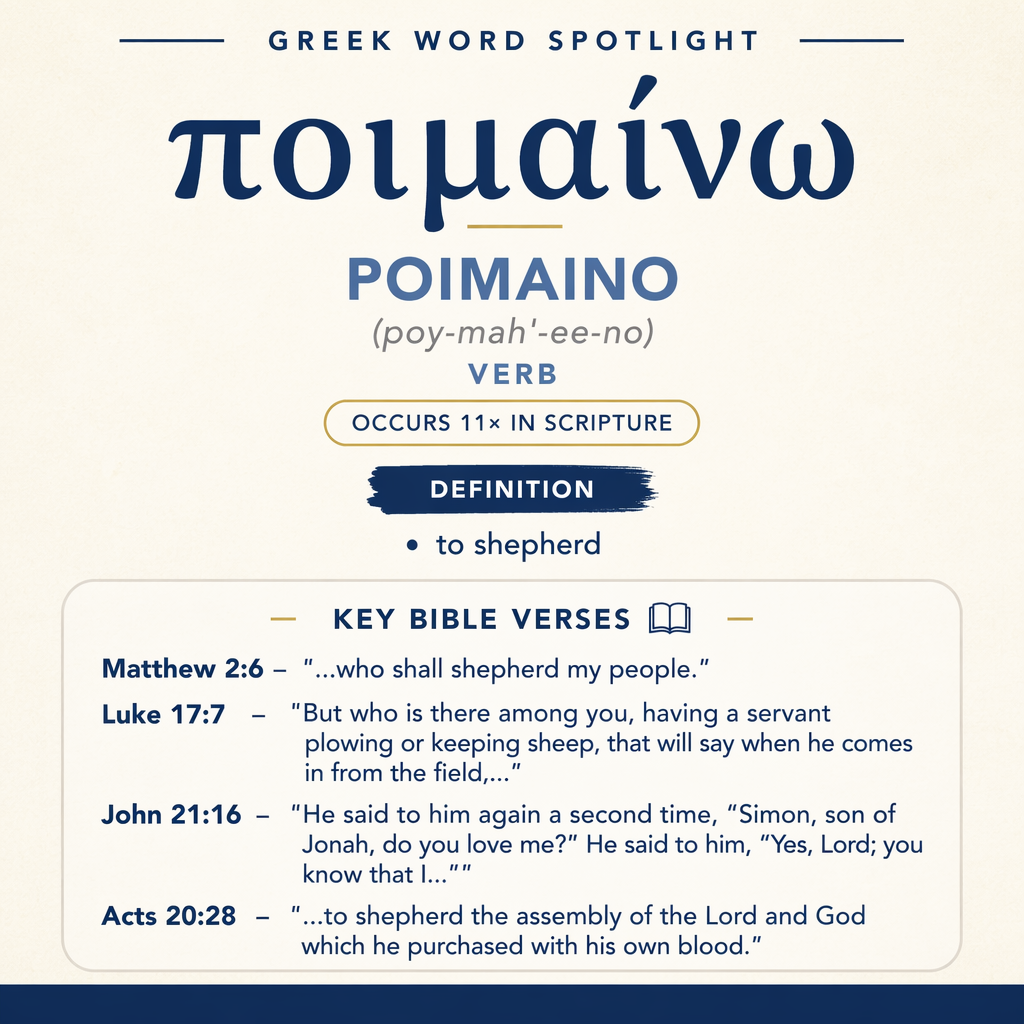
ποιμαίνω means “to shepherd” and occurs 11 times in Scripture, including Matthew 2:6; Acts 20:28; 1 Peter 5:2; and Revelation 2:27.
Scripture Occurrences
This verb occurs 11 times in Scripture. Listed references include Matthew 2:6; Luke 17:7; John 21:16; Acts 20:28; 1 Corinthians 9:7; 1 Peter 5:2; Jude 1:12; and Revelation 2:27.
Learn More →Usage Snapshots
It is used for shepherding a flock (Acts 20:28; 1 Peter 5:2). It also appears in contexts of feeding or tending sheep and flocks (Luke 17:7; 1 Corinthians 9:7).
Learn More →ποιμαίνω means “to shepherd,” a verb used for governing, caring for, and directing a people pictured as a flock. It appears across narrative, apostolic exhortation, and apocalyptic scenes where leadership is framed in pastoral terms.
Occurrences
“‘You Bethlehem, land of Judah, are in no way least among the princes of Judah: for out of you shall come a governor, who shall shepherd my people, Israel.’ ” (Matthew 2:6)
Here ποιμαίνω is attached to “a governor” coming “out of” Bethlehem. The verb presents his rule over “my people, Israel” in the concrete image of flock-care: the coming leader governs by shepherding, not merely by holding office.

“But who is there among you, having a servant plowing or keeping sheep, that will say when he comes in from the field, ‘Come immediately and sit down at the table,’” (Luke 17:7)
This scene supplies the everyday labor-world in which shepherding is understood: “keeping sheep” is listed alongside plowing as routine field work done by a servant. The occurrence anchors the shepherd image in ordinary responsibilities—work that continues until the master’s purposes are met.
“He said to him again a second time, “Simon, son of Jonah, do you love me?” He said to him, “Yes, Lord; you know that I have affection for you.” He said to him, “Tend my sheep.”” (John 21:16)
In this exchange, the command “Tend my sheep” applies the shepherding verb to a personal commission. The sheep belong to the speaker (“my sheep”), so the action is care exercised on behalf of another owner, and it is tied closely to the relational question, “do you love me?”
“Take heed, therefore, to yourselves, and to all the flock, in which the Holy Spirit has made you overseers, to shepherd the assembly of the Lord and God which he purchased with his own blood.” (Acts 20:28)
ποιμαίνω is explicitly linked to oversight: overseers are told to watch “yourselves” and “all the flock,” and their task is “to shepherd the assembly of the Lord and God.” The “flock” metaphor identifies the community as something living and vulnerable, while the description “which he purchased with his own blood” heightens the gravity of shepherding as careful guardianship of what is costly.
“What soldier ever serves at his own expense? Who plants a vineyard, and doesn’t eat of its fruit? Or who feeds a flock, and doesn’t drink from the flock’s milk?” (1 Corinthians 9:7)
This rhetorical set pairs three familiar roles with their ordinary share in the benefits of their labor. “Feeds a flock” draws on the shepherding task to make a commonsense point: the one who tends and sustains a flock normally partakes of what the flock provides (“the flock’s milk”). The verb thus supports an argument from everyday equity.
“Shepherd the flock of God which is among you, exercising the oversight, not under compulsion, but voluntarily, not for dishonest gain, but willingly;” (1 Peter 5:2)
The command places shepherding within the local reality of a community: “the flock of God which is among you.” The verse immediately qualifies how shepherding is to be carried out—“exercising the oversight” in a manner marked by willingness rather than compulsion, and integrity rather than “dishonest gain.” ποιμαίνω here names leadership as attentive care with a defined moral posture.
“These are hidden rocky reefs in your love feasts when they feast with you, shepherds who without fear feed themselves; clouds without water, carried along by winds; autumn trees without fruit, twice dead, plucked up by the roots;” (Jude 1:12)
In this sharp portrait, the term “shepherds” is set in contrast to what shepherding ought to be: instead of caring for the flock, they “without fear feed themselves.” The imagery of danger (“hidden rocky reefs”) and fruitlessness (“clouds without water,” “autumn trees without fruit”) casts these “shepherds” as destructive and self-serving within communal meals.
“He will rule them with a rod of iron, shattering them like clay pots; as I also have received of my Father:” (Revelation 2:27)
Though the English reads “rule,” this occurrence stands in the same shepherding verb’s range in Revelation’s scenes: governance is described with forceful, unyielding imagery. The “rod of iron” and the result—“shattering them like clay pots”—present shepherding as authoritative control over resistant nations.
“for the Lamb who is in the middle of the throne shepherds them and leads them to springs of life-giving waters. And God will wipe away every tear from their eyes.” (Revelation 7:17)
Here the shepherd is “the Lamb,” and the action is both protective and guiding: he “shepherds them and leads them to springs of life-giving waters.” The verse pairs shepherding with consolation—“God will wipe away every tear”—so the verb participates in a scene of care, direction, and relief for the tearful.
“She gave birth to a son, a male child, who is to rule all the nations with a rod of iron. Her child was caught up to God, and to his throne.” (Revelation 12:5)
Again the English presents “rule,” and again the action is specified “with a rod of iron,” now applied to “all the nations.” In this birth-and-exaltation scene, shepherding imagery is fused to royal destiny: the child’s future governance is expressed as firm, decisive rule over the nations.
“Out of his mouth proceeds a sharp, double-edged sword, that with it he should strike the nations. He will rule them with an iron rod. He treads the wine press of the fierceness of the wrath of God, the Almighty.” (Revelation 19:15)
This depiction intensifies the governing aspect associated with ποιμαίνω in Revelation: “strike the nations,” “rule them with an iron rod,” and “treads the wine press” all paint shepherding as victorious authority enacted in judgment. The verb belongs to a scene where rule is not merely guidance but the enforcement of dominion.
Sense and Usage
Across these passages, ποιμαίνω consistently casts leadership in pastoral terms, but the pastoral frame flexes according to context. In Matthew 2:6, shepherding describes a governor’s relationship to “my people, Israel,” presenting governance as care for a defined people. John 21:16 personalizes the same action as an entrusted duty: the shepherding target is “my sheep,” and the command comes from the one who owns the flock, so the shepherd’s work is delegated stewardship rather than possession.
Acts 20:28 and 1 Peter 5:2 develop shepherding as structured oversight within the community. Both explicitly name the group as a “flock,” and both connect shepherding to watchfulness and moral responsibility. Acts adds the solemn valuation of the flock as purchased “with his own blood,” while 1 Peter specifies the internal dispositions that match shepherding—voluntary service and freedom from “dishonest gain.” Together they show that shepherding can describe an office-bearing responsibility (“overseers”) as well as the manner in which such responsibility is exercised.
Luke 17:7 and 1 Corinthians 9:7 keep the verb grounded in the commonplace. “Keeping sheep” stands beside “plowing” as ordinary labor, and “feeds a flock” is used as an everyday analogy about the normal share in the produce of one’s work. These uses give texture to the metaphorical applications elsewhere: shepherding is not a distant ideal but a task with routine demands, time, and expectations.
Jude 1:12 shows how powerful the shepherd image becomes when inverted. Calling certain people “shepherds” while portraying them as those “who without fear feed themselves” highlights betrayal of role: the title implies responsibility for others, yet the action described is self-consumption in the very setting of shared fellowship (“your love feasts”). The shepherding concept, therefore, can function as a moral measure—what shepherds do is visible in whether they feed the flock or themselves.
Revelation uses the shepherding verb within explicitly coercive royal imagery (“rod of iron”) while also preserving a gentler pastoral direction (“leads them to springs of life-giving waters”). The same shepherding frame thus spans tender guidance and unbreakable rule. Revelation 7:17 places shepherding at the center of comfort and provision, whereas Revelation 2:27, 12:5, and 19:15 associate it with decisive dominion over “the nations,” even to the point of shattering resistance. Within these scenes, shepherding includes both leading and restraining—actions that a flock-and-rod image can carry, depending on whether the flock is being guided to water or subjected to an iron rule.
Imagery
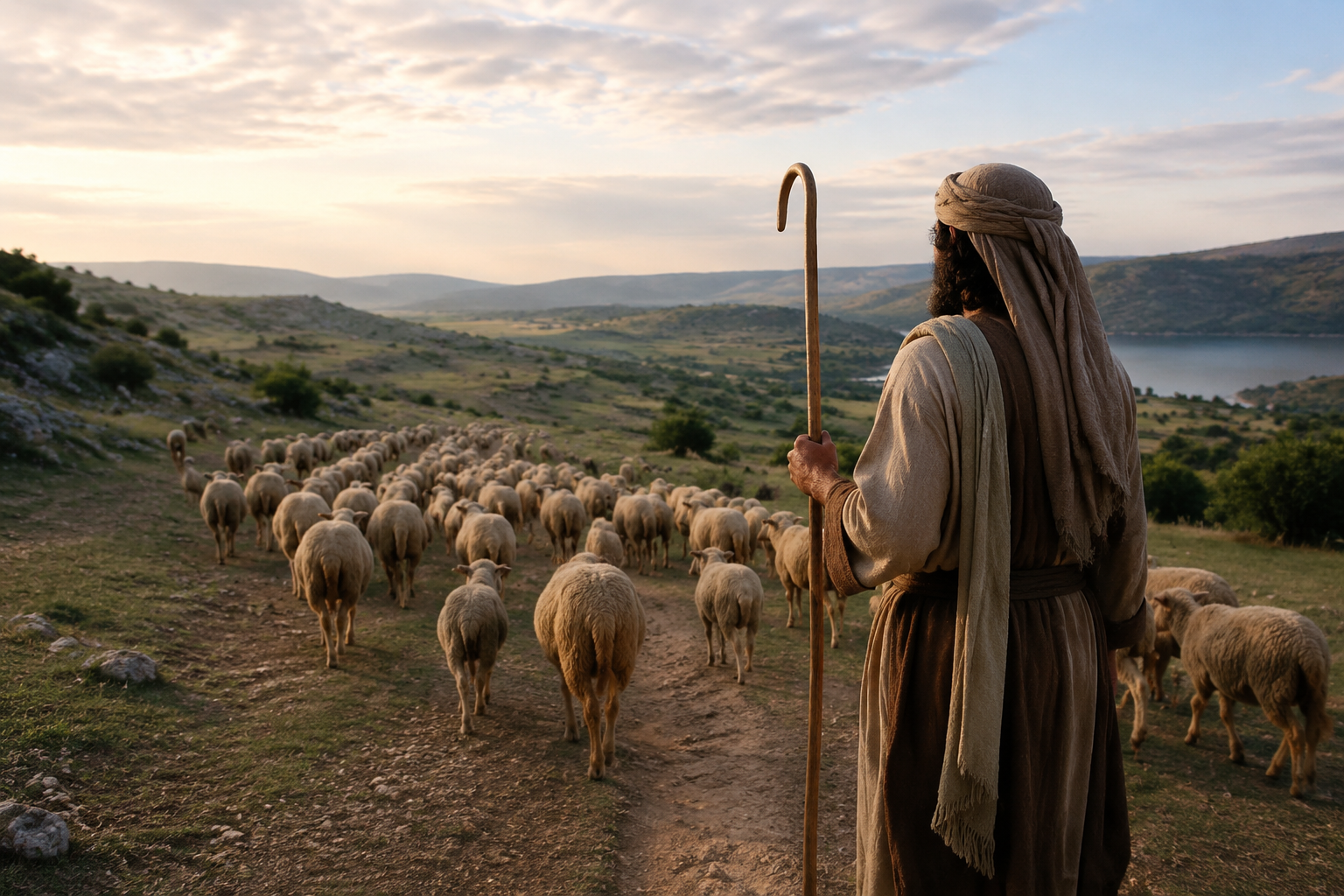
The passages collectively attach ποιμαίνω to a cluster of concrete pictures: a flock under care, overseers watching a community, servants working in fields, and a shepherd’s rod that can guide or strike. Revelation 7:17 places the verb in a calm scene of movement toward “springs of life-giving waters,” while Revelation’s “rod of iron” scenes depict the same shepherding frame as unyielding authority over the nations. Between these poles, the pastoral image becomes a way to speak about responsibility, ownership (“my sheep”), integrity in leadership, and the visible outcomes of those who claim to shepherd.
Sources: Lexical data from Strong’s Exhaustive Concordance and the Translators Brief Lexicon of Extended Strongs for Greek (STEPBible, CC BY). Occurrence data from the Translators Amalgamated Greek New Testament (STEPBible, CC BY). Scripture quotations from the World English Bible (public domain).