Exploring the Meaning of Pistoo in Greek
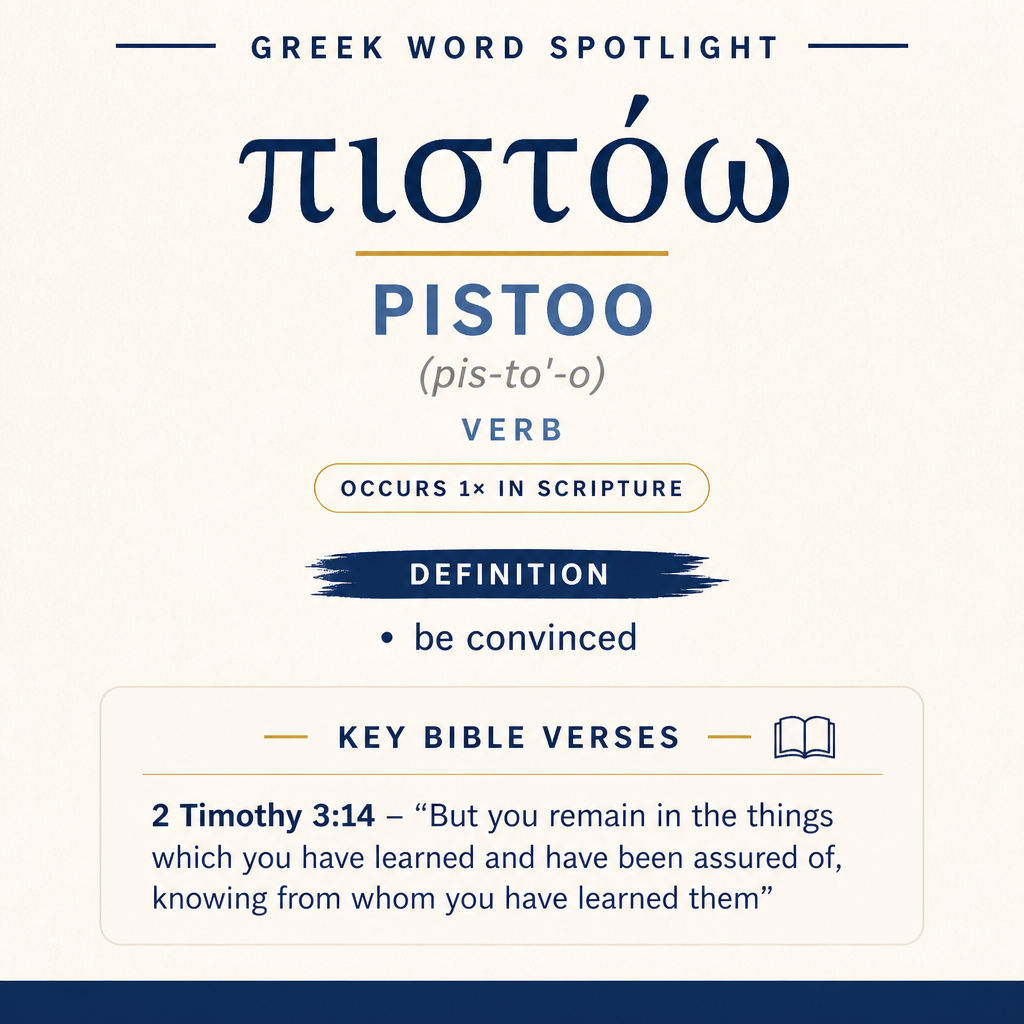
πιστόω means “be convinced” and appears once in Scripture in 2 Timothy 3:14.
Verse Context
In 2 Timothy 3:14, it describes being assured of what has been learned, knowing from whom it was learned.
Learn More →πιστόω expresses the idea “be convinced,” describing the settled assurance that follows learning. It appears in 2 Timothy 3:14, where it marks the firmness with which Timothy is to hold what he has received.
Root and Related Words
πιστόω is related to pistos (πιστός), “faithful” (Strong’s G4103). In this relationship, the verb form presents the action or result associated with what pistos describes: a stance characterized by reliability and trustworthiness becomes, in the verb, something that is brought home to the mind so that a person stands persuaded.

Occurrences
“But you remain in the things which you have learned and have been assured of, knowing from whom you have learned them.” (2 Timothy 3:14)
In this exhortation, πιστόω anchors the second of two closely linked realities: Timothy has “learned” certain things, and he has also been “assured of” them. The flow of the sentence treats assurance as more than mere exposure to teaching; it is the inward settling that makes continued perseverance possible—“But you remain…” The command to remain is supported by the fact that what he has received is not only information stored in memory but convictions held with certainty.

The verse also supplies the stated ground for this assurance: “knowing from whom you have learned them.” The assurance signaled by πιστόω is presented as connected to recognized sources—persons whose identity and reliability Timothy “knows.” The persuasion, then, is not portrayed as an isolated feeling or a private intuition; it is tied to a remembered process of learning that involved identifiable teachers. Within the logic of the sentence, the stability of Timothy’s convictions is strengthened by the trustworthiness of the instruction’s origin, and that stability is what enables him to “remain” rather than drift.
Sense and Usage
“Be convinced” highlights the movement from receiving instruction to possessing settled certainty. In 2 Timothy 3:14, the verb functions as the bridge between learning and endurance: what is learned becomes something one is persuaded of, and that persuasion supports ongoing fidelity to it. The verse sets learning and conviction side by side, implying a distinction without separating them: learning is the acquisition of content; being convinced is the inward confirmation that fixes that content as something one can stand on. This is why the command is not merely to remember but to “remain”—continuance is sustained by persuasion.
The wording also places this conviction within a relational and historical frame. The assurance is linked to “knowing from whom” the teaching came. Thus the verb’s sense here includes the idea that conviction has reasons embedded in lived experience: Timothy can look back to the teachers through whom he learned, and that knowledge reinforces his confidence. The verse portrays persuasion as compatible with memory, instruction, and personal knowledge of sources. It is an assurance that grows out of a received tradition rather than a conviction generated in isolation.
Finally, the verse shows that being convinced is not treated as a temporary spike of confidence but as a state with durability. The surrounding imperative (“remain”) assumes that the assurance has continuing relevance; it is something that can undergird perseverance over time. In this single occurrence, πιστόω carries the force of settled certainty that stabilizes practice: Timothy stays in what he has learned because he stands persuaded about it, and that persuasion is tied to the trustworthy people from whom he learned.
Imagery
The verse’s imagery is quiet and practical: a person “remain[s]” in learned things because those things have become assured convictions. The picture is of steadfastness grounded in persuasion—an inner certainty that holds its place when alternatives or pressures might pull it away, supported by remembered teachers whose identity lends weight to what was taught.
Sources: Lexical data from Strong’s Exhaustive Concordance and the Translators Brief Lexicon of Extended Strongs for Greek (STEPBible, CC BY). Occurrence data from the Translators Amalgamated Greek New Testament (STEPBible, CC BY). Scripture quotations from the World English Bible (public domain).