
Exploring the Meaning of Petomai in Greek
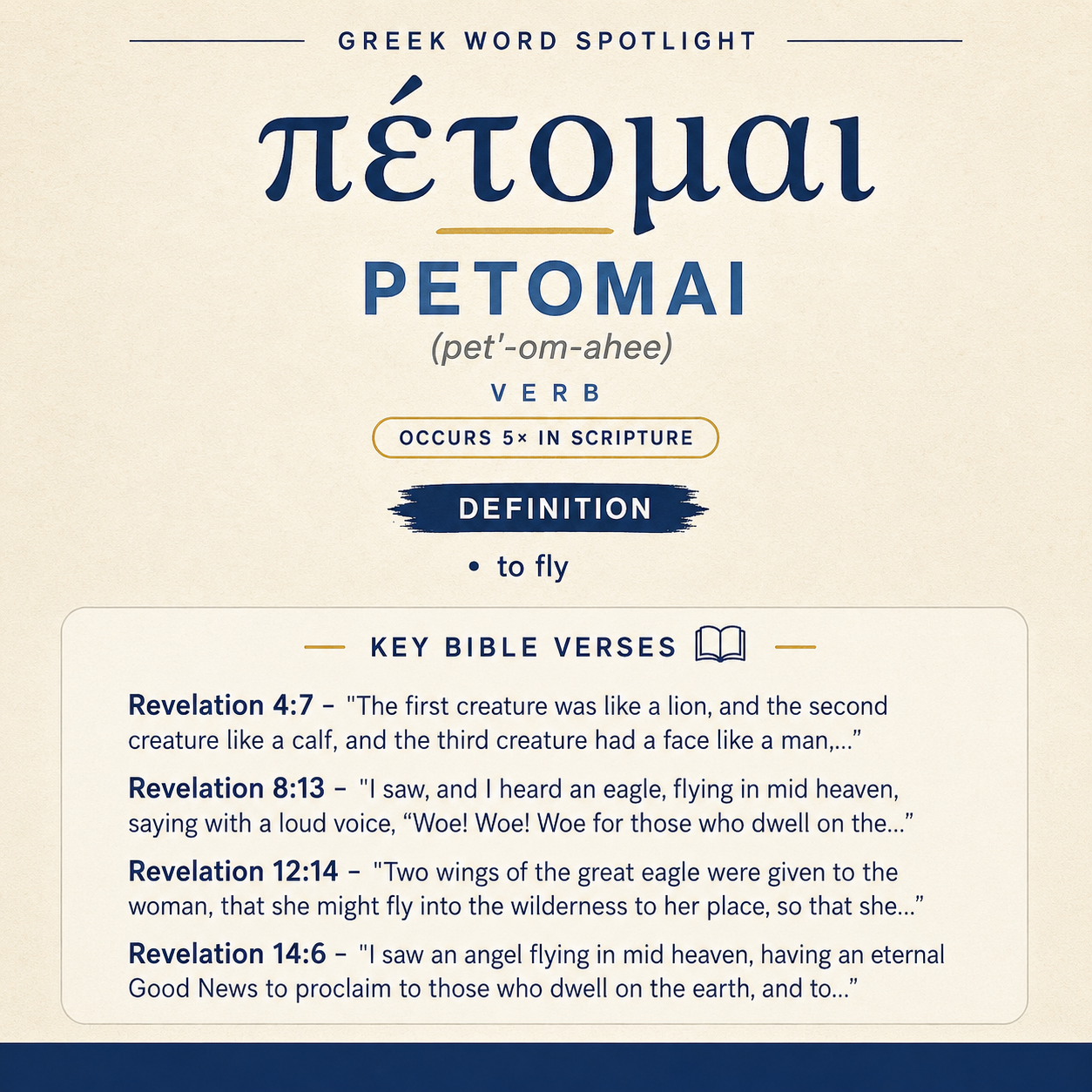
πέτομαι means “to fly” and occurs five times in Scripture, all in Revelation (4:7; 8:13; 12:14; 14:6; 19:17).
Scripture Occurrences
This verb occurs five times in Scripture. Every occurrence is in the book of Revelation.
Learn More →Revelation Scenes
In Revelation, it describes flying creatures and birds (4:7; 19:17). It is also used of an eagle and an angel flying in mid heaven (8:13; 14:6).
Learn More →πέτομαι expresses the action of flying. It appears in Revelation in scenes of heavenly vision, urgent proclamation, flight to safety, and the gathering of birds.
Occurrences
“The first creature was like a lion, and the second creature like a calf, and the third creature had a face like a man, and the fourth was like a flying eagle.” (Revelation 4:7)
Here the word marks a defining feature of the fourth living creature: it is “like a … eagle,” specified further as “flying.” In a list built on likenesses (“like a lion,” “like a calf”), the participial description “flying” does more than identify the creature as birdlike; it presents the creature in motion. The vision does not merely place an eagle within the scene but depicts it in the characteristic act that distinguishes it in the air.
“I saw, and I heard an eagle, flying in mid heaven, saying with a loud voice, “Woe! Woe! Woe for those who dwell on the earth, because of the other voices of the trumpets of the three angels, who are yet to sound!” (Revelation 8:13)
In this passage πέτομαι locates the eagle’s movement within a specific spatial frame: it is “flying in mid heaven.” The flight positions the eagle as a messenger whose voice carries broadly—its loud cry of “Woe! Woe! Woe” is directed “for those who dwell on the earth.” The action of flying works together with the elevated location to bridge heaven and earth in the scene: the eagle is seen and heard, moving above while addressing those below, and its ongoing flight accompanies an announcement of coming trumpet voices.
“Two wings of the great eagle were given to the woman, that she might fly into the wilderness to her place, so that she might be nourished for a time, and times, and half a time, from the face of the serpent.” (Revelation 12:14)
Here the verb is purpose-driven: wings are given “that she might fly.” The movement is away from danger and toward a destination—“into the wilderness to her place.” Flight in this setting is not descriptive ornamentation but a means of escape and relocation, resulting in a protected interval: “so that she might be nourished for a time, and times, and half a time, from the face of the serpent.” The clause structure ties the act of flying to separation (“from the face of the serpent”) and to provision (“might be nourished”), so that the flight is the decisive transition that places the woman where nourishment can occur.
“I saw an angel flying in mid heaven, having an eternal Good News to proclaim to those who dwell on the earth, and to every nation, tribe, language, and people.” (Revelation 14:6)
In this vision an angel is likewise “flying in mid heaven,” again combining flight with an elevated platform for communication. The angel’s message is explicitly outward-facing: it has “an eternal Good News to proclaim” to earth-dwellers and, with expanding scope, “to every nation, tribe, language, and people.” Flight supports the portrayal of wide reach and active proclamation. The angel is not stationed at a fixed point; it is seen in motion while bearing a message intended for the whole inhabited world, and the movement through “mid heaven” visually matches the broad audience named in the verse.
“I saw an angel standing in the sun. He cried with a loud voice, saying to all the birds that fly in the sky, “Come! Be gathered together to the great supper of God,” (Revelation 19:17)
In this scene the verb characterizes “the birds that fly in the sky.” The flight is the ordinary activity and identifying trait by which the birds are addressed as a group, wherever they are in the air. The angel’s loud cry summons them—“Come! Be gathered together”—and the description “that fly in the sky” frames the call as one aimed at creatures already aloft and dispersed. The action of flying thus sets the audience’s domain (the sky) and underscores the breadth of the summons, reaching birds across the open air rather than a localized flock on the ground.

Sense and Usage
Across these passages πέτομαι consistently depicts the act of flying, but Revelation uses that simple action to serve different narrative functions. In Revelation 4:7, flight operates as a visual attribute within a catalogue of living creatures: “flying” distinguishes and animates the eagle-like creature. In Revelation 8:13 and 14:6, the verb helps establish “mid heaven” as a vantage point for loud, far-reaching address; the flight is paired with hearing as well as seeing (“I saw, and I heard”), and the messages are aimed at those “who dwell on the earth” and even at “every nation, tribe, language, and people.” In Revelation 12:14, flight becomes a purposeful means of movement to a place of refuge and sustenance—wings are provided, a destination is specified, and the result is nourishment and distance “from the face of the serpent.” Finally, in Revelation 19:17, πέτομαι identifies the aerial domain where birds are found and from which they can be summoned collectively.
Two recurrent settings sharpen the verb’s force. First, “mid heaven” appears where flying accompanies proclamation (the eagle’s triple “Woe” and the angel’s “eternal Good News”). Flight there is not merely locomotion; it marks a moving herald positioned above the earth, suited to address “those who dwell on the earth.” Second, flight is repeatedly linked to wings and birds—eagle, great eagle, and birds in the sky—so that the action is pictured concretely in creatures for whom flying is native, even when the subject is human (“that she might fly”) by means of gifted wings.
Imagery
In these Revelation scenes, flying belongs to the borderland of heaven and earth: eagles and angels appear aloft, and their movement in the sky accompanies speech that reaches the earth below. The same action also conveys swift transition into a prepared place, as when the woman flies “into the wilderness to her place,” and it gathers aerial creatures under a single command, calling “all the birds that fly in the sky” to assemble.
Sources: Lexical data from Strong’s Exhaustive Concordance and the Translators Brief Lexicon of Extended Strongs for Greek (STEPBible, CC BY). Occurrence data from the Translators Amalgamated Greek New Testament (STEPBible, CC BY). Scripture quotations from the World English Bible (public domain).





