
Exploring the Meaning of Perisseia in Greek
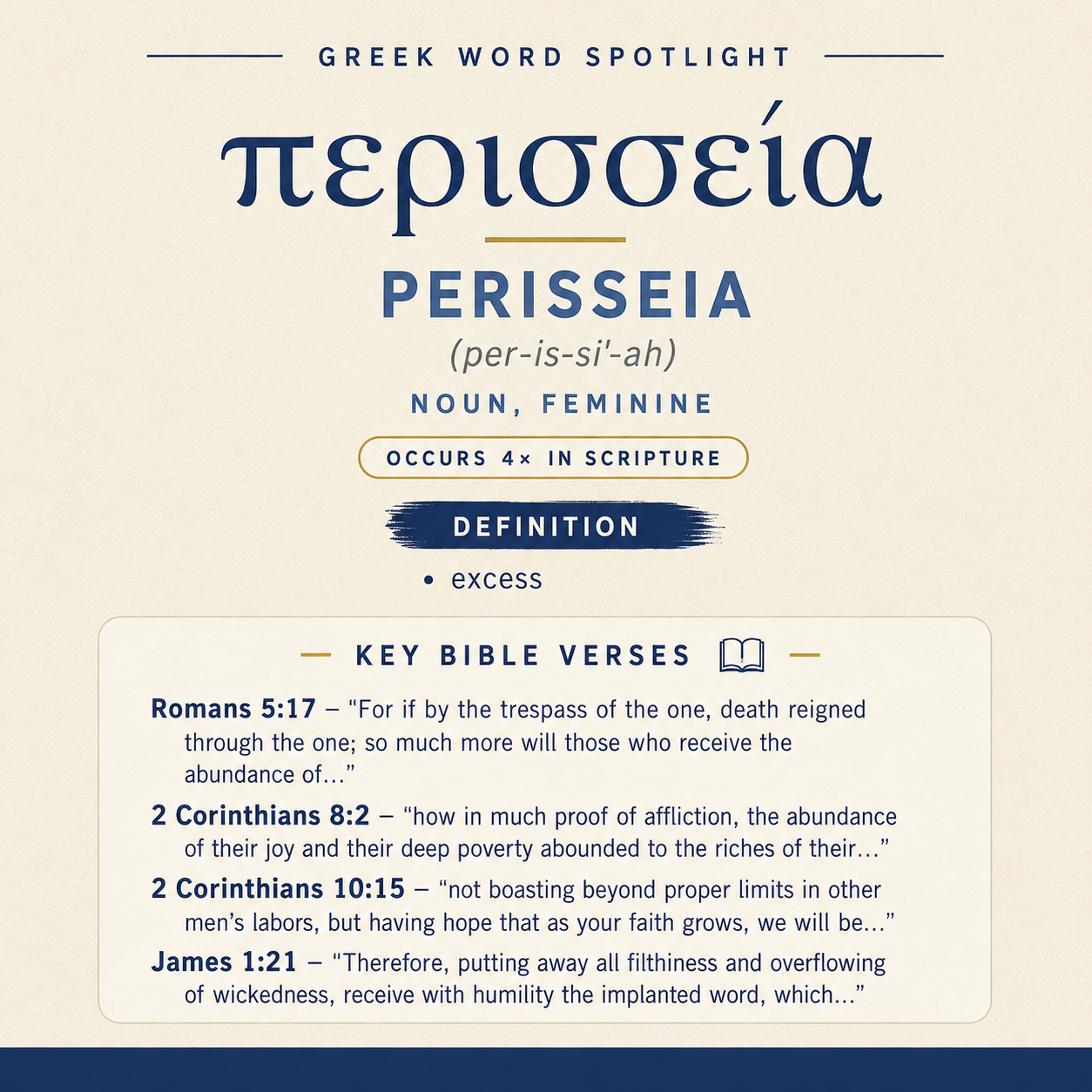
περισσεία means “excess” and appears four times in Scripture: Romans 5:17; 2 Corinthians 8:2; 2 Corinthians 10:15; James 1:21.
Where It Appears
This word appears in Romans 5:17; 2 Corinthians 8:2; 2 Corinthians 10:15; and James 1:21.
Learn More →Verse Contexts
In James 1:21 it appears in “overflowing of wickedness.” In Romans 5:17 and 2 Corinthians 8:2 it is rendered as “abundance.”
Learn More →περισσεία expresses the idea of excess, and it appears in four New Testament contexts that speak of grace, joy, influence, and moral danger. Across these settings, it marks a quantity or condition that goes beyond what is ordinary, whether for good or for ill.
Root and Related Words
περισσεία is related to the verb perisseuō (περισσεύω), “to exceed” (Strong’s G4052). The noun draws on the same basic concept of going beyond a set measure, and it functions as a way to speak of a surplus within a described situation.

Occurrences
“For if by the trespass of the one, death reigned through the one; so much more will those who receive the abundance of grace and of the gift of righteousness reign in life through the one, Jesus Christ.” (Romans 5:17)
Here περισσεία belongs to the phrase “the abundance of grace,” set within a contrast between what flows from “the trespass of the one” and what is received “through the one, Jesus Christ.” The verse frames two reigns: death “reigned through the one,” and those who receive grace and righteousness “reign in life.” In that argument, excess highlights the scale of what is received—grace is not pictured as barely sufficient, but as more than enough for the stated outcome (“reign in life”). The word helps the sentence carry its “so much more” logic by giving grace the character of an overflowing supply relative to the problem being described.
“how in much proof of affliction, the abundance of their joy and their deep poverty abounded to the riches of their generosity.” (2 Corinthians 8:2)
In this description, περισσεία modifies “their joy” and is placed beside two pressures: “much proof of affliction” and “their deep poverty.” The verse then says these conditions “abounded to the riches of their generosity.” The noun contributes by intensifying the inner resource named (“joy”), portraying it as a surplus that exists even under affliction. That excess does not remain private; it is depicted as moving outward (“abounded to”) and resulting in “riches of…generosity.” Within the single sentence, excess joy sits paradoxically next to deep poverty, and the word supports that tension by allowing the writer to speak of a surplus in one domain while another domain is marked by lack.
“not boasting beyond proper limits in other men’s labors, but having hope that as your faith grows, we will be abundantly enlarged by you in our sphere of influence,” (2 Corinthians 10:15)
This line begins by refusing overreach: “not boasting beyond proper limits in other men’s labors.” Against that backdrop, the writer states a “hope” tied to growth—“as your faith grows”—and anticipates being “abundantly enlarged…in our sphere of influence.” The noun frames the hoped-for enlargement as an increase that goes beyond a minimal expansion. Even though the verse is careful about “proper limits,” it still uses excess-language to describe the desired result: growth is envisioned as a widening effect in their “sphere of influence,” and the word signals that the increase is not marginal. In the logic of the sentence, excess does not authorize boasting; it characterizes the extent of enlargement expected to come as a consequence of the readers’ growing faith.
“Therefore, putting away all filthiness and overflowing of wickedness, receive with humility the implanted word, which is able to save your souls.” (James 1:21)
Here περισσεία is paired with moral imagery: “filthiness” and “overflowing of wickedness.” The instruction is to put these away, then to “receive with humility the implanted word.” In this setting, excess is not a positive surplus but a dangerous overabundance described as “overflowing,” something that must be removed to make room for reception. The noun intensifies the problem: wickedness is portrayed as more than an isolated act or trace; it is an overflow that spreads. The contrast in the verse is sharp and practical—excess wickedness is to be discarded, and humble reception of “the implanted word” is presented as the path to what the sentence names as its outcome: it “is able to save your souls.”

Sense and Usage
Across these four passages, excess functions as a quantitative and qualitative intensifier within the writer’s chosen subject matter. In Romans 5:17, it strengthens a comparative argument (“so much more”) by characterizing grace as a surplus appropriate to overturn the reign of death and to accompany “the gift of righteousness.” The emphasis falls on what is received: excess is attached to grace in a way that supports the verse’s movement from death’s reign to life’s reign.
In 2 Corinthians 8:2, excess is linked to an internal condition (“joy”) that exists alongside affliction and poverty. The word allows the verse to speak in a way that does not deny hardship (“much proof of affliction,” “deep poverty”) yet still insists that a surplus can be present and can yield tangible outcomes (“riches of…generosity”). Excess here is not mere accumulation; it is depicted as productive, having an outward direction and a result.
In 2 Corinthians 10:15, excess describes expansion within a relational and ministerial frame: a “sphere of influence” that may be “abundantly enlarged.” The surrounding caution about “proper limits” keeps the idea from becoming an excuse for trespassing into “other men’s labors.” Excess in this verse serves a different rhetorical purpose than in Romans: it does not magnify a gift received so much as it magnifies the hoped-for growth that comes with the readers’ increasing faith, while remaining bounded by appropriate restraint.
James 1:21 shows the term’s negative capacity. Excess is not inherently virtuous in these passages; it can name an overgrowth that corrupts (“overflowing of wickedness”). In that moral register, excess is something to be removed, contrasted with “humility” and with receptive openness to “the implanted word.” The noun’s force lies in presenting wickedness as spilling over, implying not just presence but spread, and so making the command to “put away” sound urgent and comprehensive.
Imagery
The word’s imagery turns on the idea of overflow and surplus. Romans 5:17 and 2 Corinthians 8:2 place excess alongside gifts that sustain and empower—grace that supports reigning in life, and joy that issues in generosity even amid poverty. James 1:21 uses the same surplus notion as a warning picture: wickedness as an overflow that must be cleared away before something good can be received. Together these verses present excess as a powerful descriptor of scale—capable of portraying both the abundance that enriches and the overflow that defiles.
Sources: Lexical data from Strong’s Exhaustive Concordance and the Translators Brief Lexicon of Extended Strongs for Greek (STEPBible, CC BY). Occurrence data from the Translators Amalgamated Greek New Testament (STEPBible, CC BY). Scripture quotations from the World English Bible (public domain).





