Exploring the Meaning of Perispao in Greek
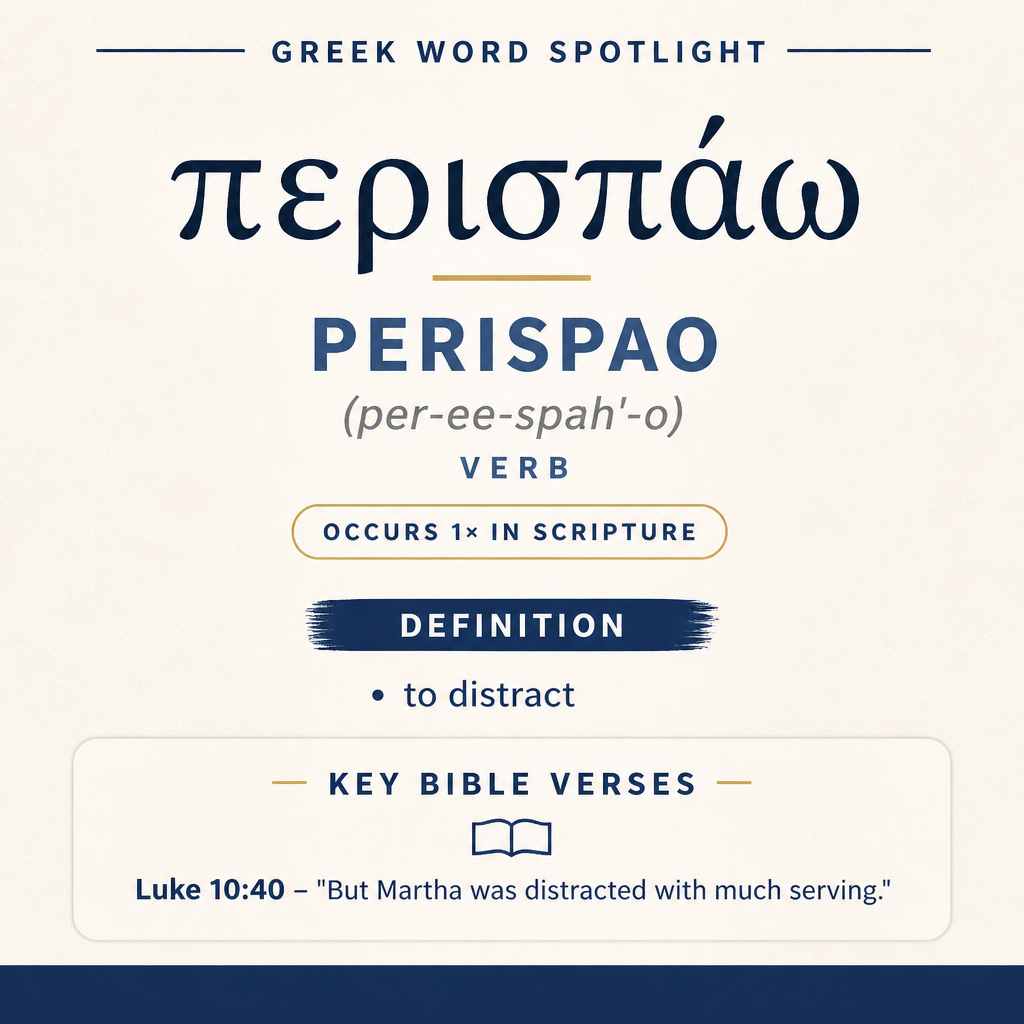
περισπάω means “to distract” and appears once in Scripture, in Luke 10:40.
Scripture Occurrence
This word occurs one time in Scripture. Its single occurrence is in Luke 10:40.
Learn More →Luke Context
In Luke 10:40, Martha is described as distracted with much serving. She addresses the Lord about her sister leaving her.
Learn More →περισπάω means “to distract,” and it appears in the account of Martha’s service in Luke 10:40. In that scene it describes an inner pulling-away from what is most needed in the moment.
Root and Related Words
περισπάω (Perispao) is formed from περί (peri), “about” (Strong’s G4012), and σπάω (spao), “to draw” (Strong’s G4685). The combination frames distraction as a kind of being drawn around—attention and energy pulled toward surrounding concerns.

Occurrences
“But Martha was distracted with much serving, and she came up to him, and said, “Lord, don’t you care that my sister left me to serve alone? Ask her therefore to help me.”” (Luke 10:40)
In Luke 10:40, περισπάω characterizes Martha’s state while she is engaged in “much serving.” The word does more than label busyness; it depicts her focus as captured and carried off by the demands of the work itself. The verse places this distraction alongside a cascade of actions: she is distracted, she approaches Jesus, and she speaks. Her speech shows how the distraction shapes her perception and priorities: she interprets the situation through the lens of being “left…to serve alone,” and her first impulse is to seek intervention—“Ask her therefore to help me.”
The wording “with much serving” anchors the distraction in a specific source: the many tasks of service. The scene, as quoted, presents the service as real and extensive, and the distraction as the mental and emotional consequence of that press of activity. The result is relational strain: Martha frames Mary’s absence from the work as abandonment and appeals to Jesus with the pointed question, “don’t you care…?” The verb thus explains why a practical workload becomes a complaint and a demand; her attention has been pulled toward the work to the point that it governs her interpretation of others’ actions.
Sense and Usage
The single New Testament use of περισπάω in Luke 10:40 situates “to distract” within a domestic and religiously significant moment: Jesus is present, yet Martha’s attention is carried by “much serving.” In this setting, distraction is not mere interruption by something trivial; it is a divided or displaced attention produced by legitimate responsibilities multiplying. The word fits a situation where duties crowd the foreground so thoroughly that the person’s emotional register and speech are shaped by those duties.
Luke’s phrasing links distraction with movement and reaction. Martha is not described as pausing to reflect; she “came up to him” and immediately voices a grievance. The complaint reveals how distraction can narrow the field of vision: she sees herself as “alone,” interprets her sister’s absence as being “left,” and measures the moment by the distribution of work. The verb is therefore well suited to depict an attention that has been drawn away from a fuller perspective, not by idleness, but by the press of tasks.
The content of Martha’s request also shows that distraction can enlist others: she does not only feel inwardly strained; she seeks to recruit Jesus to resolve the imbalance—“Ask her therefore to help me.” The word helps explain this outward turn. Once the mind is pulled toward the demands surrounding it, the natural next step is to try to reshape the environment so the pressure eases. In Luke 10:40, distraction thus functions as the hinge between “much serving” and the relational and spiritual tensions expressed in Martha’s words.
Imagery
Luke 10:40 gives περισπάω a concrete picture: a household scene where service has become “much,” with competing demands tugging at a person’s attention. The imagery is of being drawn in multiple directions by the needs of the moment, until the weight of the tasks presses into one’s tone and judgments.
Sources: Lexical data from Strong’s Exhaustive Concordance and the Translators Brief Lexicon of Extended Strongs for Greek (STEPBible, CC BY). Occurrence data from the Translators Amalgamated Greek New Testament (STEPBible, CC BY). Scripture quotations from the World English Bible (public domain).