
Exploring the Meaning of Paraplesios in Greek
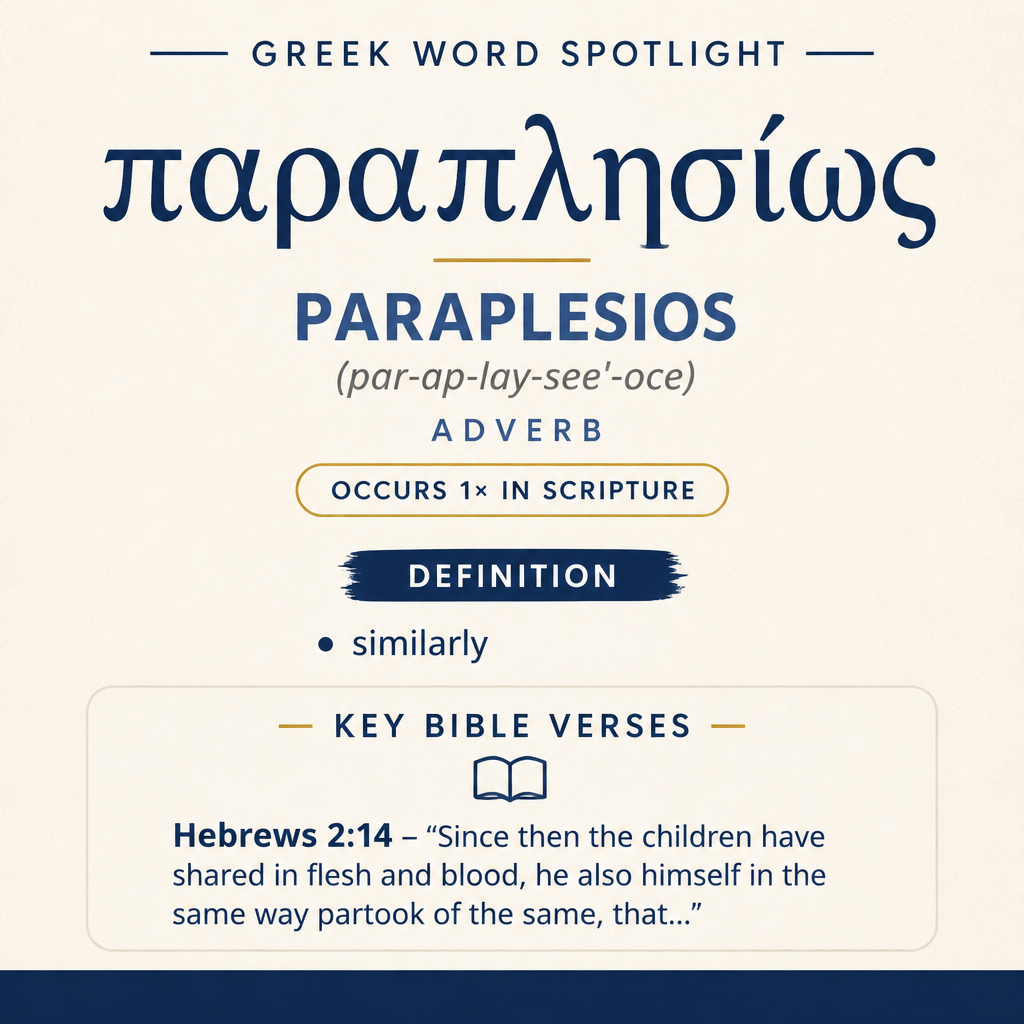
παραπλησίως means “similarly” and appears once in Scripture, in Hebrews 2:14.
Scripture Occurrence
This word occurs 1 time in Scripture. Its single occurrence is in Hebrews 2:14.
Learn More →Context Glimpse
In Hebrews 2:14, it appears in the statement “he also himself in the same way partook of the same.”
Learn More →Paraplēsiōs means “similarly” and appears in Hebrews 2:14. In that verse it functions as a tight connective that sets one action alongside another as corresponding in manner.
Root and Related Words
Paraplēsion (παραπλήσιον, “almost”; Strong’s G3897) stands behind paraplēsiōs as the related form from which it is derived. The relationship is visible in the shared opening element para- and the stem that signals nearness or comparability, with the adverbial ending marking the word’s role in describing how an action is carried out.

Occurrences
Hebrews 2:14: “Since then the children have shared in flesh and blood, he also himself in the same way partook of the same, that through death he might bring to nothing him who had the power of death, that is, the devil,”
In Hebrews 2:14, paraplēsiōs is embedded in a careful chain of statements that compares two participations. First, “the children have shared in flesh and blood”; then, with the adverbial marker, “he also himself in the same way partook of the same.” The sentence is not merely describing two facts placed side by side; it explicitly aligns the manner of his participation with theirs. The adverb makes the correspondence explicit: the one described as “he” does not engage “flesh and blood” in a wholly different mode or on a disconnected plane, but in a way that is set alongside the children’s sharing as comparable.
This comparison functions as a hinge between the opening premise and the purpose clause that follows. The verse begins with “Since then” and moves from the children’s condition (“shared in flesh and blood”) to his responsive action (“partook of the same”), and then to the intended outcome (“that through death he might bring to nothing him who had the power of death”). Within that movement, paraplēsiōs supplies a kind of logical continuity: the stated purpose (“through death”) is grounded in the way he entered the same sphere described at the start of the verse. By saying he partook “in the same way,” the verse ties the later mention of “death” back to the shared “flesh and blood” context, presenting his death as occurring within the same domain that characterizes the children.
The adverb also sharpens the emphatic repetition in the line “partook of the same.” The verse uses a clustered set of sameness language: “shared”; “in the same way”; “of the same.” Paraplēsiōs occupies the middle position, shaping how the later phrase is to be heard. The stress is not only on the object (“flesh and blood” as what is shared/partaken) but on the comparability of participation itself. The result is that the text portrays his action as closely corresponding to the children’s condition, which in turn supports the claim that “through death” he could act against “him who had the power of death.”
Sense and Usage
The sense “similarly” in this context is not an ornamental synonym for “also,” but a precise indicator of resemblance in manner. Hebrews 2:14 sets up a parallelism: one group (“the children”) is characterized by participation in “flesh and blood,” and the other actor (“he”) answers that condition by participating in a corresponding way. The adverb does the work of analogy, stating that the second participation is to be understood alongside the first as comparable rather than merely consequent.
Because the verse is tightly argued, “similarly” contributes to the logic of the stated outcome. The movement of the sentence is: shared flesh and blood → similarly partook of the same → through death might bring to nothing the one with the power of death. The resemblance marked by the adverb supports the transition from incarnation-language (“flesh and blood”) to death-language (“through death”). The verse presents death not as an incidental detail, but as a means available within the shared condition. In other words, the adverb helps the reader track that the purpose clause is not detached from the initial premise; it is the fitting outworking of a participation that corresponds to the children’s.
Within the verse, “similarly” also intensifies the personal emphasis: “he also himself” is immediately followed by the adverbial phrase. The placement highlights that the subject’s action is not abstract or merely representative; it is portrayed as a real taking-part that matches the children’s sharing. The adverb thereby functions as a rhetorical bridge between identity and action: the one who acts does so in a way that can be set alongside the children’s situation as a genuine counterpart.
Finally, the single use here shows “similarly” operating at the level of comparison within a theological argument, not at the level of mere stylistic variety. It points the reader to read two clauses as corresponding: the children’s sharing and his partaking are meant to be mentally aligned. That alignment undergirds the verse’s explanation of how “through death” he could “bring to nothing” the devil, identified here as “him who had the power of death.”
Imagery
Hebrews 2:14 frames its comparison with concrete bodily language: “flesh and blood” shared by “the children,” and then a corresponding taking-part by “he” that leads into the stark reality of “death.” In that sequence, “similarly” carries the imagery of closeness and correspondence: one participation stands beside another, and the shared human sphere becomes the setting in which the decisive act “through death” is carried out against “the devil.”
Sources: Lexical data from Strong’s Exhaustive Concordance and the Translators Brief Lexicon of Extended Strongs for Greek (STEPBible, CC BY). Occurrence data from the Translators Amalgamated Greek New Testament (STEPBible, CC BY). Scripture quotations from the World English Bible (public domain).





