
Exploring the Meaning of Parameno in Greek
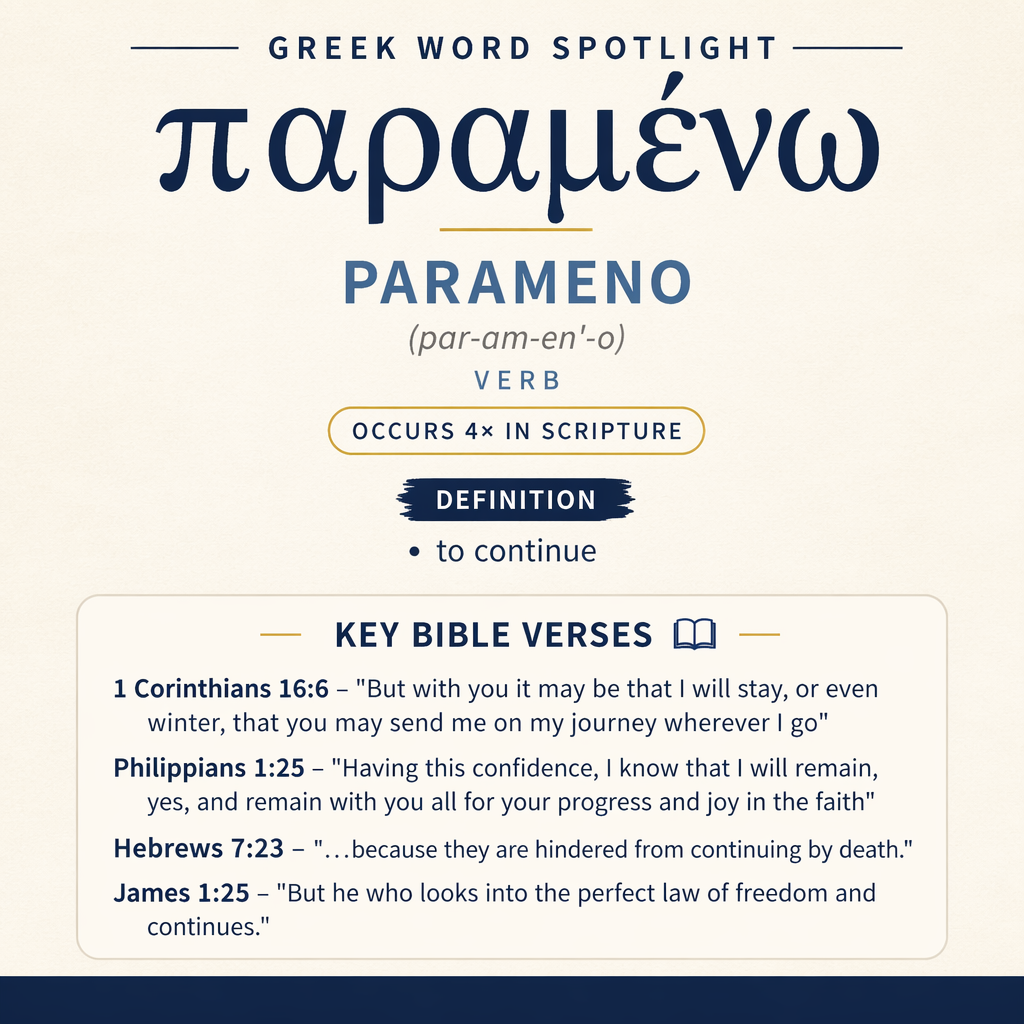
παραμένω means “to continue” and occurs four times in Scripture: 1 Corinthians 16:6, Philippians 1:25, Hebrews 7:23, and James 1:25.
Scripture Occurrences
It appears 4 times: 1 Corinthians 16:6; Philippians 1:25; Hebrews 7:23; James 1:25.
Learn More →Usage Snapshots
It describes remaining with believers (Philippians 1:25) and continuing in the perfect law of freedom (James 1:25).
Learn More →παραμένω expresses the idea of continuing, with four New Testament uses that span travel plans, pastoral commitment, priestly succession, and sustained obedience. In its contexts it marks not a momentary act but an ongoing persistence that shapes what follows.
Root and Related Words
παραμένω (Parameno) is built from μένω (meno), “to stay” (Strong’s G3306), together with παρά (para), “from/with/beside” (Strong’s G3844). The combination naturally suits situations where staying or remaining is conceived in relation to someone or something—alongside, with, or in proximity.

Occurrences
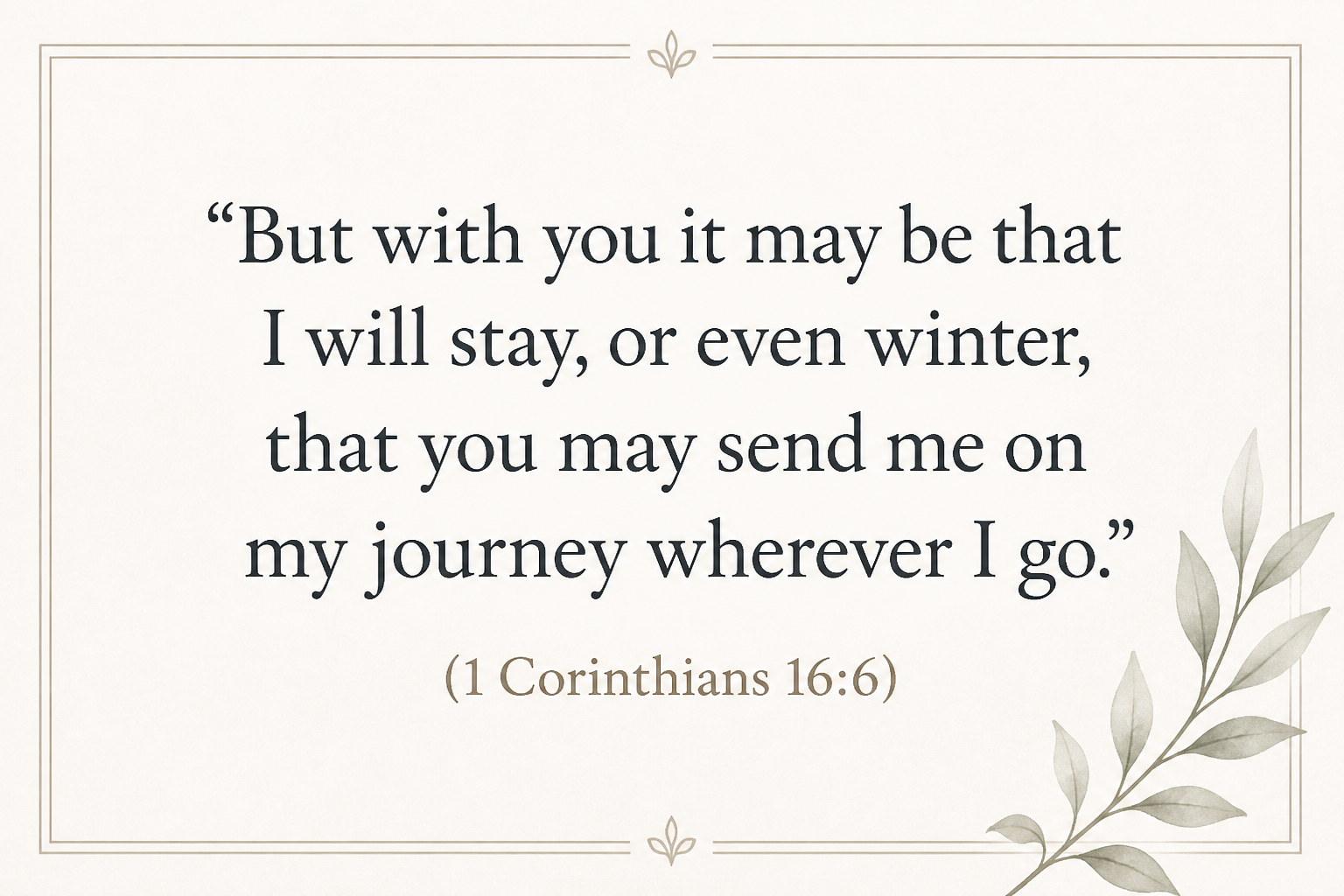
“But with you it may be that I will stay, or even winter, that you may send me on my journey wherever I go.” (1 Corinthians 16:6)
Here παραμένω is used in a practical, relational setting: the speaker contemplates staying “with you,” possibly long enough to “winter.” Continuing is not abstract endurance but a concrete extension of presence in a place and among a people. The contemplated duration has a purpose: “that you may send me on my journey wherever I go.” The continuing stay creates space for shared preparation and support, linking the time of remaining to the next stage of travel.
“Having this confidence, I know that I will remain, yes, and remain with you all for your progress and joy in the faith,” (Philippians 1:25)
In this sentence the continuing is explicitly doubled—“remain, yes, and remain”—which intensifies the sense of persistence in ongoing presence. The continuing is also tied to companionship: “with you all.” The verse sets the continuing within a pastoral aim: it serves “your progress and joy in the faith.” παραμένω thus contributes the idea of sustained nearness over time as a means to communal benefit, where continuing is measured not merely by survival but by the ongoing opportunity to foster “progress and joy.”
“Many, indeed, have been made priests, because they are hindered from continuing by death.” (Hebrews 7:23)
Here παραμένω is framed by limitation: death “hinders” people “from continuing.” The verse uses continuing as a way to explain why “many…have been made priests”: individuals do not continue indefinitely, so the office passes to others. παραμένω therefore helps articulate a contrast between what one might wish—uninterrupted continuance—and what actually happens in human life. In this setting, continuing is not a moral or relational choice but a capacity curtailed by mortality, and the consequence is multiplicity (“many”) rather than permanence in a single person.
“But he who looks into the perfect law of freedom and continues, not being a hearer who forgets, but a doer of the work, this man will be blessed in what he does.” (James 1:25)
In James, παραμένω names the ongoing stance that distinguishes a fleeting encounter from a lasting response. The verse begins with “looks into the perfect law of freedom,” then adds “and continues,” making continuing the hinge between observing and acting. The contrast clarifies what kind of continuing is meant: it is “not being a hearer who forgets, but a doer of the work.” Continuing is therefore portrayed as sustained engagement that resists forgetfulness and expresses itself in consistent doing. The promised outcome—“this man will be blessed in what he does”—is tied not to a single act of looking or hearing but to the persevering pattern signaled by παραμένω.
Sense and Usage
Across these passages, παραμένω consistently carries the force of continuation as an extended reality rather than a brief point in time. In 1 Corinthians 16:6 and Philippians 1:25, the word belongs to the sphere of presence with others: continuing is experienced as staying among a community, and that sustained proximity becomes the setting for tangible outcomes—being “send…on my journey” in one case, and the community’s “progress and joy” in the other. The word’s placement beside phrases like “with you” and “with you all” highlights how continuation can be socially located: the continuing is not merely internal resolve but a maintained relationship of nearness.
Hebrews 7:23 shows the same notion of continuation, but from the opposite angle: it explains an inability to continue. The verse turns continuation into a measure of durability, and then states that death interrupts it. By using παραμένω to describe what death prevents, the text portrays continuation as something that would keep a role or activity ongoing in a single person if it were possible; because it is hindered, succession becomes necessary. The word thus functions as a conceptual benchmark for stability, even when the point is to show that such stability is unattainable for “many” individuals.
James 1:25 draws παραμένω into moral and practical life: continuing is the sustained posture that keeps one from becoming “a hearer who forgets.” The verse links continuing directly with consistent doing (“a doer of the work”), so continuation is not simply duration but duration that maintains integrity between what is perceived (“looks into”) and what is performed (“does”). In this usage, the word sits between input and output—between looking/hearing and doing—and asserts that blessing is connected with the ongoingness of that connection.
Together, these uses show παραμένω applied to (1) a projected length of stay that enables shared action, (2) a continued presence serving communal growth and joy, (3) the interruption of continuity by death with institutional consequences, and (4) the persevering constancy that makes hearing effective through sustained doing. The common thread is continuation that matters: in every case, the continuing is not idle time but time that either enables a purpose, is directed toward a goal, is cut short with real effects, or is maintained as the condition for faithful practice.
Imagery and Texture
The passages give παραμένω an earthy texture: staying long enough to “winter” (1 Corinthians 16:6), remaining “with you all” for shared “progress and joy” (Philippians 1:25), the stark interruption of continuity “by death” (Hebrews 7:23), and the steady persistence that turns looking into doing (James 1:25). In each scene, continuing is felt as a stretch of time that either holds people together, breaks apart under mortality, or carries an initial encounter forward into a lived pattern.
Sources: Lexical data from Strong’s Exhaustive Concordance and the Translators Brief Lexicon of Extended Strongs for Greek (STEPBible, CC BY). Occurrence data from the Translators Amalgamated Greek New Testament (STEPBible, CC BY). Scripture quotations from the World English Bible (public domain).





