Exploring the Meaning of Palaiotes in Greek
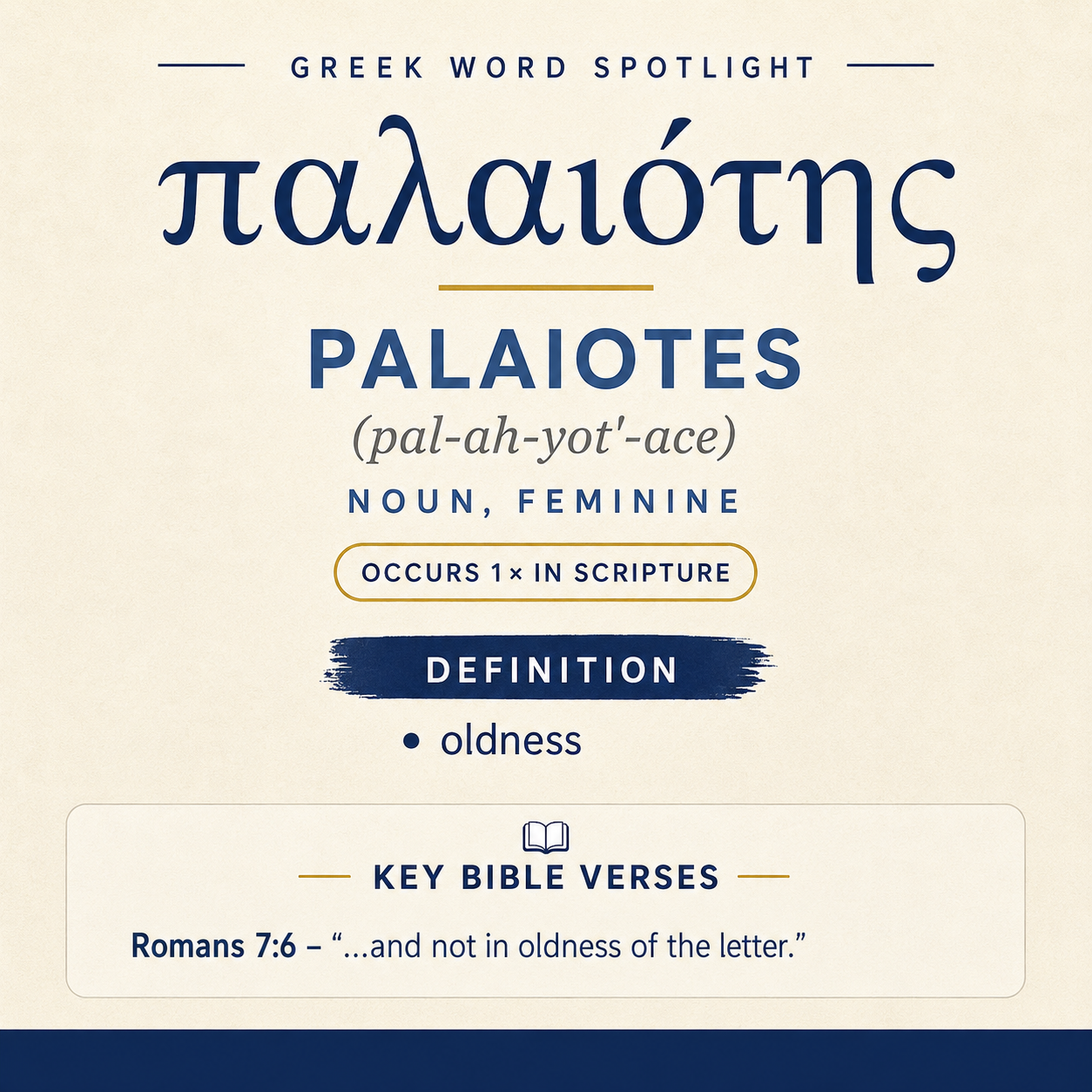
παλαιότης (Palaiotes) means “oldness” and occurs once in Scripture, in Romans 7:6.
Scripture Occurrence
This word occurs 1 time in Scripture. Its occurrence is in Romans 7:6.
Learn More →Verse Context
In Romans 7:6, it appears in the phrase “newness of …,” contrasting with what is old.
Learn More →παλαιότης expresses “oldness” and appears in Paul’s contrast between two ways of serving. Its single New Testament occurrence sets “oldness” against “newness,” sharpening a distinction that depends on the source and character of that service.
Root and Related Words
παλαιότης derives from the adjective palaios (παλαιός), “old” (Strong’s G3820). The noun form gathers the quality expressed by the adjective into an abstract state: “oldness” as a condition or mode.

Occurrences
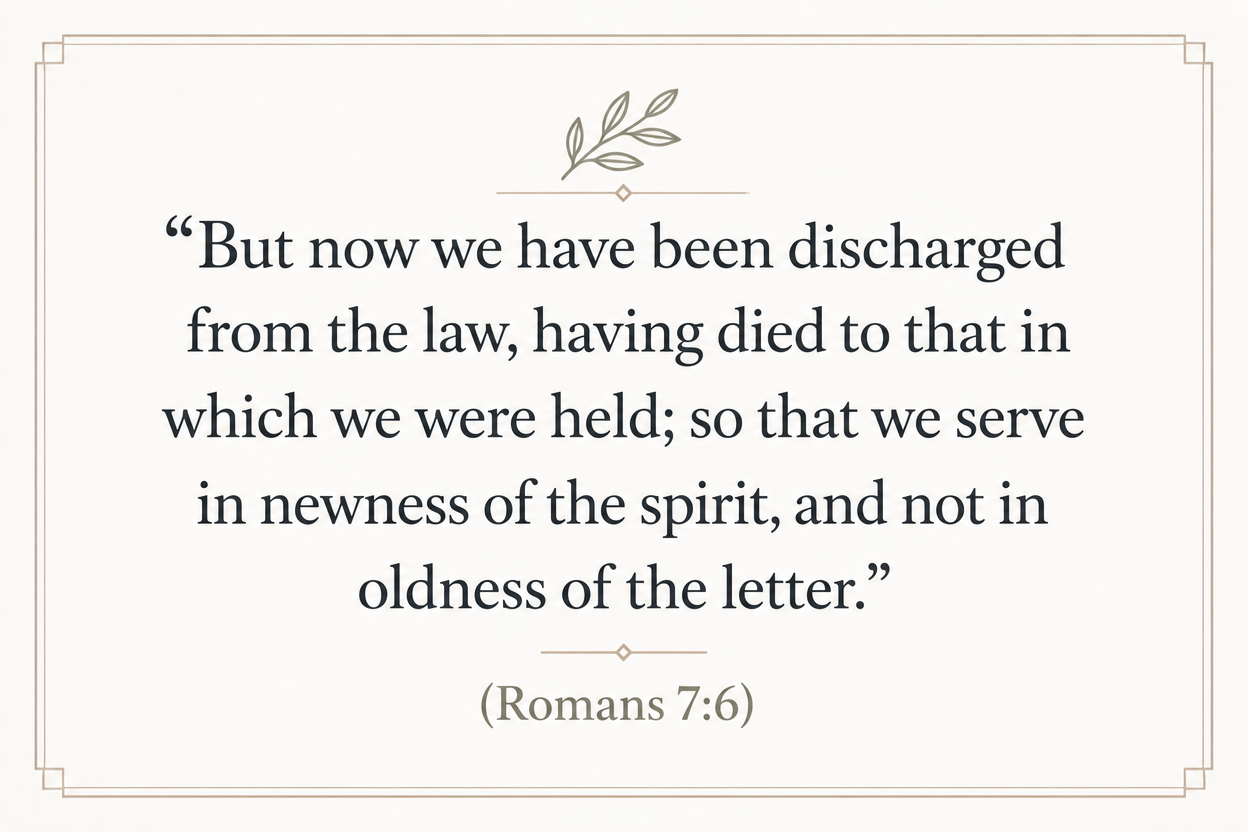
“But now we have been discharged from the law, having died to that in which we were held; so that we serve in newness of the spirit, and not in oldness of the letter.” (Romans 7:6)
Here παλαιότης names the character of a particular kind of service: “oldness of the letter.” Paul sets up a tightly balanced contrast: on one side, “newness of the spirit”; on the other, “oldness of the letter.” Within the verse, the word functions as the negative pole of the contrast (“and not in…”), describing what the readers are no longer to serve in now that they have been “discharged from the law.”
The immediate context inside the sentence frames “oldness” as belonging to “the letter,” with “letter” marked by the genitive phrase “of the letter.” In the same way, “newness” is marked as belonging to “the spirit.” The parallelism is deliberate: the two nouns (“newness” and “oldness”) are matched, and each is further specified by what it is “of.” In that balanced structure, παλαιότης does not stand alone as a general description of age, but as a defined mode of serving, located in relation to “the letter.”
The clause beginning “so that we serve…” indicates purpose or result: discharge from the law and death to the former holding lead to a new kind of service. Against that movement, “oldness” represents the prior manner that fits with being “held” in the earlier situation. The verse’s shift markers—“But now…,” “having died…,” “so that…,” “and not…”—all point in the same direction: παλαιότης belongs to what is left behind when the readers move from being held to being discharged, and from the former relation to the law to a new mode of serving.
Sense and Usage
As “oldness,” παλαιότης denotes a state characterized by what is old, and in Romans 7:6 that state is attached to “the letter.” The word’s force in the verse depends on its placement in a paired contrast: oldness is not merely the opposite of newness in an abstract sense, but the descriptor for one of two competing qualities of service. The structure makes “oldness” a qualifier of how the service is carried out and what governs it.
Because παλαιότης is paired with “newness,” it carries the rhetorical weight of the before-and-after transition expressed in “But now…” The verse itself supplies a temporal and relational pivot: discharged from the law, having died to what held them, now serving in newness rather than oldness. In that flow, “oldness” is the term that marks the earlier condition as a mode that is no longer appropriate for those who have undergone the stated change. The contrastive “not” does more than deny; it defines the boundaries of the new service by excluding the old mode.
The phrase “oldness of the letter” also indicates that “oldness” is not presented as a free-floating quality. It is a condition tied to a particular sphere (“the letter”) in exactly the same way that “newness” is tied to “the spirit.” The two genitives clarify that Paul is not contrasting newness and oldness as mere subjective feelings, but as identifiable modes with distinct reference points. In this setting, παλαιότης contributes to a conceptual map with two coordinates: the kind of service (“we serve”) and the mode or quality of that service (newness versus oldness), each anchored by its defining domain (“spirit” versus “letter”).
Imagery
Romans 7:6 gives παλαιότης an image through its immediate partner word: “letter.” “Oldness of the letter” evokes the feel of what is worn by time in the realm of written form—an established, earlier mode of service that stands in contrast to “newness of the spirit.” The verse’s imagery is not decorative; it supports the verse’s movement from being held to being discharged, and from an old mode to a new one.
Sources: Lexical data from Strong’s Exhaustive Concordance and the Translators Brief Lexicon of Extended Strongs for Greek (STEPBible, CC BY). Occurrence data from the Translators Amalgamated Greek New Testament (STEPBible, CC BY). Scripture quotations from the World English Bible (public domain).