Exploring the Meaning of Pais in Greek
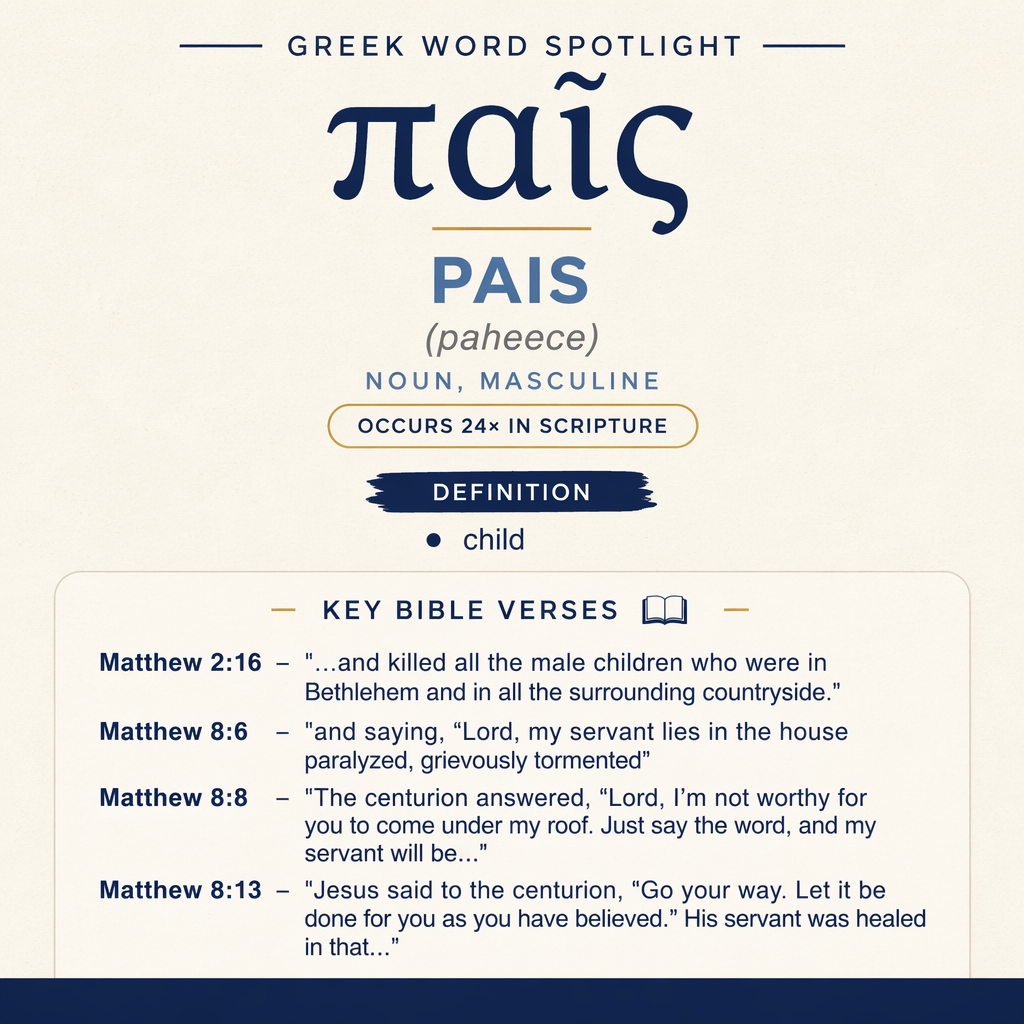
παῖς (Pais) means “child” and occurs 24 times in Scripture, including Matthew 2:16; 8:6, 8, 13; 12:18; 14:2; 17:18; 21:15.
Matthew Examples
In Matthew 2:16, it appears in the account of Herod killing the male children. In Matthew 21:15, it appears with children crying in the temple.
Learn More →Servant Contexts
In Matthew 8:6, 8, and 13, it appears in the centurion’s request concerning his servant. In Matthew 12:18, it appears in the quoted line, “Behold, my servant.”
Learn More →παῖς refers to a “child,” a concrete term for youth that can appear in scenes of family life, public worship, or vulnerability in need of help. In the passages quoted here it is used both for literal children and for figures spoken of in a child-related role within relationships of care, authority, or belonging.
Occurrences
Matthew 2:16 — “Then Herod, when he saw that he was mocked by the wise men, was exceedingly angry, and sent out, and killed all the male children who were in Bethlehem and in all the surrounding countryside, from two years old and under, according to the exact time which he had learned from the wise men.”
Here παῖς marks the victims specifically as children—“male children…from two years old and under.” The term frames the scene with the helplessness and smallness of those targeted: the narrative’s horror turns on the fact that these are not combatants or rivals but very young lives defined by age and dependence.
Matthew 8:6 — “and saying, “Lord, my servant lies in the house paralyzed, grievously tormented.””
In the centurion’s plea, παῖς identifies the afflicted person as someone within his household whom he can speak for. The emphasis falls on the sufferer’s condition (“paralyzed, grievously tormented”) and on the centurion’s concern, as he brings the child into Jesus’ hearing through intercession.
Matthew 8:8 — “The centurion answered, “Lord, I’m not worthy for you to come under my roof. Just say the word, and my servant will be healed.”
παῖς remains the one needing restoration, but the focus shifts to Jesus’ authority and the centurion’s sense of unworthiness. The child’s location—“under my roof”—places him inside the centurion’s private sphere, and the request “say the word” highlights the distance between the child’s situation and the help sought.
Matthew 8:13 — “Jesus said to the centurion, “Go your way. Let it be done for you as you have believed.” His servant was healed in that hour.”
The healing is narrated as immediate and decisive: “was healed in that hour.” παῖς is the recipient of mercy without appearing directly in the dialogue, which keeps attention on the centurion’s faith and Jesus’ effective command while still resolving the child’s suffering.
Matthew 12:18 — ““Behold, my servant whom I have chosen; my beloved in whom my soul is well pleased: I will put my Spirit on him. He will proclaim justice to the nations.”
παῖς appears in a proclamatory description: the servant is “chosen,” “beloved,” and Spirit-endowed for a mission that reaches “the nations.” Within this quotation, the word’s child-sense contributes relational coloring—this figure stands in a belonging relationship to God, marked by favor and purpose rather than by weakness or immaturity.
Matthew 14:2 — “and said to his servants, “This is John the Baptizer. He is risen from the dead. That is why these powers work in him.””
In this courtly setting, παῖς is used for those who serve and receive a ruler’s explanation. The word situates the speaker within a household of attendants; the servants function as the audience for his interpretation of events and his fear-driven reasoning about “powers.”
Matthew 17:18 — “Jesus rebuked him, the demon went out of him, and the boy was cured from that hour.”
παῖς straightforwardly designates a “boy” who is suffering and then healed. The verse compresses the action—rebuke, departure of the demon, cure—so the child’s identity is carried largely by the term itself: he is the young one who benefits from deliverance and restoration.
Matthew 21:15 — “But when the chief priests and the scribes saw the wonderful things that he did, and the children who were crying in the temple and saying, “Hosanna to the son of David!” they were indignant,”
In the temple, παῖς points to a group of children whose public cries become part of the scene’s tension. Their speech—“Hosanna to the son of David!”—is presented as loud, open, and communal; the term highlights that the acclaim comes from the young, and this contributes to the indignation of the religious leaders.
Luke 1:54 — “He has given help to Israel, his servant, that he might remember mercy,”
παῖς is used in a corporate sense: Israel is called “his servant” in a context of divine help and remembered mercy. The word’s child-related resonance supports the picture of a people defined by belonging and dependence—receiving “help” rather than generating it, grounded in the relationship implied by “his.”
Luke 1:69 — “and has raised up a horn of salvation for us in the house of his servant David”
Here παῖς identifies David as “his servant” within a lineage described as “the house of his servant David.” The term ties salvation imagery (“horn of salvation”) to a household line, and it portrays David in a role of belonging under God’s direction, a relationship that anchors hope in a named house.
Luke 2:43 — “and when they had fulfilled the days, as they were returning, the boy Jesus stayed behind in Jerusalem. Joseph and his mother didn’t know it,”
παῖς designates Jesus as “the boy” in an episode of separation and unknowing. The term keeps the reader aware of age and familial dynamics: Joseph and his mother depart unaware, while the boy remains in Jerusalem, setting up a scene where a child’s presence or absence carries narrative weight.
Luke 7:7 — “Therefore I didn’t even think myself worthy to come to you; but say the word, and my servant will be healed.”
As in Matthew’s account, παῖς is the one in need of healing, and the request is framed by humility—“didn’t even think myself worthy.” The child is not described at length here, but the word anchors the petition in a household relationship and keeps the focus on Jesus’ ability to heal by command alone.

Sense and Usage
Across these verses, παῖς consistently signals the category of “child,” yet the scenes show how that category can function in different relational directions. In Matthew 2:16 and Matthew 21:15, the word draws attention to children as a visible group within a wider public event: in one case, children are the victims of violence defined by age (“two years old and under”); in the other, children are participants in worshipful acclamation, their voices shaping the atmosphere of the temple. The term therefore carries strong social visibility: children can be both the most vulnerable and the most audibly present.
In narratives of healing (Matthew 8:6, 8:8, 8:13; Matthew 17:18; Luke 7:7), παῖς marks the one who cannot easily advocate for himself in the moment. The child is spoken of by another (“my servant”) and is the object of concern and action—paralysis, torment, and demonic oppression are all resolved not by the child’s initiative but by Jesus’ authority and the faith or appeal of others. The repeated pattern of distance (“in the house,” “under my roof,” “say the word”) also highlights how a child’s need can be met without direct physical proximity, while still remaining a deeply personal household concern.
Several occurrences place παῖς in the language of service and belonging (Matthew 12:18; Matthew 14:2; Luke 1:54; Luke 1:69). In these, “child” language is applied within households and divine-human relations: servants belong to a master, and Israel and David are described as “his servant.” The term’s child-sense brings relational coloring to these statements—service is not presented as abstract labor but as a tied relationship expressed through possessive phrases (“my servant,” “his servant”) and through favor (“chosen,” “beloved”) or mercy (“help,” “remember mercy”). Even when the referent is not a literal child, the usage keeps the relational structure vivid: one who is “his” stands under care, authority, and purpose.
Imagery in Context
In these passages, παῖς gathers a set of concrete images around childhood: small children in a threatened town, a boy restored from affliction, children shouting praise in sacred space, and a boy staying behind in Jerusalem while his parents travel on. Alongside those scenes, the same word supports relational portraits of servants within a household and of a people or king described as belonging to God—language that ties “child” not only to age but to lived relationships of dependence, care, and commission.
Sources: Lexical data from Strong’s Exhaustive Concordance and the Translators Brief Lexicon of Extended Strongs for Greek (STEPBible, CC BY). Occurrence data from the Translators Amalgamated Greek New Testament (STEPBible, CC BY). Scripture quotations from the World English Bible (public domain).