Exploring the Meaning of Houto in Greek
οὕτως means “thus” and appears 215 times in Scripture, including in Matthew (e.g., 1:18; 6:9).
Matthew Examples
In Matthew it appears in contexts like “was like this” (Matthew 1:18) and “Pray like this” (Matthew 6:9).
Learn More →οὕτως expresses a manner: “thus,” pointing to how something is done, happens, or should be understood. In the passages quoted here, it regularly links an event, instruction, or judgment to a stated pattern—”like this,” “so,” or “that is how”—so the reader grasps the shape of what is being described.
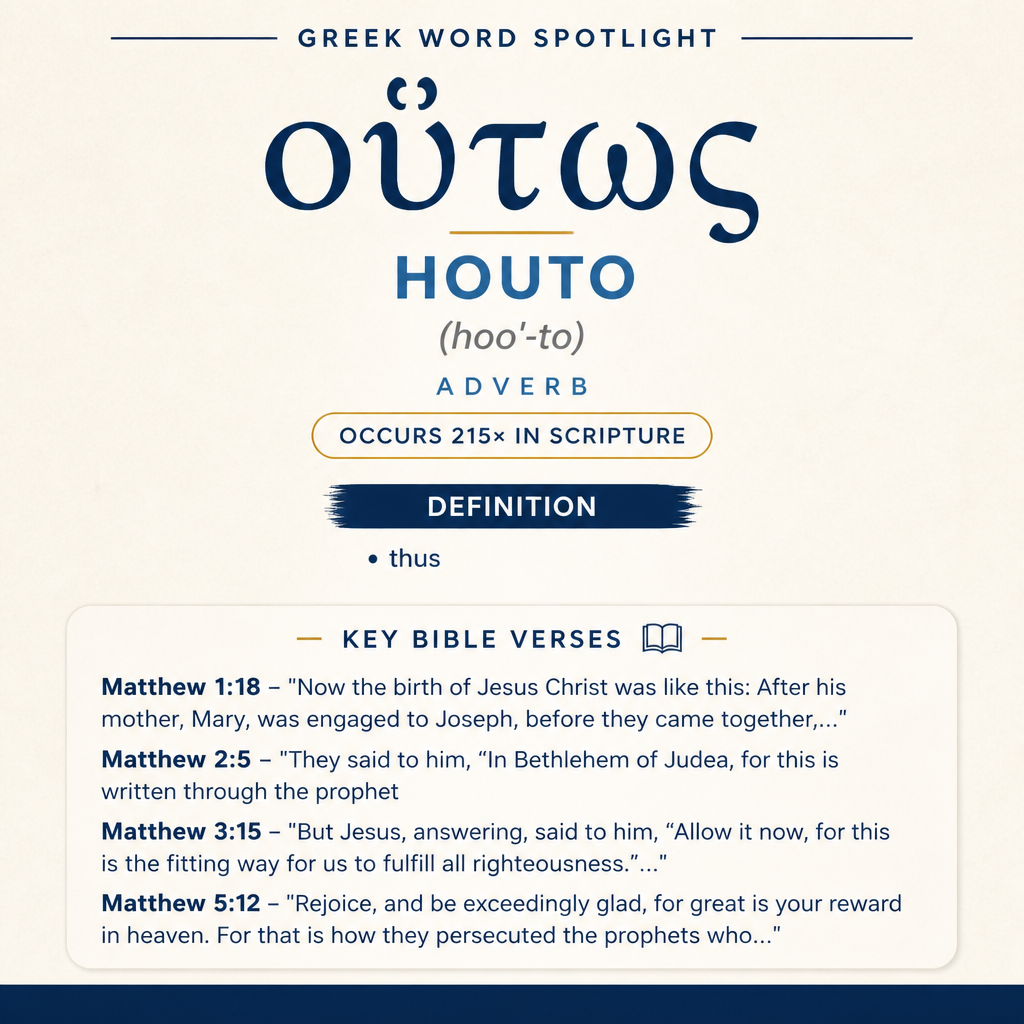
Occurrences
“Now the birth of Jesus Christ was like this: After his mother, Mary, was engaged to Joseph, before they came together, she was found pregnant by the Holy Spirit.” (Matthew 1:18)
Here οὕτως introduces an explanatory sequence. “Like this” signals that what follows is the manner or arrangement of the circumstances surrounding Jesus’ birth: the engagement to Joseph, the fact that they had not come together, and the discovery of pregnancy “by the Holy Spirit.” The adverb frames the narrative as an ordered account of how the situation stood.

“They said to him, “In Bethlehem of Judea, for this is written through the prophet,” (Matthew 2:5)
In this reply, οὕτως points to the manner in which the answer is grounded: it is given “for this is written.” The adverb helps present the response not as mere opinion but as an answer formed in a particular way—by appeal to what is written through the prophet—so the location “In Bethlehem of Judea” is presented as the fitting result of that written witness.
“But Jesus, answering, said to him, “Allow it now, for this is the fitting way for us to fulfill all righteousness.” Then he allowed him.” (Matthew 3:15)
Jesus uses οὕτως to characterize the action being requested: permitting the act “now” is “the fitting way” to fulfill all righteousness. “Thus” here is practical and directive: it specifies the manner in which righteousness is to be fulfilled in this moment—by allowing what is about to happen—so the request is justified as the appropriate course.
“Rejoice, and be exceedingly glad, for great is your reward in heaven. For that is how they persecuted the prophets who were before you.” (Matthew 5:12)
In this beatitude, οὕτως draws a comparison of pattern. “That is how” ties the present experience of persecution to an established manner of treatment: the prophets “who were before you” were persecuted in the same way. The adverb makes the encouragement concrete by locating present suffering within a recognizable historical pattern of opposition.
“Even so, let your light shine before men; that they may see your good works, and glorify your Father who is in heaven.” (Matthew 5:16)
“Even so” uses οὕτως to press a parallel from prior teaching into an imperative. The point is not only that light exists, but that it should shine in a certain way: “before men,” with the effect that they “may see your good works” and respond by glorifying the Father in heaven. οὕτως gives the command its shape, directing attention to the manner and intended outcome of public goodness.
“Whoever, therefore, shall break one of these least commandments, and teach others to do so, shall be called least in the Kingdom of Heaven; but whoever shall do and teach them shall be called great in the Kingdom of Heaven.” (Matthew 5:19)
At the end of the first clause, οὕτως (“do so”) compresses the described practice into a pointed summary. It refers back to the manner just described—breaking a least commandment and teaching others in the same way—and shows that the issue is not abstract disobedience but a particular pattern of conduct that is replicated by instruction. The adverb also sets up a contrast: another manner (“do and teach them”) corresponds to being “called great.”
“Pray like this: ‘Our Father in heaven, may your name be kept holy.” (Matthew 6:9)
In introducing the model prayer, οὕτως provides the manner of praying: “like this.” It functions as a guide word, orienting the listener to what follows as an example of how prayer is to be framed. The opening address (“Our Father in heaven”) is presented not merely as content but as a pattern-setting beginning.
“But if God so clothes the grass of the field, which today exists, and tomorrow is thrown into the oven, won’t he much more clothe you, you of little faith?” (Matthew 6:30)
“So clothes” uses οὕτως to highlight the manner and degree of God’s care for something transient: grass that exists today and is thrown into the oven tomorrow. The adverb sharpens the argument by emphasizing what God does in this way for the lesser case, thereby strengthening the inference that God will “much more” act toward “you.”
“Therefore whatever you desire for men to do to you, you shall also do to them; for this is the law and the prophets.” (Matthew 7:12)
In this ethical maxim, οὕτως (“do to them” in the same way) binds the measure of one’s action toward others to the manner one desires for oneself. The adverb supports the reciprocity: the desired manner of being treated becomes the manner of treating. The concluding clause (“for this is the law and the prophets”) presents this manner of action as a summative expression.
“Even so, every good tree produces good fruit; but the corrupt tree produces evil fruit.” (Matthew 7:17)
“Even so” again uses οὕτως to present an illustrative parallel: as the principle stands, the good tree bears good fruit and the corrupt tree bears evil fruit. The adverb signals that the statement is offered as a manner-based correspondence—this is how things work—so the moral or evaluative point is grounded in a recognizable pattern of results.
“When the demon was cast out, the mute man spoke. The multitudes marveled, saying, “Nothing like this has ever been seen in Israel!”” (Matthew 9:33)
In the crowd’s reaction, οὕτως contributes to an exclamation about unprecedented manner: “Nothing like this.” The sequence describes an effect—after the demon is cast out, the mute man speaks—and οὕτως captures the distinctive character of what has occurred as something without parallel “in Israel,” emphasizing the striking nature of the event as experienced.
“Yes, Father, for so it was well-pleasing in your sight.” (Matthew 11:26)
In this affirmation, οὕτως (“so”) points to the way something stands in relation to the Father’s pleasure: it was well-pleasing “in your sight” in this manner. The adverb gives the statement a settled, consenting tone: what has been spoken is embraced as fitting because it stands “so” with the Father.

Sense and Usage
Across these passages, οὕτως consistently marks “thus” as a pointer to manner, often doing one of three things.
First, it introduces an explanation of how a situation is constituted or how a statement is grounded. “Now the birth of Jesus Christ was like this” (Matthew 1:18) opens a structured account of circumstances; “for this is written through the prophet” (Matthew 2:5) presents the manner of answering as shaped by a written source. In both, οὕτως helps the reader follow a line from claim to supporting description.
Second, it provides a directive or pattern to imitate. “Allow it now, for this is the fitting way for us to fulfill all righteousness” (Matthew 3:15) uses manner-language to justify a specific action as the appropriate route. “Pray like this” (Matthew 6:9) explicitly sets a model. “Whatever you desire for men to do to you, you shall also do to them” (Matthew 7:12) uses the same manner-principle ethically, defining the shape of conduct by mirroring one’s desired treatment.
Third, it establishes analogies and comparisons that reinforce a point. “For that is how they persecuted the prophets who were before you” (Matthew 5:12) draws a line between present experience and prior pattern. “Even so, let your light shine before men” (Matthew 5:16) and “Even so, every good tree produces good fruit” (Matthew 7:17) use οὕτως to press an illustration into application: the adverb cues that the next statement should be read as a parallel that clarifies what faithful living looks like and how outcomes align with character. Even when the use is brief, as in “teach others to do so” (Matthew 5:19), οὕτως has a moral edge: it condenses a described practice into a replicable manner—whether destructive (breaking and teaching) or constructive (doing and teaching).
In addition, οὕτως can intensify the force of an argument by highlighting a striking instance. In Matthew 6:30, “if God so clothes the grass of the field” underscores the manner of divine provision toward what is short-lived, strengthening the rhetorical question that follows. In Matthew 9:33, “Nothing like this has ever been seen in Israel!” uses manner-language to express astonishment at the distinctive character of what the crowd has witnessed. In Matthew 11:26, “for so it was well-pleasing in your sight” presents a calm assent to the way events or truths stand before the Father.
Imagery and Emphasis
Because οὕτως points to “thus,” it often carries a subtle demonstrative force in these scenes: it gathers up what is being shown—an account of a birth (Matthew 1:18), a scriptural-grounded answer (Matthew 2:5), a chosen course that fulfills righteousness (Matthew 3:15), a longstanding pattern of persecution (Matthew 5:12), a public shining that results in glorifying the Father (Matthew 5:16), a teachable pattern of obedience or disobedience (Matthew 5:19), a model of prayer (Matthew 6:9), clothing of grass as an argument from lesser to greater (Matthew 6:30), a reciprocal ethic (Matthew 7:12), the tree-and-fruit correspondence (Matthew 7:17), and an unprecedented healing event (Matthew 9:33)—and holds it out as the way something is.
Sources: Lexical data from Strong’s Exhaustive Concordance and the Translators Brief Lexicon of Extended Strongs for Greek (STEPBible, CC BY). Occurrence data from the Translators Amalgamated Greek New Testament (STEPBible, CC BY). Scripture quotations from the World English Bible (public domain).