
xploring the Meaning of Orguia in Greek
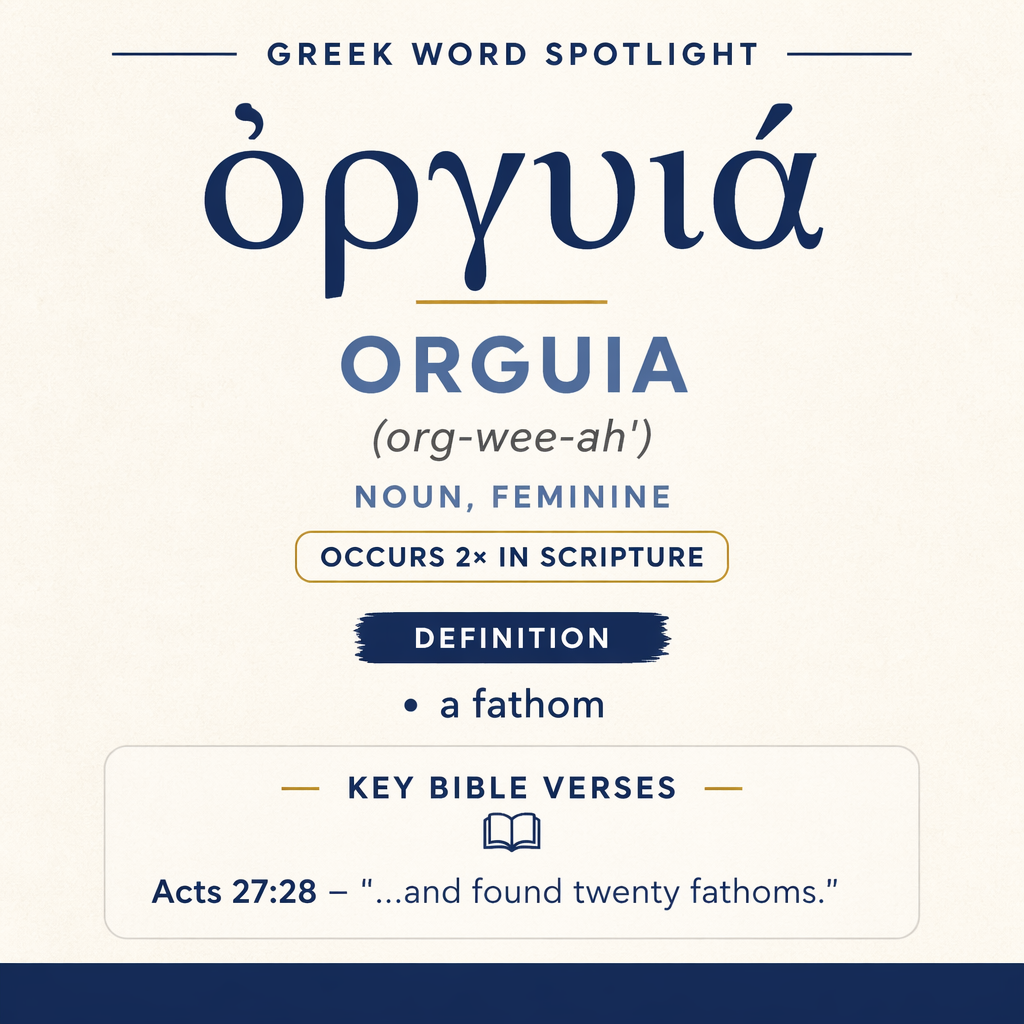
ὀργυιά (Orguia) means “a fathom” and appears in Acts 27:28 in the soundings taken during Paul’s voyage.
Context in Acts
In Acts 27:28, sailors take soundings and measure twenty fathoms, then fifteen fathoms.
Learn More →ὀργυιά denotes a measured depth of “a fathom,” used when assessing how much water lies beneath a vessel. It appears in the shipboard sounding report in Acts 27:28, where successive measurements mark a rapid change in depth.
Root and Related Words
ὀργυιά (Orguia) is connected with the verb ὀρέγω (oregomai), “to aspire” (Strong’s G3713).

Occurrences
“They took soundings, and found twenty fathoms. After a little while, they took soundings again, and found fifteen fathoms.” (Acts 27:28)
In this brief, clipped report, ὀργυιά supplies the unit by which the sailors’ soundings are stated and compared. The narrative gives two measured results—“twenty fathoms” and then “fifteen fathoms”—and the word anchors both numbers to a concrete depth. The effect is not merely to provide a statistic, but to make the danger legible: the second measurement is smaller than the first, and the change occurs “after a little while,” so the water is becoming shallower quickly. ὀργυιά, as a named unit, turns what could have been an impression (“it feels shallower”) into an observed reading, the sort of information a crew would use to judge whether they are nearing land or hidden hazards.
The verse also uses ὀργυιά in a repeated, almost rhythmic way. The first sounding yields one depth, then the crew repeats the action, and the same unit frames the new result. That repetition makes the comparison straightforward: the measurements are commensurable because they are given in the same unit. The narrative thus invites the reader to follow the crew’s reasoning as they respond to the sea’s changing conditions through concrete measurement.
Sense and Usage
In Acts 27:28, “a fathom” functions as a practical seafaring measure tied to the act of “taking soundings.” The word belongs to the world of navigation and safety: it is chosen because it can be counted (“twenty … fifteen”) and because those counts can be taken again after a short interval to detect change. Used this way, ὀργυιά is not a vague approximation but a unit suitable for repeated observation, allowing a situation to be tracked over time even within a single verse.
The immediate context in the sentence highlights how a fathom-measurement serves as a warning signal. The crew measures, waits only briefly (“after a little while”), measures again, and the reported depth decreases. Because ὀργυιά expresses the result in a stable unit, the danger is communicated as a downward movement in the numbers themselves. The word therefore participates in the verse’s sense of urgency: it supports an inference drawn from objective readings rather than from speculation.
ὀργυιά also suits the narrative’s economy. The author does not describe the method of sounding or the equipment; the unit alone is enough to place the action on board a ship where depth is being checked. A term like “fathoms” carries the scene’s concreteness: a crew working with measurable distances, calculating risk in the dark or near an unseen coastline, and recognizing that what is beneath them is changing.
Imagery
Acts 27:28 frames ὀργυιά with the stark simplicity of repeated measurement: “They took soundings … they took soundings again.” The imagery is of a ship pressing forward while the sea-floor rises toward it, and the word “fathoms” gives the reader a way to feel that approach as a narrowing margin of safety—from “twenty” down to “fifteen”—within the short span of “a little while.”
Sources: Lexical data from Strong’s Exhaustive Concordance and the Translators Brief Lexicon of Extended Strongs for Greek (STEPBible, CC BY). Occurrence data from the Translators Amalgamated Greek New Testament (STEPBible, CC BY). Scripture quotations from the World English Bible (public domain).





