
Exploring the Meaning of Oregomai in Greek
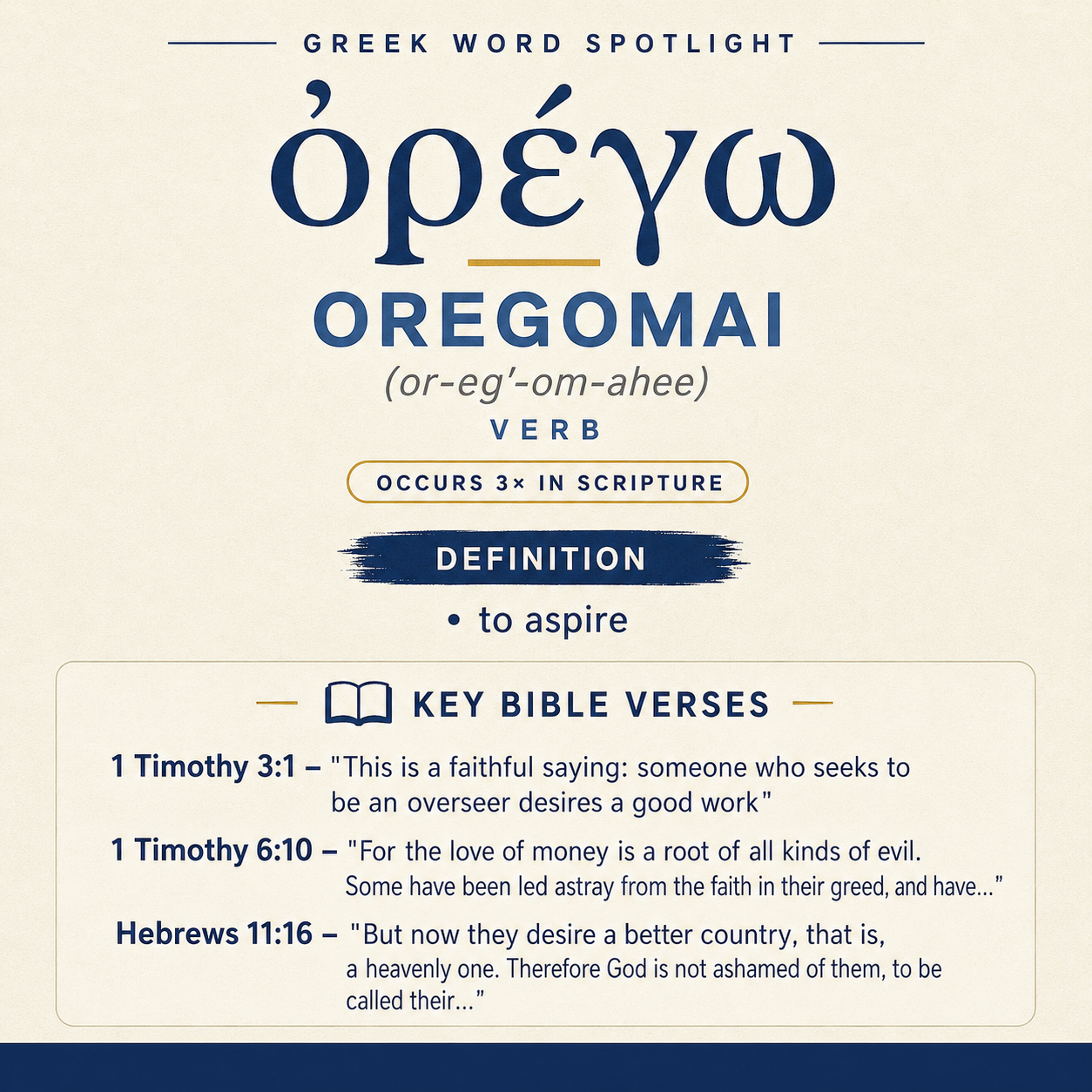
ὀρέγω means “to aspire” and occurs three times in Scripture: 1 Timothy 3:1; 1 Timothy 6:10; Hebrews 11:16.
Where It Appears
This verb occurs three times in Scripture. Its references are 1 Timothy 3:1; 1 Timothy 6:10; and Hebrews 11:16.
Learn More →Usage In Context
In 1 Timothy 3:1 it describes seeking the work of an overseer. In Hebrews 11:16 it describes desiring a better, heavenly country.
Learn More →ὀρέγω expresses aspiration, the inward reaching of desire toward a goal. It appears in contexts that weigh what a person sets the heart on—church leadership, wealth, and a promised homeland.
Root and Related Words
ὀρέγω is presented as deriving from oros (ὄρος), “mountain” (Strong’s G3735).

Occurrences
1 Timothy 3:1: “This is a faithful saying: someone who seeks to be an overseer desires a good work.”
Here ὀρέγω describes aspiration toward a role of oversight in the church. The verse frames this desire as directed toward “a good work,” so the word’s force lies in the purposeful aiming of a person’s longing: the seeker is not merely curious about the office but stretches toward it as a chosen goal. The statement is crafted as a maxim (“This is a faithful saying”), and the aspiration is treated as something that can be evaluated by its object—what is being reached for is “good work,” not personal status spelled out in the verse. In this setting, aspiration is linked to intentional pursuit (“someone who seeks”) and to a concrete sphere of service (“work”).

1 Timothy 6:10: “For the love of money is a root of all kinds of evil. Some have been led astray from the faith in their greed, and have pierced themselves through with many sorrows.”
In this warning, ὀρέγω stands behind the movement from desire to ruin. The verse traces a chain: “love of money” produces “all kinds of evil,” and “some” are “led astray from the faith” in “their greed,” ending in self-inflicted suffering—“pierced themselves through with many sorrows.” The contribution of the word is to depict aspiration as a reaching that can seize a person so strongly that it pulls them off course. The language is not neutral: it presents aspiration as capable of exerting directional force (“led astray”) and of carrying moral consequence. The final picture is painfully physical (“pierced themselves through”), emphasizing that misdirected longing does not remain internal; it results in lived damage that returns upon the one who reaches.
Hebrews 11:16: “But now they desire a better country, that is, a heavenly one. Therefore God is not ashamed of them, to be called their God, for he has prepared a city for them.”
In Hebrews, ὀρέγω names aspiration with an explicitly elevated object: “a better country,” further defined as “a heavenly one.” The verse then links that desire to divine response: “Therefore God is not ashamed of them, to be called their God,” and it grounds the outcome in provision—“for he has prepared a city for them.” The word contributes a sense of forward-reaching longing that is not satisfied by what is immediate; it is aimed toward a homeland characterized as “better.” The desire is portrayed as fitting and honored: it coheres with God’s willingness to be publicly associated with them (“not ashamed…to be called their God”) and with God’s action in preparing what corresponds to their aspiration (“a city”). In this scene, aspiration is not only personal yearning but an orientation that aligns with promise and preparation.
Sense and Usage
Across these passages, ὀρέγω functions as a verb of aspiration whose moral and spiritual weight depends on what the desire reaches toward. In 1 Timothy 3:1, aspiration is tethered to “a good work,” and the verse treats the reach of desire as an intentional seeking that can be spoken of approvingly. In 1 Timothy 6:10, aspiration attaches to money and becomes a centrifugal pull away from “the faith,” ending not in fulfillment but in multiplied grief; the verse describes aspiration as capable of steering a life and of creating painful consequences. In Hebrews 11:16, aspiration is fixed on “a better country…a heavenly one,” and that reaching is met with divine affirmation and divine preparation.
These three settings show aspiration operating on a spectrum of objects: service in the community (“overseer”), wealth (“money”), and homeland (“country…heavenly one”). In each case, the aspiration is not a fleeting wish but an orientation that sets direction. The surrounding verbs and results bring this out: “seeks” and “desires” in 1 Timothy 3:1 place aspiration alongside deliberate pursuit; “led astray” and “pierced themselves through” in 1 Timothy 6:10 show aspiration’s ability to redirect and wound; “desire,” “Therefore,” and “prepared” in Hebrews 11:16 connect aspiration with an evaluative conclusion and with a promised destination. The word’s scenes thus present aspiration as a reaching that both reveals and shapes what a person values, with consequences that can be affirmed as “good” or lamented as sorrow.
Because aspiration is portrayed as directional, ὀρέγω naturally invites attention to its object in context. The same kind of reaching can be commendable when aimed at “a good work,” destructive when fastened to “money,” and honored when fixed on “a better country.” The passages do not treat aspiration as self-justifying; they frame it as an energy of the heart that must be assessed by where it points and what it produces.
Imagery
The imagery surrounding ὀρέγω includes both pain and promise. One text ends with the stark picture of people who “have pierced themselves through with many sorrows” (1 Timothy 6:10), portraying aspiration as a force that can turn inward against the aspirant. Another culminates in a prepared destination—“he has prepared a city for them” (Hebrews 11:16)—where aspiration is answered by provision. Between these, the aspiration toward oversight (1 Timothy 3:1) anchors the word in everyday, concrete service: desire reaching toward “work,” not simply toward an idea.
Sources: Lexical data from Strong’s Exhaustive Concordance and the Translators Brief Lexicon of Extended Strongs for Greek (STEPBible, CC BY). Occurrence data from the Translators Amalgamated Greek New Testament (STEPBible, CC BY). Scripture quotations from the World English Bible (public domain).




