
Exploring the Meaning of Orgizo in Greek
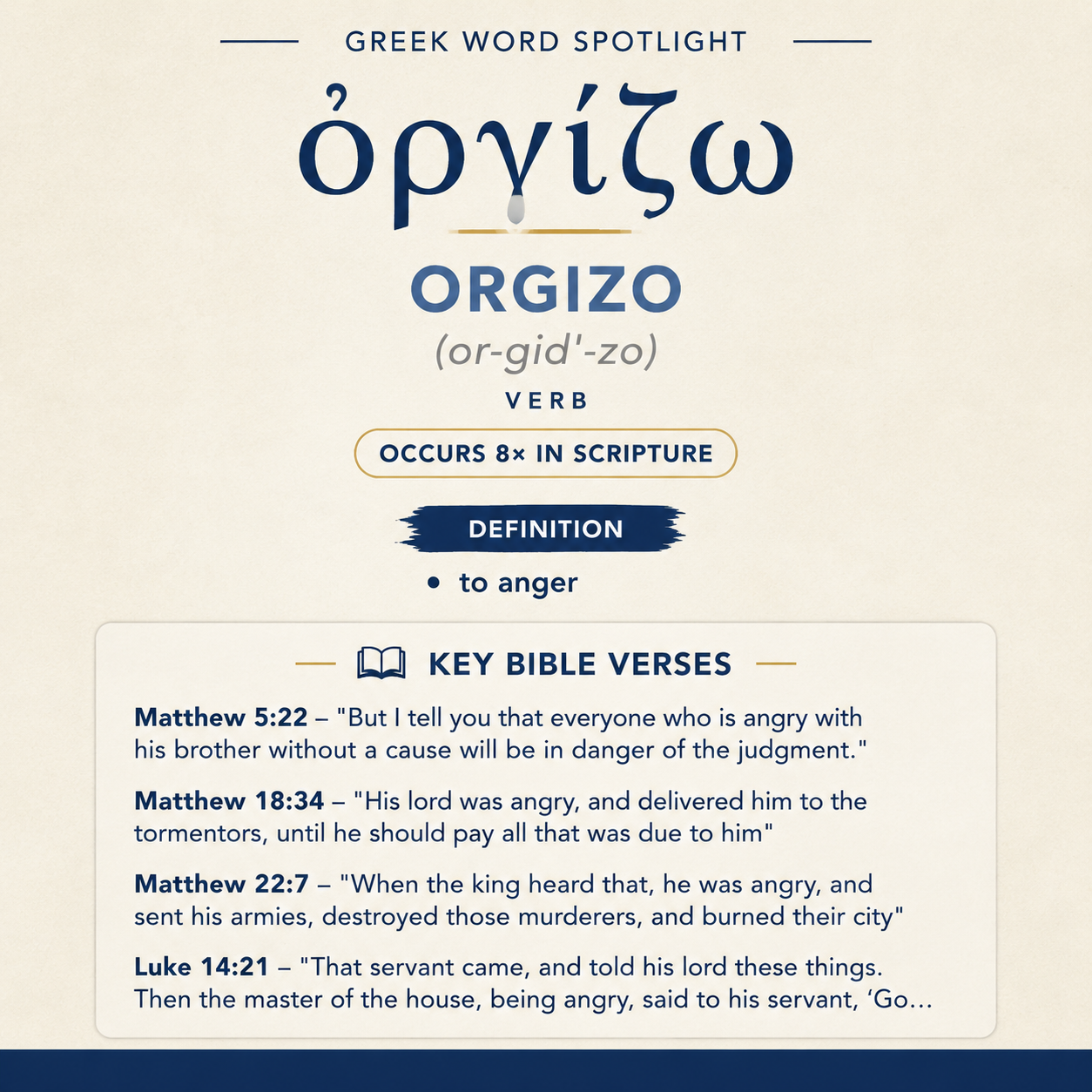
ὀργίζω means “to anger” and occurs 8 times in Scripture: Matthew 5:22; 18:34; 22:7; Luke 14:21; 15:28; Ephesians 4:26; Revelation 11:18; 12:17.
Core Meaning
ὀργίζω is defined as “to anger.” It describes becoming angry in multiple narrative and exhortational contexts.
Learn More →Gospel Scenes
In Matthew and Luke, it describes anger in responses to wrongdoing, refusals, and reports (Matthew 18:34; 22:7; Luke 14:21; 15:28). Matthew 5:22 warns about being angry with a brother.
Learn More →Instruction & Conflict
Ephesians 4:26 commands, “Be angry, and don’t sin,” with a warning not to let the sun go down on wrath. In Revelation, nations are angry and the dragon grows angry (Revelation 11:18; 12:17).
Learn More →ὀργίζω means “to anger,” describing the rising of anger in individuals, rulers, nations, and even the dragon of apocalyptic vision. In the passages where it appears, it marks a decisive inner reaction that often leads toward speech, refusal, command, punishment, or violent action.
Occurrences
Matthew 5:22: “But I tell you that everyone who is angry with his brother without a cause will be in danger of the judgment. Whoever says to his brother, ‘Raca!’ will be in danger of the council. Whoever says, ‘You fool!’ will be in danger of the fire of Gehenna.”
Here ὀργίζω frames anger as a moral and judicially weighty disposition “with his brother.” The saying links being angry to escalating outcomes: first “danger of the judgment,” then insulting speech (“Raca!”), then a harsher contempt (“You fool!”) with correspondingly heightened peril. The verb anchors the inner impulse that can spill into words, and the verse places that anger under the scrutiny of judgment rather than treating it as a merely private feeling.
Matthew 18:34: “His lord was angry, and delivered him to the tormentors, until he should pay all that was due to him.”
In this parabolic scene, ὀργίζω describes the lord’s anger as the turning point that moves him from authority exercised in ordinary governance to authority exercised in punitive force. The anger is not left as an emotion; it is immediately tied to an action: the debtor is “delivered… to the tormentors,” with a stated condition (“until he should pay all that was due to him”). The verb thus marks anger as the impetus for an enforced, ongoing consequence.
Matthew 22:7: “When the king heard that, he was angry, and sent his armies, destroyed those murderers, and burned their city.”
Again in parable, the king’s anger is triggered by what he “heard,” and the verb introduces a chain of royal responses. The anger is portrayed as public and political, expressed through military deployment (“sent his armies”) and extensive retribution (“destroyed… burned their city”). ὀργίζω here sets the tone for a sweeping judgment that reaches beyond individuals to a whole city, highlighting anger’s capacity, in a ruler, to become policy and force.
Luke 14:21: ““That servant came, and told his lord these things. Then the master of the house, being angry, said to his servant, ‘Go out quickly into the streets and lanes of the city, and bring in the poor, maimed, blind, and lame.’”
In this banquet setting, ὀργίζω describes the master’s anger as a reaction to a report from the servant. Yet the immediate expression of that anger is not punishment but a command that reshapes the guest list: “Go out quickly… bring in the poor, maimed, blind, and lame.” The verb signals an emotional jolt that drives decisive instruction and urgency (“quickly”), steering the narrative toward inclusion of those named in the command.
Luke 15:28: “But he was angry, and would not go in. Therefore his father came out, and begged him.”
Here ὀργίζω characterizes the older brother’s anger as resistance: “would not go in.” The verb explains his refusal and creates the relational tension that prompts another action—“his father came out, and begged him.” Anger is shown not as a momentary flash but as a stance that blocks fellowship and requires pleading to overcome.
Ephesians 4:26: ““Be angry, and don’t sin.” Don’t let the sun go down on your wrath,”
In this ethical instruction, ὀργίζω is used as an imperative (“Be angry”), set beside an immediate boundary (“and don’t sin”). The command acknowledges anger as a real human experience, but it is paired with a time-sensitive restraint: “Don’t let the sun go down on your wrath.” The verb’s force here is practical and pastoral in tone—anger is addressed directly and placed under moral limits so it does not harden into enduring wrath.
Revelation 11:18: “The nations were angry, and your wrath came, as did the time for the dead to be judged, and to give your bondservants the prophets, their reward, as well as to the saints, and those who fear your name, to the small and the great, and to destroy those who destroy the earth.”
In this apocalyptic proclamation, ὀργίζω describes anger on a vast scale: “The nations were angry.” That anger is juxtaposed with “your wrath,” which “came” together with the appointed “time… to be judged” and to give reward to “bondservants… prophets,” “saints,” and “those who fear your name.” The verb contributes the picture of a world in agitation, set over against divine action that both judges and rewards and finally “destroy[s] those who destroy the earth.”
Revelation 12:17: “The dragon grew angry with the woman, and went away to make war with the rest of her offspring, who keep God’s commandments and hold Jesus’ testimony.”
Here ὀργίζω intensifies anger into hostility that becomes open conflict. The dragon’s anger is directed “with the woman,” but it results in a new target and campaign: he “went away to make war with the rest of her offspring,” defined as those who “keep God’s commandments and hold Jesus’ testimony.” The verb thus introduces the motive force behind persecution, where anger fuels strategic aggression.

Sense and Usage
Across these passages, ὀργίζω functions as the hinge between an occasion and a response. The occasions vary: interpersonal friction (“angry with his brother,” Matthew 5:22), a lord’s reaction within a debt scenario (Matthew 18:34), a king’s response to grievous news (Matthew 22:7), a master’s reaction to a servant’s report (Luke 14:21), a family conflict expressed as refusal (Luke 15:28), direct moral instruction about managing anger (Ephesians 4:26), international agitation set within divine judgment and reward (Revelation 11:18), and the dragon’s rage leading to war against commandment-keepers (Revelation 12:17). In each case, the verb points to anger as an energizing state that presses toward outcome.
Several occurrences emphasize the outward consequences anger can generate. In Matthew 18:34 and Matthew 22:7, anger is attached to authoritative power and immediately produces coercive or destructive action: handing someone over to tormentors, sending armies, destroying murderers, burning a city. By contrast, Luke 14:21 shows anger driving an urgent corrective command that fills a house with new guests—still decisive and forceful, but oriented toward a different kind of outcome. Luke 15:28 locates anger within a relationship where the primary action is nonparticipation (“would not go in”), and the narrative reaction is entreaty (“his father came out, and begged him”), showing anger’s capacity to isolate and to demand relational repair.
Matthew 5:22 and Ephesians 4:26 together place anger under moral evaluation. Matthew 5:22 treats anger “with his brother” as a matter that exposes one to judgment and that can cascade into contemptuous speech, making anger the seedbed of relational and verbal harm. Ephesians 4:26, while not minimizing the danger (“don’t sin,” “Don’t let the sun go down on your wrath”), addresses anger as something that can be confronted promptly and bounded. In these two texts, ὀργίζω does not merely label a feeling; it sits in the middle of a discussion about culpability, restraint, and the speed with which anger should be dealt with.
In Revelation, ὀργίζω is scaled up to cosmic proportions. The nations’ anger (Revelation 11:18) is part of a larger scene where wrath, judgment of the dead, and the giving of reward are all announced together, so that human collective anger is framed within a decisive divine timetable and outcome. The dragon’s anger (Revelation 12:17) is personalized and targeted, producing war against a defined community characterized by obedience and testimony. In both, anger is more than temperament; it becomes a driving force within conflict and judgment narratives.
Imagery
The imagery tied to ὀργίζω ranges from the private interior of a person (“angry with his brother,” Matthew 5:22) to the public actions of a ruler (“sent his armies… burned their city,” Matthew 22:7), from a doorway where someone “would not go in” (Luke 15:28) to city streets where the master orders the servant to gather the needy (Luke 14:21). At its broadest, anger becomes a feature of end-time turmoil (“The nations were angry,” Revelation 11:18) and of a militant adversary who “went away to make war” (Revelation 12:17). In each setting, the verb paints anger as an active force that changes what happens next.
Sources: Lexical data from Strong’s Exhaustive Concordance and the Translators Brief Lexicon of Extended Strongs for Greek (STEPBible, CC BY). Occurrence data from the Translators Amalgamated Greek New Testament (STEPBible, CC BY). Scripture quotations from the World English Bible (public domain).




