
Exploring the Meaning of Olothreuo in Greek
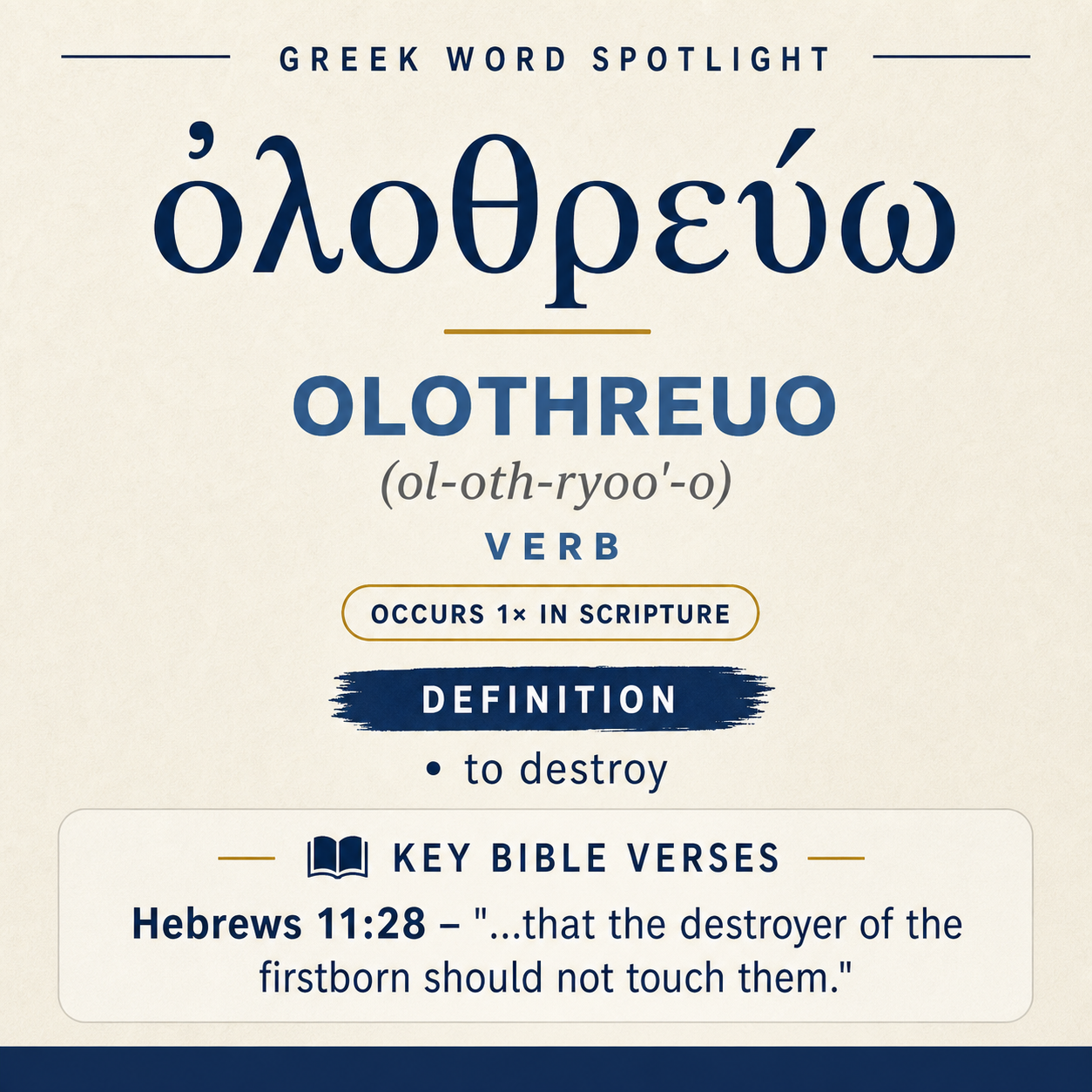
ὀλοθρεύω means “to destroy” and appears once in Scripture, in Hebrews 11:28.
Scripture Occurrence
This verb occurs 1 time in Scripture. Its single occurrence is in Hebrews 11:28.
Learn More →Context in Hebrews
In Hebrews 11:28, it appears in the statement about “the destroyer of the firstborn.” The verse says this destroyer should not touch them.
Learn More →ὀλοθρεύω means “to destroy,” and it appears in the New Testament in a context that contrasts preservation with ruin. Its single occurrence comes in Hebrews 11:28, where it is tied to the threat of a “destroyer” and the protective effect of sacrificial blood.
Root and Related Words
ὀλοθρεύω is related to
olethros (ὄλεθρος), “destructive”
(Strong’s G3639). The relationship links the verb to a word-family that expresses the idea of destruction as a characteristic or outcome.

Occurrences
“By faith, he kept the Passover, and the sprinkling of the blood, that the destroyer of the firstborn should not touch them.” (Hebrews 11:28)
In this verse, the verb’s force is carried through the figure “the destroyer of the firstborn.” The scene is framed by two coordinated actions—“he kept the Passover” and “the sprinkling of the blood”—and these are presented as the means by which a destructive outcome is averted. The statement is not abstract: it names a specific target (“the firstborn”) and describes the danger in tangible terms (“should not touch them”). Within that logic, ὀλοθρεύω supplies the grim potential that stands behind the word “destroyer”: the threat is not merely to frighten but to bring decisive ruin, and the faith described is faith that acts so that this destroyer does not reach its intended victims.
The verse also places the destructive agency in a subordinate clause of purpose: “that the destroyer… should not touch them.” That construction makes the prevention of destruction the stated aim of the Passover-keeping and the blood-sprinkling. Thus the verb’s contribution is not only to depict destruction as a real peril, but to sharpen the contrast between destructive reach and protected safety. The action of destruction is pictured as something that can “touch,” an almost physical contact, which turns the notion of destruction into an imminent approach rather than a distant possibility.
Sense and Usage
Across its attested use, ὀλοθρεύω expresses destruction as an act with concrete consequences for identifiable people (“the firstborn”). Hebrews 11:28 embeds the concept in a narrative pattern: an act of faithful obedience (“he kept the Passover”) and a ritual action (“the sprinkling of the blood”) stand between a vulnerable group (“them”) and a destructive agent (“the destroyer”). In that setting, the verb’s sense is not developed through multiple examples but through the verse’s internal contrasts—life spared versus life taken, touch versus restraint, and threat versus protection.
The passage also locates destruction at the intersection of agency and boundary. The destroyer is portrayed as active and capable of contact, but the verse insists that this contact can be prevented. Destruction, therefore, is not depicted as an impersonal fate; it is a peril that comes toward its object and can be held back. The vocabulary gives destruction a directional quality: it moves toward “them,” and the stated outcome of the actions in the verse is that it does not arrive.
Because the verse ties the prevention of destructive action directly to “faith,” ὀλοθρεύω functions within Hebrews 11’s broader emphasis on faith expressed in concrete deeds. The destructive possibility is the pressure point that makes the faithful actions meaningful. The verb’s sense thus operates as the negative horizon of the story: what would happen if the destroyer were to touch, and what is prevented when the blood is sprinkled.
Imagery
Hebrews 11:28 gives destruction a stark, almost tactile image: the destroyer “touch[es]” its victims. Against that, the verse sets the image of “the sprinkling of the blood,” a visible marker associated with protection. Within this single line, ὀλοθρεύω carries the weight of a threatened, decisive ruin that is held at bay, so that the story’s focus rests on preservation in the face of destruction.
Sources: Lexical data from Strong’s Exhaustive Concordance and the Translators Brief Lexicon of Extended Strongs for Greek (STEPBible, CC BY). Occurrence data from the Translators Amalgamated Greek New Testament (STEPBible, CC BY). Scripture quotations from the World English Bible (public domain).





