Exploring the Meaning of Nomothesia in Greek
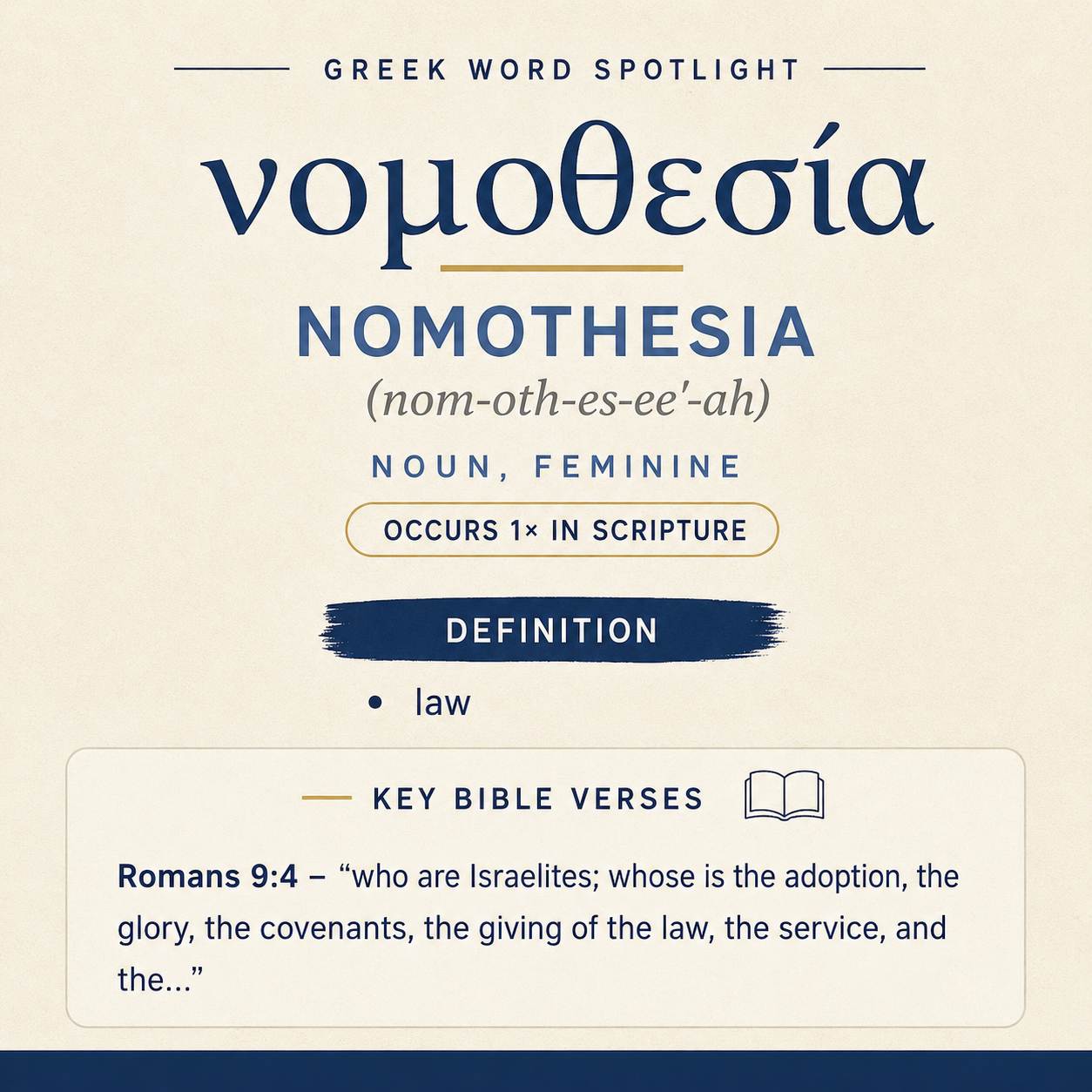
νομοθεσία means “law” and appears once in Scripture in Romans 9:4.
Romans Context
In Romans 9:4 it is listed among Israel’s privileges as “the giving of the law.”
Learn More →νομοθεσία refers to “law” and appears once in the New Testament. Its sole occurrence is in Paul’s catalogue of Israel’s privileges in Romans 9:4, where it is placed alongside covenantal and cultic gifts.
Root and Related Words
νομοθεσία is related to the term nomothetes (νομοθέτης), “lawgiver” (Strong’s G3550), from which it derives.

Occurrences
“who are Israelites; whose is the adoption, the glory, the covenants, the giving of the law, the service, and the promises;” (Romans 9:4)
In Romans 9:4, νομοθεσία stands within a carefully arranged list that identifies what belongs to “Israelites.” The verse does not present the word in isolation but embeds it among several concrete descriptors: “the adoption, the glory, the covenants, the giving of the law, the service, and the promises.” Within this accumulation, “the giving of the law” functions as a distinct item, set between “the covenants” and “the service.” That placement matters for how the word is heard in this sentence: it is not merely one honor among others, but one feature in a cluster of gifts that define a people’s historical and religious identity.

The phrase “the giving of the law” presents law in a received and bestowed frame. In this line Paul does not speak of law as human initiative or cultural achievement; rather, it is something that is “given.” That grammatical shaping ties the word to the other nouns in the series that likewise imply bestowal or possession (“whose is …”). In the same breath, “the giving of the law” is coordinated with “the covenants” and “the promises,” so that law is not described as an abstract ideal but as one element in a set of divine endowments that together mark out Israel’s story.
At the same time, the list juxtaposes “the giving of the law” with “the service.” In this verse, “the service” is presented as another possessed privilege, and its proximity helps locate what “law” does in the sentence: it fits naturally among realities that are lived, practiced, and embodied in communal life. The verse’s structure therefore lets νομοθεσία contribute not only the notion of law itself, but the idea of law as a gift situated among covenants, worship, and promises—part of a recognizable inventory of what is uniquely attributed to Israel.
Sense and Usage
Because νομοθεσία is attested here only in Romans 9:4, its sense is shaped entirely by this single rhetorical setting. The definition “law” is framed through an explicit act of giving: Paul does not simply list “law” as a concept, but as something bestowed (“the giving of the law”). The wording therefore highlights law as a granted possession, not a self-generated one. In this verse, “law” is not expounded, defined, or contrasted; instead it is named as one item in a sequence of privileges that are claimed for a specific people (“who are Israelites; whose is …”).
The surrounding items clarify what kind of semantic weight “law” carries in the sentence without requiring extra explanation. It stands alongside “the covenants” and “the promises,” which are relational and forward-looking terms, and alongside “the service,” which suggests ordered religious practice. In such a list, “law” functions as one pillar among others, contributing to a portrait of a people defined by received gifts. The word’s contribution is therefore cumulative and identificatory: it helps articulate what belongs to Israel as part of a bundle of inherited, named realities.
The list itself is also notable for its rhythm: each element is introduced as something that is “whose,” emphasizing possession and belonging. Within that repeated pattern, “the giving of the law” is a slightly different kind of noun phrase, since it names a granting event (“giving”) rather than simply an object (“the glory,” “the promises”). This difference gives “law” a particular texture in context: law is not merely a thing that exists; it is remembered as something given. That form, in turn, harmonizes with the entry’s placement among other gifts that presume divine initiative, binding “law” to a narrative of reception rather than mere legal abstraction.
The linkage to nomothetes (νομοθέτης), “lawgiver,” provides a lexical bridge that keeps the idea of law close to the act or authority of giving. In Romans 9:4, that same orientation is already present in the phrasing “the giving of the law,” which foregrounds the bestowal rather than discussion of content. Thus, even within a single occurrence, νομοθεσία bears the mark of law understood as a granted endowment within a larger constellation of covenantal privileges.
Imagery
Romans 9:4 evokes the imagery of a people defined by what has been entrusted to them: adoption, glory, covenants, law given, service, and promises. Within that catalogue, νομοθεσία contributes to the picture of an inheritance received—law not as an isolated rulebook, but as one named gift among other defining treasures that belong to Israel.
Sources: Lexical data from Strong’s Exhaustive Concordance and the Translators Brief Lexicon of Extended Strongs for Greek (STEPBible, CC BY). Occurrence data from the Translators Amalgamated Greek New Testament (STEPBible, CC BY). Scripture quotations from the World English Bible (public domain).