
Exploring the Meaning of Metra in Greek
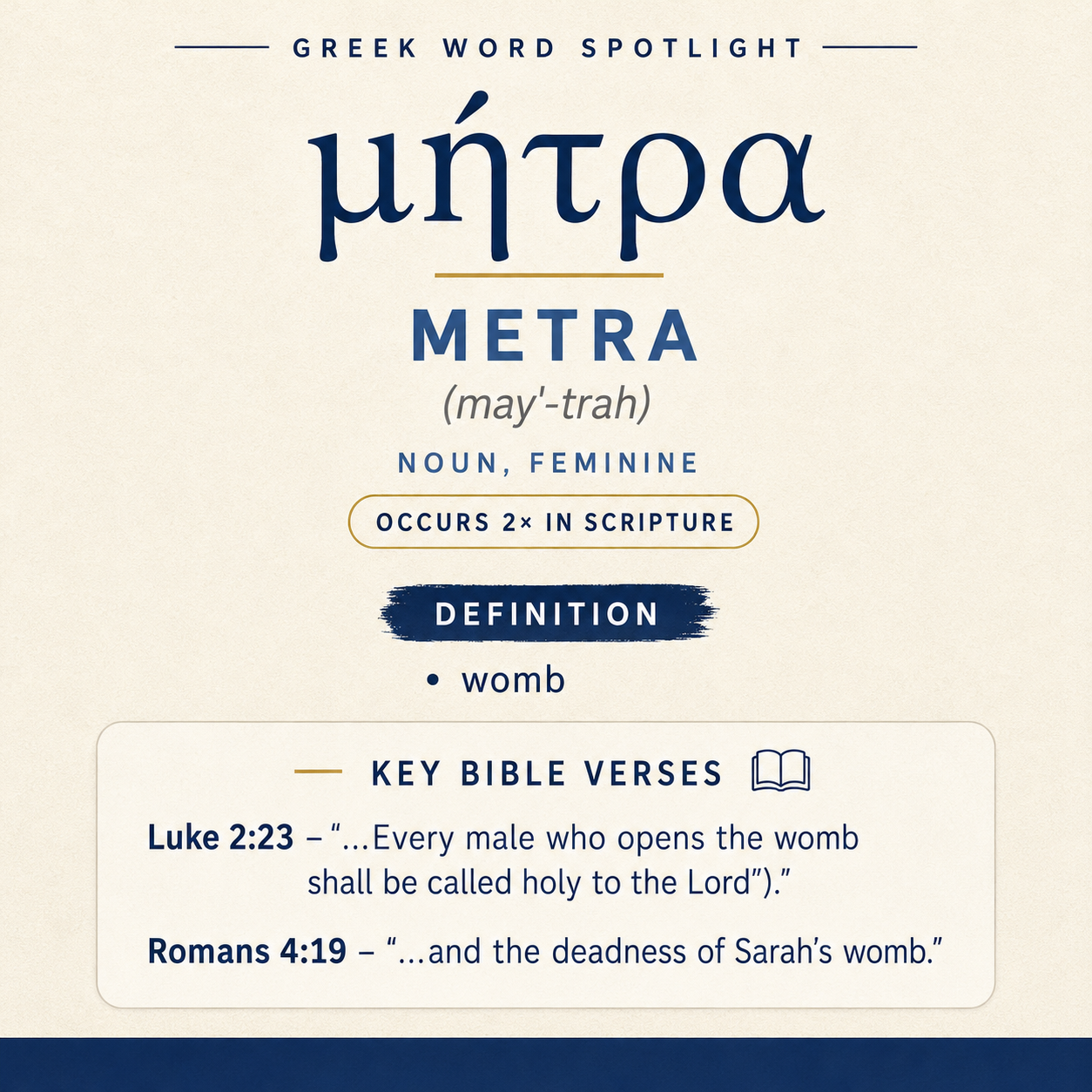
μήτρα means “womb” and appears twice in Scripture, in Luke 2:23 and Romans 4:19.
Scripture Occurrences
This Greek noun occurs 2 times in Scripture: Luke 2:23 and Romans 4:19.
Learn More →Verse Context
In Luke 2:23 it appears in the statement, “Every male who opens the womb shall be called holy to the Lord.”
Learn More →μήτρα refers to the womb, the bodily place where life is conceived and carried. In the New Testament it appears in Luke’s description of a requirement in the law and in Paul’s discussion of Sarah in an argument about faith.
Root and Related Words
μήτρα is related to μήτηρ (Metēr), “mother” (Strong’s G3384).

Occurrences
“(as it is written in the law of the Lord, “Every male who opens the womb shall be called holy to the Lord”),” (Luke 2:23)
Here μήτρα occurs inside a citation framed as written “in the law of the Lord.” The phrase “opens the womb” treats the womb as a specific, identifiable locus connected with the birth of a “male.” In this setting, the womb functions as the boundary that is crossed at birth: the child is the one who “opens” it, and that event marks him out for a declared status—“shall be called holy to the Lord.” The wording keeps attention on the physical origin of the newborn, not as a mere biological detail but as a legally meaningful marker. The womb is the concrete point of reference that links a particular birth to a religious designation.
The way Luke embeds the phrase in a parenthetical—“as it is written”—also highlights the womb as part of an inherited pattern of speech and practice. The law’s formulation is not simply “every male born,” but “every male who opens the womb,” focusing the reader on the act of emergence from within. μήτρα, therefore, supports the verse’s emphasis on the child’s first appearance into the world as the moment that carries covenantal recognition.
“Without being weakened in faith, he didn’t consider his own body, already having been worn out, (he being about a hundred years old), and the deadness of Sarah’s womb.” (Romans 4:19)
In Romans, μήτρα appears in a phrase that places it alongside “his own body” and describes both with terms of decline: his body is “already having been worn out,” and Sarah’s womb is characterized by “deadness.” The womb here is a focal point for the obstacle the couple faces: the bodily capacity associated with bearing children is portrayed as no longer active. μήτρα names the specific bodily reality being confronted, and Paul’s language turns that reality into part of the tension in the sentence—what Abraham “didn’t consider” as determinative “without being weakened in faith.”
Because μήτρα is attached to Sarah by possession (“Sarah’s womb”), the word is individualized and relational rather than generic. Paul does not speak of an abstract womb, but of Sarah’s womb in particular, and its “deadness” becomes a way of describing her condition in a stark, concrete image. In context, μήτρα helps anchor Paul’s argument in embodied life: faith is spoken of alongside physical aging and reproductive incapacity, so that “faith” is not a vague optimism but a stance taken in the face of specific bodily facts.
Sense and Usage
Across these two passages, μήτρα points to the womb as the bodily site where beginnings—and the limits on beginnings—are located. In Luke 2:23 the womb stands at the threshold of life’s entrance into the world: the male who “opens” it is identified by that first birth-event and, on that basis, “shall be called holy to the Lord.” The womb is therefore not merely background anatomy; it is the named place whose opening signals a decisive moment that can be spoken of in legal and religious terms.
In Romans 4:19, by contrast, μήτρα is used to describe the human impossibility that frames the discussion. The womb is the same kind of bodily reality as “his own body,” and it is described in terms that stress incapacity. The phrase “the deadness of Sarah’s womb” concentrates the problem into a single image: the very place associated with carrying life is spoken of as lacking life-giving capacity. The womb is thus the point where the body’s limits are felt most sharply in the narrative that Paul invokes.
Read together, the two uses show μήτρα operating as a concrete term that can bear considerable weight in theological discourse without changing its reference. It can be the location whose opening marks a newborn’s status, and it can be the location whose condition represents a barrier that faith does not treat as final. In both cases, μήτρα keeps the discussion tethered to the physical origin of human life: Luke’s legal language presumes the significance of birth from the womb, while Paul’s argumentative language presumes the significance of the womb’s condition for the possibility of descendants.
Imagery in Context
Luke 2:23 presents the womb with the imagery of an opening—an event that brings a child into view and into a named relationship to the Lord. Romans 4:19 presents the womb with the imagery of “deadness,” a stark bodily picture set beside a worn body and an advanced age. Together these passages place μήτρα at two ends of human experience: the moment life begins in a recognizable way, and the moment when the body’s power to begin life is portrayed as absent—both treated as realities that matter in how God’s purposes are spoken of.
Sources: Lexical data from Strong’s Exhaustive Concordance and the Translators Brief Lexicon of Extended Strongs for Greek (STEPBible, CC BY). Occurrence data from the Translators Amalgamated Greek New Testament (STEPBible, CC BY). Scripture quotations from the World English Bible (public domain).





