Exploring the Meaning of Metrios in Greek
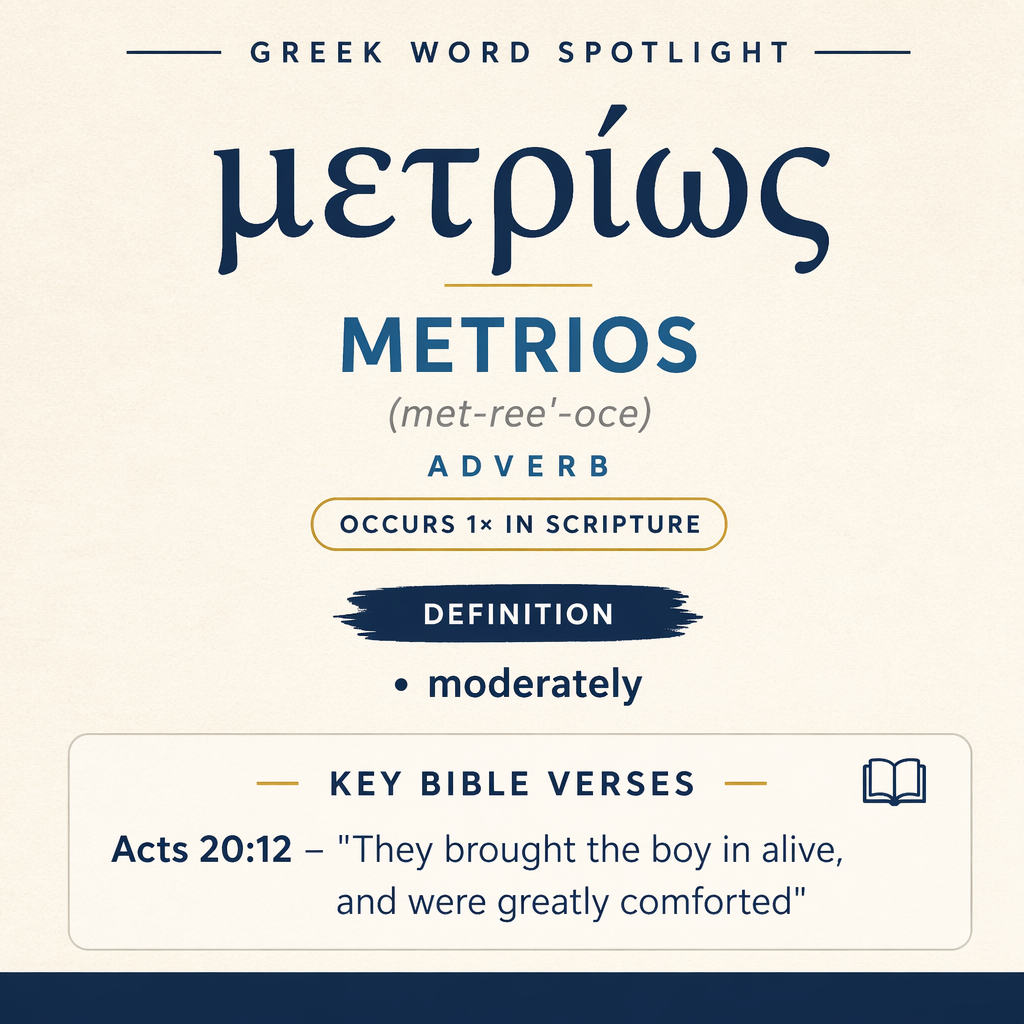
μετρίως means “moderately” and appears once in Scripture, in Acts 20:12.
Scripture Occurrence
This word occurs 1 time in Scripture. The occurrence is in Acts 20:12.
Learn More →Verse Context
In Acts 20:12, the boy was brought in alive, and the people were greatly comforted.
Learn More →μετρίως expresses the idea of acting or being “moderately.” It appears in the narrative of Acts 20:12, within the report of the community’s response after a boy is brought in alive.
Root and Related Words
μετρίως is connected with the noun metron (μέτρον), “measure” (Strong’s G3358). The relationship naturally frames the adverb in terms of what is measured or kept within a measure.

Occurrences
“They brought the boy in alive, and were greatly comforted.” (Acts 20:12)
This line reports both the outcome (“the boy in alive”) and the emotional effect on the gathered believers (“were greatly comforted”). In this setting, μετρίως functions as an adverb shaping how an action or reaction is to be understood—placing it within the bounds of moderation. The verse itself emphasizes the strength of the comfort (“greatly”), so the presence of an adverb meaning “moderately” would work as a calibrating term in the account, setting some aspect of the response in measured proportion rather than in excess. The sentence is brief and focused: it does not linger on details of the incident, but on the final state of the boy and the communal consolation that follows; within such compressed narration, an adverb like μετρίως carries weight by specifying the manner or degree attached to the report.

The scene is one of relief and reassurance. “They brought” implies communal involvement, and “comforted” shows the emotional resolution. With μετρίως, the narrative can present an element of restraint or measuredness within the outcome being recounted. It is a word suited to describing not the bare fact that comfort occurred, but the way the moment is to be taken—within a certain measure.
Sense and Usage
As an adverb meaning “moderately,” μετρίως belongs to the language of degree and proportion. It is not a word that names an object or event; it qualifies how something is done or experienced. In Acts 20:12, the surrounding language already provides the key emotional polarity: a potentially tragic situation resolves into life, and the community’s distress gives way to comfort. Within that arc, “moderately” signals measuredness—an evaluation that sets a reaction or state within limits.
Because it is linked with metron (μέτρον), “measure,” μετρίως readily carries the idea of something being kept to an appropriate scale. In narrative prose, such adverbs do not add new actors or new actions; instead, they fine-tune the reader’s sense of intensity. Acts 20:12 offers a compact report with a strong concluding note (“greatly comforted”). A term meaning “moderately” would therefore function as a deliberate adjustment within the telling: it marks the manner or degree as one that is not unbounded but measured.
In usage, “moderately” can describe the extent of an emotion, the force of a response, or the manner of an action—whichever element it modifies in a given clause. In this occurrence, it appears in the immediate context of communal comfort after the boy is brought in alive. The overall effect is to present the outcome with a sense of proportion: even where the narrative underscores comfort, μετρίως belongs to the vocabulary that can keep the description from being read as excessive, uncontrolled, or beyond measure.
Imagery
Acts 20:12 compresses the scene into two vivid impressions: a living boy being brought in, and a community receiving comfort. Within that emotional resolution, μετρίως evokes the imagery of a measured response—relief that is real and recognizably strong, yet framed in terms of moderation rather than boundlessness.
Sources: Lexical data from Strong’s Exhaustive Concordance and the Translators Brief Lexicon of Extended Strongs for Greek (STEPBible, CC BY). Occurrence data from the Translators Amalgamated Greek New Testament (STEPBible, CC BY). Scripture quotations from the World English Bible (public domain).