
Exploring the Meaning of Metriopatheo in Greek
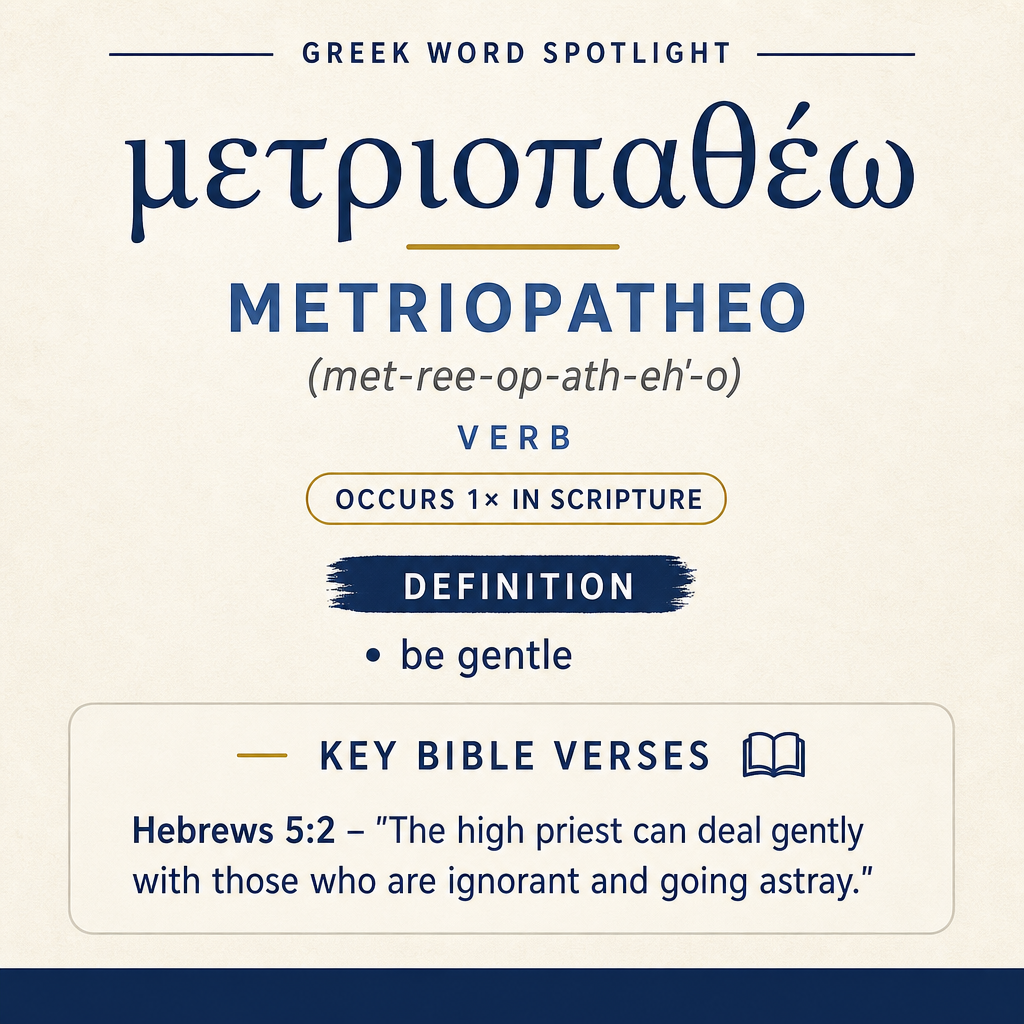
μετριοπαθέω means “be gentle” and appears once in Scripture, in Hebrews 5:2.
Verse Context
In Hebrews 5:2, the high priest can deal gently with those who are ignorant and going astray.
Learn More →μετριοπαθέω means “be gentle” and appears in the New Testament discussion of the high priest’s manner toward those under his care. Its single attested use occurs in Hebrews 5:2, where the writer describes a posture of gentleness shaped by shared human weakness.
Root and Related Words
μετριοπαθέω (Metriopatheo) is connected with μετρίως (metriōs), “moderately” (Strong’s G3357), and πάθος (pathos), “passion” (Strong’s G3806). These related terms frame the verb’s conceptual neighborhood: moderation on the one side and passion on the other, together forming a picture of gentleness as a measured response in the presence of strong human feelings.

Occurrences
“The high priest can deal gently with those who are ignorant and going astray, because he himself is also surrounded with weakness.” (Hebrews 5:2)
Here μετριοπαθέω is tied directly to the high priest’s role and to the kinds of people he must address: “those who are ignorant and going astray.” The sentence presents gentleness as a capability (“can deal gently”), not as an abstract ideal detached from the realities of moral and mental limitation. The people in view are characterized by lack of understanding (“ignorant”) and misdirection (“going astray”), conditions that can invite harshness or impatience; the verb marks the high priest’s appropriate manner as gentleness in precisely that context.

The verse also grounds this gentleness in the high priest’s own condition: “because he himself is also surrounded with weakness.” The causal clause does not merely add a sympathetic detail; it supplies the reason gentleness is possible and fitting. He is not described as above weakness but enclosed by it—“surrounded”—so his dealings with others occur from within the same vulnerable human frame. In this immediate setting, gentleness is portrayed as realism about weakness, shaping how authority is exercised. The high priest’s gentleness is not presented as indifference toward error (“going astray”), but as a way of engaging straying and ignorance while remembering that the one correcting or representing others shares the same frailty.
Within the logic of the line, gentleness functions as a bridge between two sides of the priestly situation: the needs of those who fail and the weakness of the one who serves. The verb therefore contributes a relational and pastoral dimension to priestly ministry. It is the manner in which the high priest “can” deal with people who are in spiritual and practical trouble, precisely because he is not insulated from the kind of weakness that makes such trouble possible.
Sense and Usage
In Hebrews 5:2, “be gentle” is not an isolated temperament but an enacted posture toward particular people. The verse specifies both the recipients of gentleness and the moral landscape in which gentleness operates. The recipients are not described as neutral observers; they are “ignorant and going astray.” Gentleness, then, is shown functioning where correction, instruction, or intercession would be relevant—contexts where a severe or contemptuous tone could easily emerge. The verb names the alternative: the high priest’s dealings are gentle, implying restraint and carefulness in how he responds to human failure.
The immediate explanation—being “surrounded with weakness”—locates gentleness in a shared human condition. Gentleness is portrayed as compatible with, and even supported by, a sober recognition of weakness. The verse’s phrasing does not present weakness as an excuse for the priest or for those he serves; rather, it is the experiential ground that makes a gentle manner reasonable. In this way, the sense of the verb is bound to empathy without sentimentality: he can treat straying and ignorance with gentleness because he knows weakness from the inside.
The related words help clarify what kind of gentleness is being described. The connection with μετρίως, “moderately,” suggests a quality of measured response—gentleness as something controlled, not driven to extremes. The connection with πάθος, “passion,” sets gentleness in proximity to strong feeling: the arena where passions could flare, where frustration with ignorance and error might rise. In Hebrews 5:2, the high priest stands in precisely such a space: dealing with people who are “going astray” naturally raises the question of how one handles missteps and confusion. The verb’s placement in this sentence shows gentleness acting as a steadying manner amid circumstances that could otherwise provoke harsh passion.
The construction of the verse also emphasizes capacity: “can deal gently.” Gentleness is presented as something the high priest is able to practice, not merely admire. This ability is not attributed to distance from the problem but to proximity to weakness. The gentleness described is therefore not a softness born of naïveté; it is a steadiness born of knowing the contours of weakness personally. The verb carries the idea of a way of dealing—how one handles people—so its sense includes behavior and tone, not only inner disposition.
Because the word is attested here in a priestly context, its usage is shaped by authority and responsibility. The high priest has a position that could authorize strong corrective action, yet the verse highlights gentleness as the fitting manner in dealing with vulnerable and failing people. Gentleness is thus shown as compatible with leadership: the presence of weakness (in the leader) is not portrayed as disqualifying for his role in this sentence, but as a factor that shapes the manner of his engagement with others.
Imagery
The imagery in Hebrews 5:2 is domestic and bodily rather than dramatic: a high priest “surrounded with weakness” meeting people who are “going astray.” Gentleness is pictured as what happens when someone invested with responsibility faces human confusion and misdirection without acting as though he stands outside the weakness that marks ordinary life. The verse leaves the reader with a scene of careful dealings—authority exercised with restraint, and care offered in a way shaped by the shared reality of weakness.
Sources: Lexical data from Strong’s Exhaustive Concordance and the Translators Brief Lexicon of Extended Strongs for Greek (STEPBible, CC BY). Occurrence data from the Translators Amalgamated Greek New Testament (STEPBible, CC BY). Scripture quotations from the World English Bible (public domain).




