Exploring the Meaning of Merimna in Greek
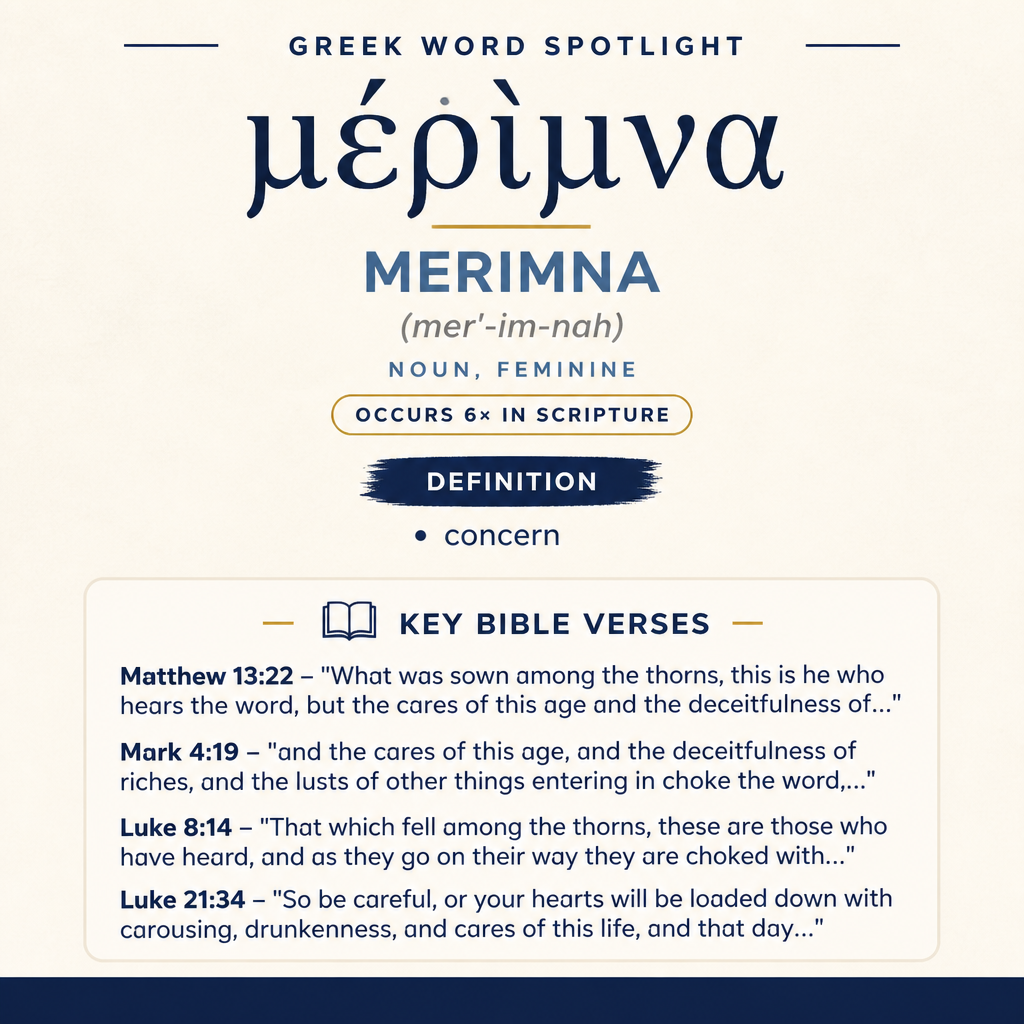
μέριμνα means “concern” and appears six times in Scripture: Matthew 13:22; Mark 4:19; Luke 8:14; Luke 21:34; 2 Corinthians 11:28; 1 Peter 5:7.
Core Meaning
μέριμνα is defined as “concern.” In the listed passages it is also rendered “cares,” “anxiety,” and “worries.”
Learn More →Gospel Parables
In Matthew 13:22, Mark 4:19, and Luke 8:14, μέριμνα (“cares”) is linked with the choking of the word. These verses connect it with “this age” and “this life.”
Learn More →Apostolic Contexts
In 2 Corinthians 11:28, μέριμνα describes Paul’s daily anxiety for all the assemblies. In 1 Peter 5:7, believers are told to cast all their worries on God because he cares for them.
Learn More →μέριμνα expresses “concern” in contexts where life’s pressures weigh on people and can shape what they hear, what they carry, and how they respond. It appears in Jesus’ teaching about the word being choked, in a warning about hearts being weighed down, in Paul’s description of an ongoing inner pressure, and in an exhortation to hand worries over to God.
Occurrences
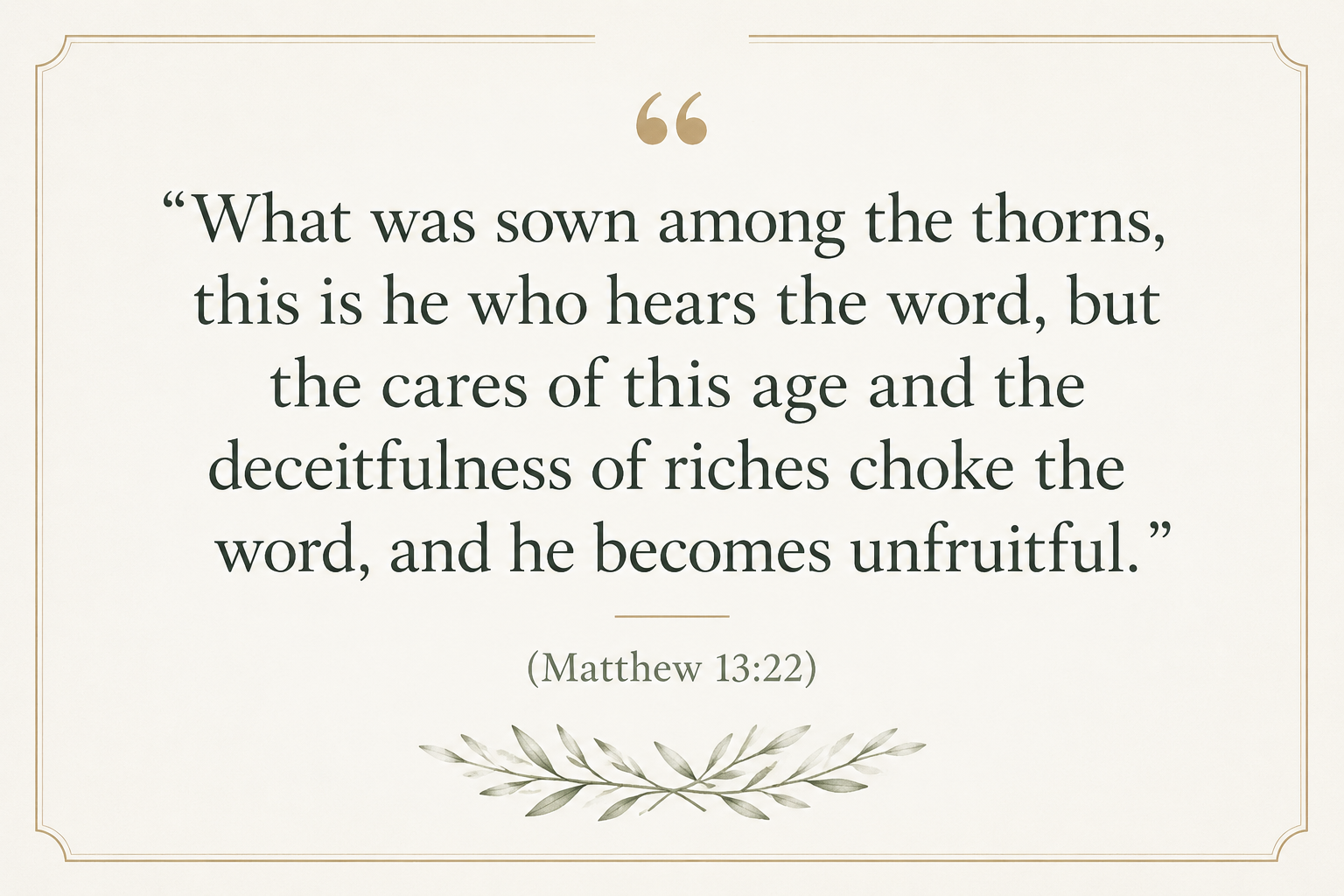
“What was sown among the thorns, this is he who hears the word, but the cares of this age and the deceitfulness of riches choke the word, and he becomes unfruitful.” (Matthew 13:22)
Here μέριμνα is joined to “this age” and set alongside “the deceitfulness of riches.” The picture is agricultural: the word is heard, but competing pressures rise like thorns and “choke the word.” The concern in view is not a fleeting thought; it is strong enough to crowd out growth until the result is “unfruitful.” μέριμνα thus functions as one of the active forces that constrict what has been received.
“and the cares of this age, and the deceitfulness of riches, and the lusts of other things entering in choke the word, and it becomes unfruitful.” (Mark 4:19)
Mark’s wording keeps the same choking outcome but expands the list of intruders: “the lusts of other things entering in.” μέριμνα is again plural (“cares”), one item in a bundle of competing interests that “entering in” do not merely distract but suffocate. In this scene, concern belongs to the everyday mixture of pressures and desires that crowd the interior life; the effect is visible in what fails to happen—fruitfulness does not develop.
“That which fell among the thorns, these are those who have heard, and as they go on their way they are choked with cares, riches, and pleasures of life, and bring no fruit to maturity.” (Luke 8:14)
Luke places μέριμνα in the lived timeline of discipleship: “as they go on their way.” Concern is not only an initial reaction to hearing; it accompanies movement through ordinary life. It is grouped with “riches, and pleasures of life,” and the choking is described as something that happens to people (“they are choked with…”), emphasizing how concern can become an enveloping condition. The result is phrased with nuance: they “bring no fruit to maturity,” suggesting that growth may begin but is prevented from reaching its intended completion because concern presses in over time.
““So be careful, or your hearts will be loaded down with carousing, drunkenness, and cares of this life, and that day will come on you suddenly.” (Luke 21:34)
In this warning, μέριμνα belongs to a triad of burdens that weigh upon the “hearts”: “carousing, drunkenness, and cares of this life.” The imagery shifts from choking plants to a human interior being “loaded down,” as though weighed with a heavy pack. Concern is treated as something that can dull readiness, not by overt rebellion alone but by the accumulation of pressures that make the heart sluggish. The concern is marked as “of this life,” tying it to present-day preoccupations that can make “that day” arrive “suddenly” upon the unprepared.
“Besides those things that are outside, there is that which presses on me daily: anxiety for all the assemblies.” (2 Corinthians 11:28)
Paul uses μέριμνα to name an inward load distinct from “those things that are outside.” The concern “presses on” him and does so “daily,” portraying it as a constant weight rather than an occasional worry. Its object is specific and communal: “for all the assemblies.” In this setting, μέριμνα is not presented as a seductive rival to the word but as an ongoing, felt pressure tied to responsibility and care for communities; it is the interior counterpart to external hardships, a steady burden carried in the course of ministry.
“casting all your worries on him, because he cares for you.” (1 Peter 5:7)
μέριμνα here is something that can be gathered up (“all your worries”) and decisively transferred (“casting…on him”). The verse frames concern as a load suitable to be placed onto another who is able to bear it. The motivation is relational and grounded in divine attentiveness: “because he cares for you.” In this scene μέριμνα is not denied or minimized; it is acknowledged as real and potentially heavy, yet it is treated as something that need not remain self-carried.

Sense and Usage
Across these passages, μέριμνα names an inward pressure connected to ordinary life—its age, its routines, its responsibilities, and its attractions. In the parable settings (Matthew 13:22; Mark 4:19; Luke 8:14), concern is one of the primary forces that competes with hearing the word. It acts like an invasive growth: it does not merely coexist with receptivity but constricts it. The consistent outcome language (“choke the word,” “it becomes unfruitful,” “bring no fruit to maturity”) presents concern as capable of reshaping a person’s trajectory; it can redirect energy and attention so thoroughly that what is heard does not reach the stage of mature fruitfulness.
Luke 8:14 adds a temporal dimension: concern operates “as they go on their way.” That phrase situates μέριμνα in the prolonged process of living, where pressures can accumulate gradually. Luke 21:34 complements this by shifting to the heart as the locus where concern sits: the heart can be “loaded down.” In that warning, concern stands alongside obvious excesses (“carousing, drunkenness”), implying that μέριμνα is not a trivial, morally neutral background noise but part of what can make a person spiritually heavy and unready. Concern is therefore depicted as both pervasive (woven into “this life”) and potent (able to weigh down the core of decision and alertness).
Paul’s usage in 2 Corinthians 11:28 shows that μέριμνα can also describe a continual internal burden linked to the welfare of others: “anxiety for all the assemblies.” The verb phrase “presses on me daily” underscores its repetitive, persistent character. This frames concern as something experienced not only as temptation or distraction but as a genuine pressure felt in the course of caring responsibilities—still a weight, still something that presses, but with a defined object that lies beyond the self.
First Peter 5:7 supplies a practical counter-movement within the word’s own field of imagery: if concern is a weight that presses and loads down, it can be “cast” off the self and onto God. The sentence makes the direction of transfer explicit and total (“all your worries”), and it grounds the act in God’s ongoing attentiveness (“because he cares for you”). Within the set of occurrences, this is the only place where μέριμνα is directly paired with an action that relocates it rather than simply describing its effects. The verse treats concern as something a person possesses and can relinquish, not an unalterable feature of life.
Imagery and Texture
Two dominant images shape how μέριμνα feels in these texts: choking and weighing down. In the parables, concern grows amid other entanglements and constricts the life of the word until fruitfulness fails. In Luke’s warning and Paul’s testimony, concern becomes a load that presses—on the heart, on the apostle—creating heaviness and ongoing strain. First Peter turns the same physicality outward: what weighs can be thrown onto one who is attentive, so that concern no longer functions as a private, crushing burden.
Sources: Lexical data from Strong’s Exhaustive Concordance and the Translators Brief Lexicon of Extended Strongs for Greek (STEPBible, CC BY). Occurrence data from the Translators Amalgamated Greek New Testament (STEPBible, CC BY). Scripture quotations from the World English Bible (public domain).