Exploring the Meaning of Mache in Greek
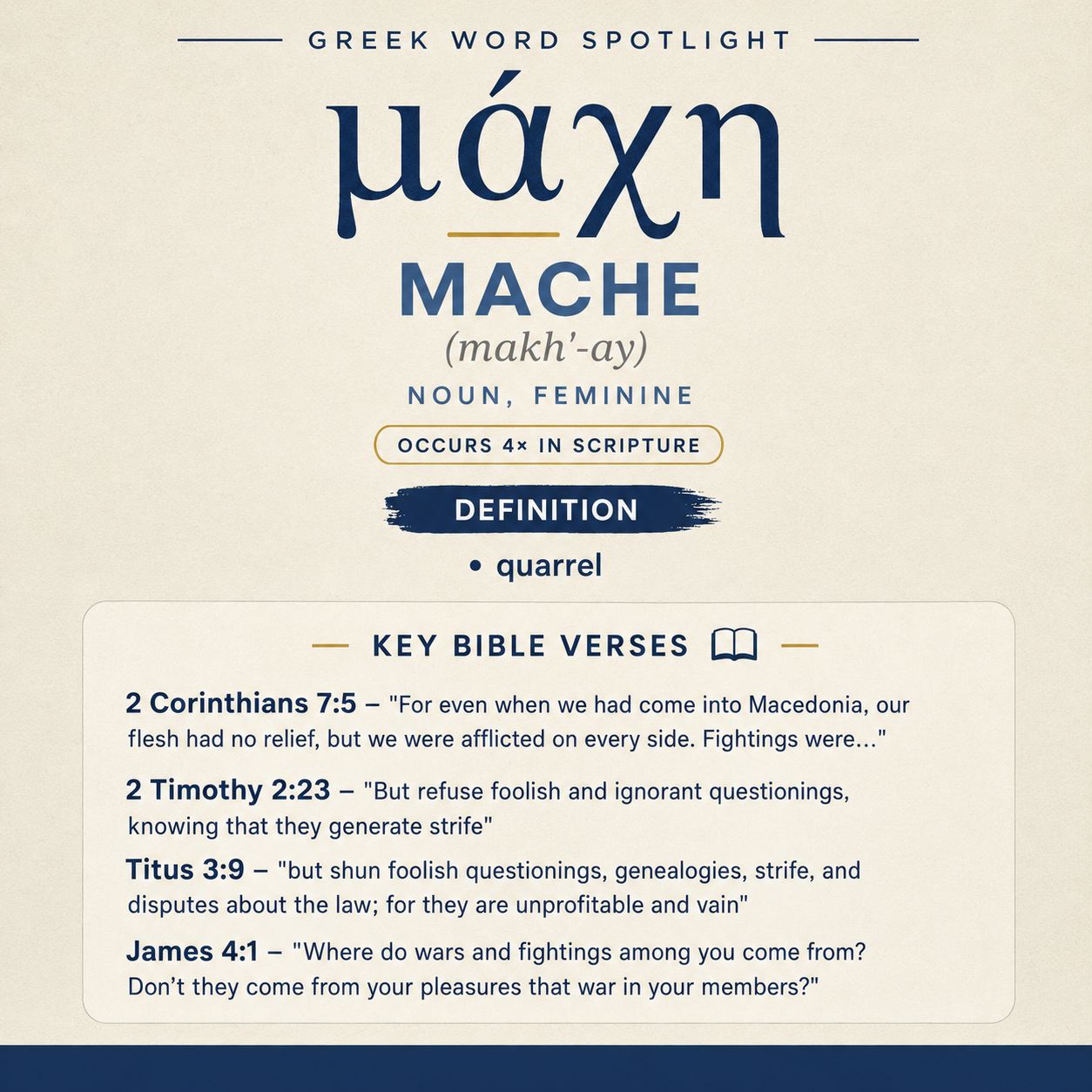
μάχη means “quarrel” and appears four times in Scripture: 2 Corinthians 7:5; 2 Timothy 2:23; Titus 3:9; James 4:1.
Core Meaning
μάχη is defined as “quarrel.” It is used for conflict such as “fightings” and “wars.”
Learn More →Where It Appears
This word occurs 4 times in Scripture. The references are 2 Corinthians 7:5; 2 Timothy 2:23; Titus 3:9; James 4:1.
Learn More →Context Snapshots
In 2 Corinthians 7:5 it describes “fightings” amid affliction. In James 4:1 it asks about “wars and fightings among you.”
Learn More →μάχη denotes a quarrel, a word used in a small cluster of New Testament exhortations and lived experience where conflict is either endured, diagnosed, or deliberately avoided. Its four appearances span narrative report, pastoral instruction, and a probing question about the source of communal hostilities.
Root and Related Words
μάχη is connected with the verb machomai (μάχομαι), “to quarrel” (Strong’s G3164). The noun names the conflict as a thing; the related verb expresses the act of engaging in it.
Occurrences
“For even when we had come into Macedonia, our flesh had no relief, but we were afflicted on every side. Fightings were outside. Fear was inside.” (2 Corinthians 7:5)
Here μάχη appears in a stark pair of short clauses that divide Paul’s pressures into external and internal realities. “Fightings were outside” frames quarrel as something encountered from without—an environmental hostility surrounding the apostolic party—while “Fear was inside” places an inward counterpart alongside it. The noun functions almost like a label on the outer edge of their experience: quarrels press in as part of the affliction “on every side,” contributing to the sense that relief is absent. In this sentence, μάχη is not argued about or analyzed; it is simply reported as a concrete feature of the situation, an external conflict that forms the background against which inner fear is also felt.
“But refuse foolish and ignorant questionings, knowing that they generate strife.” (2 Timothy 2:23)
In this instruction, μάχη is presented as the predictable product of a certain kind of speech: “foolish and ignorant questionings.” The verb “generate” gives quarrel a cause-and-effect relation to habits of conversation; it is not an accident but a harvest. The imperative “refuse” treats quarrel as something to be prevented at an earlier stage, before it takes social shape. μάχη, then, sits at the end of a chain: a pattern of questions → an outcome of strife. The noun captures what such questionings do to a community: they do not merely exchange ideas; they breed conflict.
“but shun foolish questionings, genealogies, strife, and disputes about the law; for they are unprofitable and vain.” (Titus 3:9)
In Titus, μάχη is one item in a list of things to “shun,” grouped with “foolish questionings,” “genealogies,” and “disputes about the law.” The list paints quarrel as part of a wider tangle of argumentative and speculative behaviors that occupy attention without producing lasting good. The concluding evaluation—“for they are unprofitable and vain”—casts μάχη not as a sign of zeal or seriousness but as an activity that fails the test of usefulness. The noun here helps name the kind of communal life that should be avoided: a life crowded with contentious exchanges, where disputes become a pattern rather than an exception.
“Where do wars and fightings among you come from? Don’t they come from your pleasures that war in your members?” (James 4:1)
James places μάχη in a diagnostic question: “Where do wars and fightings among you come from?” Quarrels are not treated as isolated incidents; they are symptoms demanding an origin. The phrase “among you” anchors the noun in communal relationships: these are conflicts within the group, not merely pressures from outsiders. James then presses deeper with a second question, tying the source of such conflicts to “your pleasures that war in your members.” Within the sentence’s imagery, μάχη belongs to a network of conflict terms—“wars,” “fightings,” and “war”—and it participates in the picture of inner forces producing outward hostilities. The noun thus marks the visible interpersonal friction that corresponds to unseen internal contention.
Sense and Usage
Across these passages, μάχη consistently names quarrel as a real and disruptive form of conflict, but each context highlights a different angle of how quarrels exist and spread.
First, quarrel can be experienced as an external pressure. In 2 Corinthians 7:5 it stands outside, one part of a total affliction that surrounds the speakers. The word contributes to the portrait of hardship by giving that hardship a social edge: it is not only fatigue or limitation (“our flesh had no relief”) but also contentious opposition pressing from without.
Second, quarrel can be generated by certain modes of talk. In 2 Timothy 2:23, the focus is not on suffering quarrels but on refusing the inputs that produce them. The line of reasoning assumes a moral and relational predictability: some kinds of “questionings” are not neutral; they create strife. μάχη here is the relational outcome that leadership must anticipate and forestall.
Third, quarrel can become part of a broader culture of unprofitable contention. Titus 3:9 places μάχη within a catalog of behaviors that are to be avoided because they are “unprofitable and vain.” That evaluative pair does not describe how quarrel feels, but what it yields: it consumes energy without delivering constructive fruit. In that setting, μάχη is less an isolated clash and more a habitual pattern intertwined with other controversial pursuits.
Finally, quarrel can be traced to internal desires that spill outward into community life. James 4:1 explicitly connects interpersonal conflicts (“among you”) with inward forces (“your pleasures that war in your members”). μάχη is the outward manifestation, the observable disputes and clashes that call for an account of their origin. This usage gives quarrel explanatory weight: it becomes evidence that something deeper is at work within the people involved.
Taken together, these occurrences show μάχη functioning both descriptively and prescriptively. It is descriptive when named as a circumstance—something happening “outside.” It is prescriptive when framed as the outcome to be prevented—something generated by “foolish and ignorant questionings,” something to “shun,” and something that demands self-examination about where it “come[s] from.” In each case, the noun provides a concrete name for conflict that is recognizable in lived relationships: quarrel is not merely an idea but a social reality that can surround, arise, cluster with other disputes, and spread through a group.
Imagery
The passages that use μάχη lean on spatial and military-like imagery to make quarrel vivid. Paul’s “Fightings were outside” (2 Corinthians 7:5) places it at the perimeter, pressing in; James pairs “wars and fightings among you” with pleasures that “war in your members” (James 4:1), picturing conflict as something that can be both internal and communal. Even where the imagery is less pronounced, the verbs of avoidance—“refuse” (2 Timothy 2:23) and “shun” (Titus 3:9)—treat quarrel as something that can be kept at a distance, as though it approaches and must be turned away before it takes hold.
Sources: Lexical data from Strong’s Exhaustive Concordance and the Translators Brief Lexicon of Extended Strongs for Greek (STEPBible, CC BY). Occurrence data from the Translators Amalgamated Greek New Testament (STEPBible, CC BY). Scripture quotations from the World English Bible (public domain).